Street Smarts

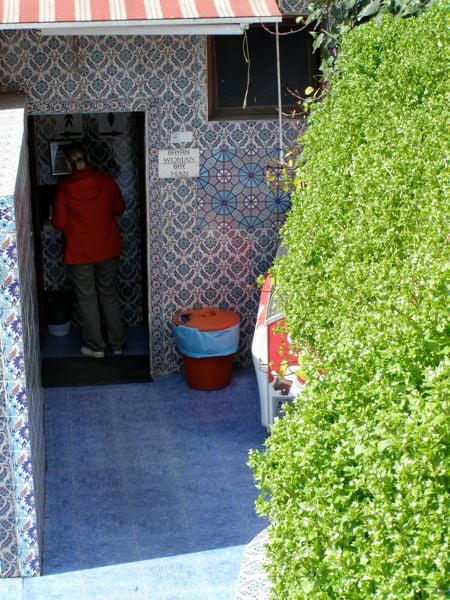
Navigating the streets of Istanbul offers either adventure or challenge, whichever you make it. I enjoy it, especially now that I know my way around (after four years). Good maps are an absolute necessity, at least early on, and my favorites were the back pages of the DK Istanbul guidebook. One thing they don’t have on those maps, though, is the location of public rest rooms. Crucial information. I often just make a point of stopping for a cup of coffee or tea and use the restaurant’s facilities, but I’ve also located some very lovely tuvalets near tourist spots. My favorite is the one at the Arasta Bazaar, just around the corner from the Blue Mosque. The rest rooms cost a lira (about 60 cents), but they’re sparking clean, and definitely eye candy with their brilliant blue, white, and red ceramic tile décor.

The Arasta Bazaar Tuvalet

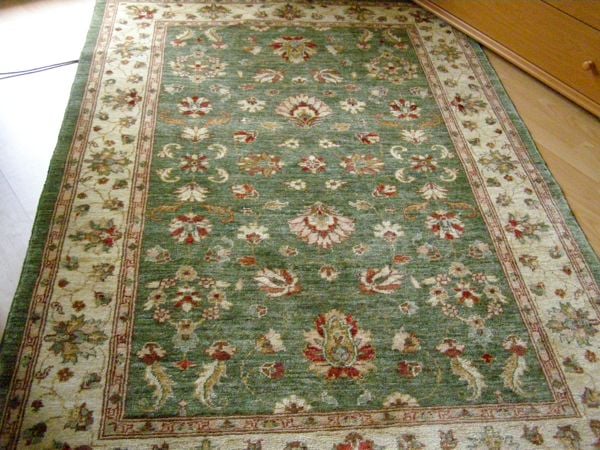
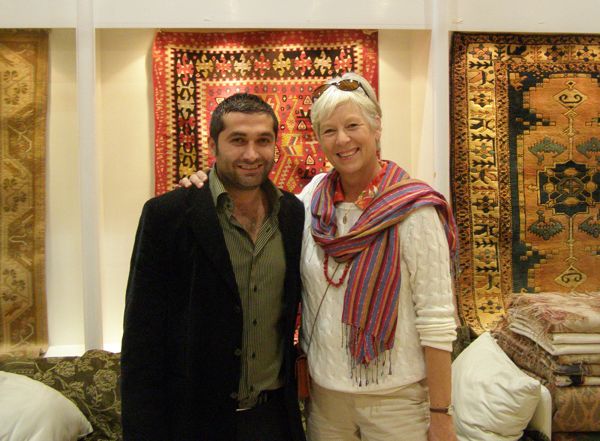
The bonus of a visit to the Arasta bazaar is always a cup of tea with Hüseyin Palioğlu at Harem 49—his treasure trove of a rug shop. In fact, during my visit with him last weekend, I succumbed to the allure of a lush green Uşak (Oushak) rug. It’s a design I’ve admired since first arriving in Turkey, and now I’m the proud owner of an enviable specimen.

My beautiful new Uşak carpet

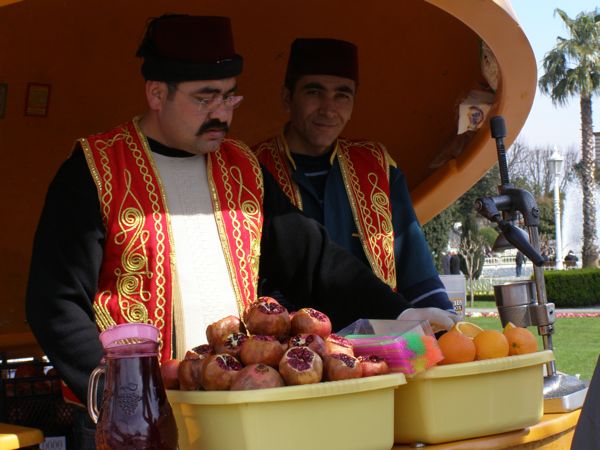
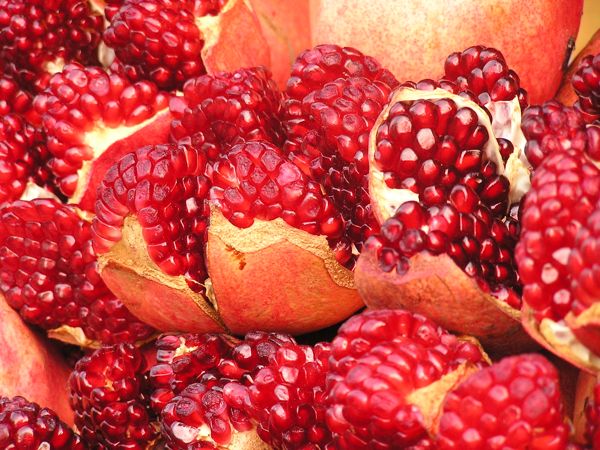
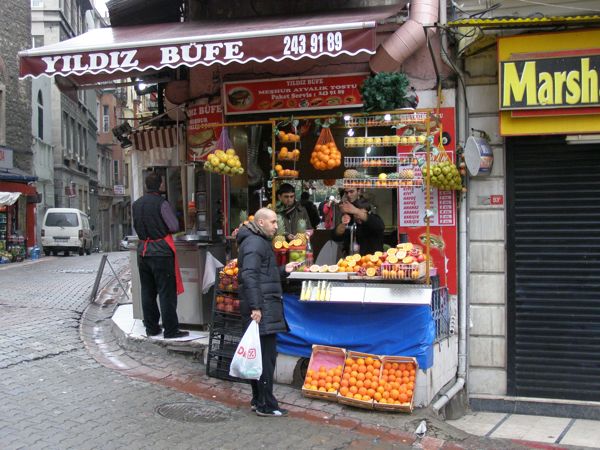
A body gets thirsty trekking Istanbul’s cobbled streets, but there’s always a juice seller nearby. Often they’re just little carts or storefronts, but in Sultanahmet there’s a bona-fide Orange stand. Something out of Sesame Street, complete with ornate-vested juice stewards. May I recommend the pomegranate juice? It’s merely 3 lira (about $2). Well worth the wait as they press the fruit right before your eyes.


Pomegranate juice abounds in Istanbul.

If you don’t stick around, though, you’ll have a bit of a shock when you can’t find a trash receptacle for your empty cup. There just aren’t any. You can walk blocks and blocks without finding a trash can of any kind, so I often step into a shop to ask if I can use their wastebasket (Çop var mi?). I’ve been told that the absence of trash cans is due to past bomb threats. Whatever the reason, it’s mighty inconvenient. I’ve carried an empty coffee cup or an apple core for hours. Unfortunately, many people just give up and throw their refuse on the street.

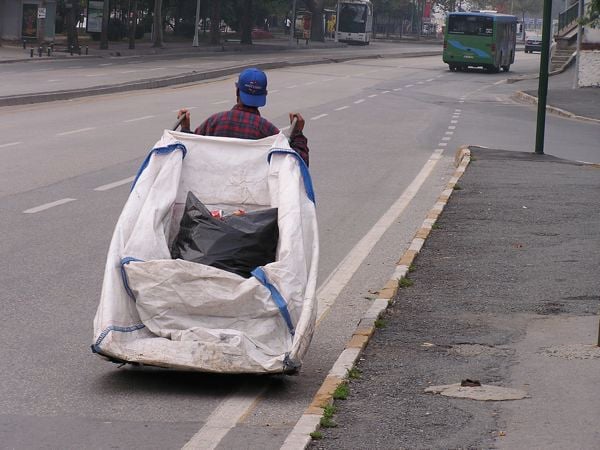
I’ve often seen men pulling huge bags of trash up and down the streets of the city, and thanks to my friend Cristi, I now know that they’re not trash but recycling bags. The city pays men to walk the streets picking up recyclables (and sorting through trash bins for them as well). It’s a humble beginning for a recycling program, but it’s alleviated much of the trash that was once strewn all over the city.

A man at the start of his recycling route.

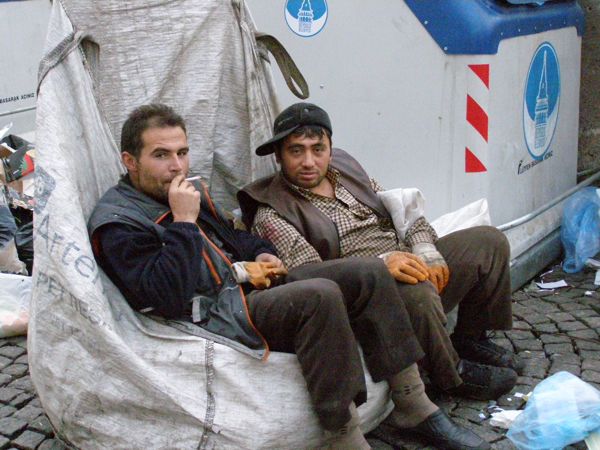
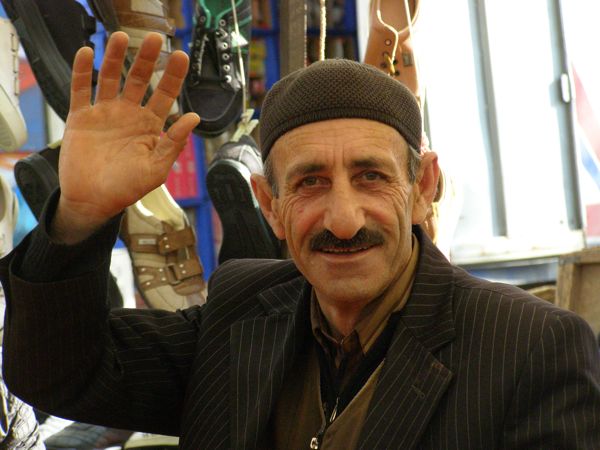
Last weekend I came across two such collectors relaxing on a half-full recycling bag enjoying a smoke break. They kindly agreed to a photo. (“Foto çekabilir miyim?” is a question I ask many times a day when trekking the city.) Istanbul employs thousands of street cleaners and rubbage collectors, and the improvement they’ve made over the past four years is commendable.

Recyclers take a break.

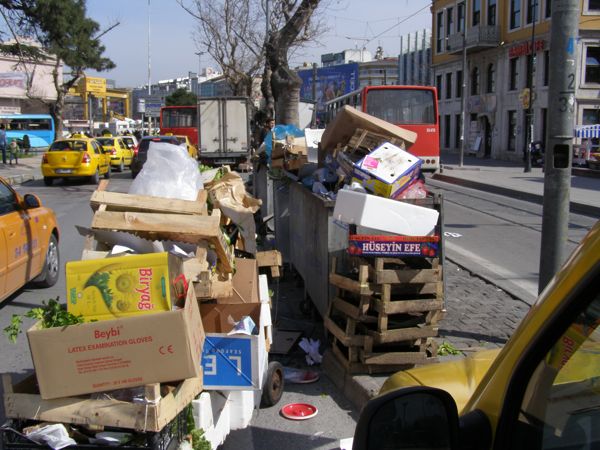
They also hire men to cruise the streets with large, flat 2-wheeled carts collecting scrap metal. Though I didn’t spot any this weekend, I did snap a photo of the overnight trash accumulated on a street in Kadiköy. Slowly, slowly, the city’s garbage problems are being addressed. Try to imagine how much trash is generated by a city of 15 million…

A night’s trash waits for pick-up in Kadiköy.

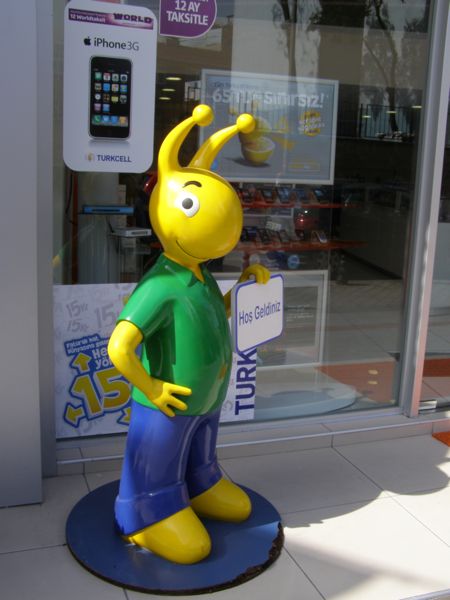
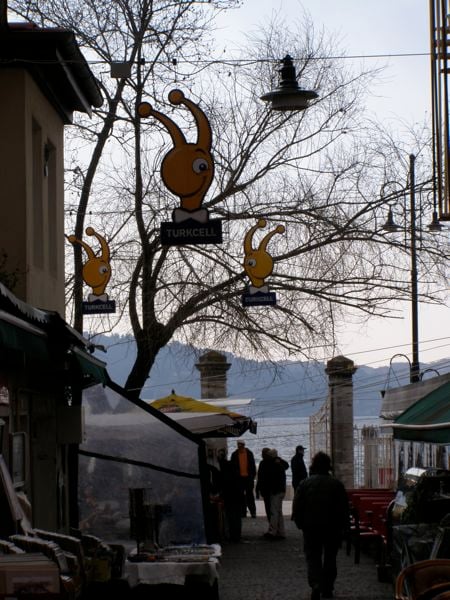
There were a few other street surprises, the first one a curbside Turkcell bug holding a Hoş Geldiniz (welcome) sign. Pretty cute, especially in the sunshine.

The Turkcell bug welcomes us to a Kadiköy cell phone shop.

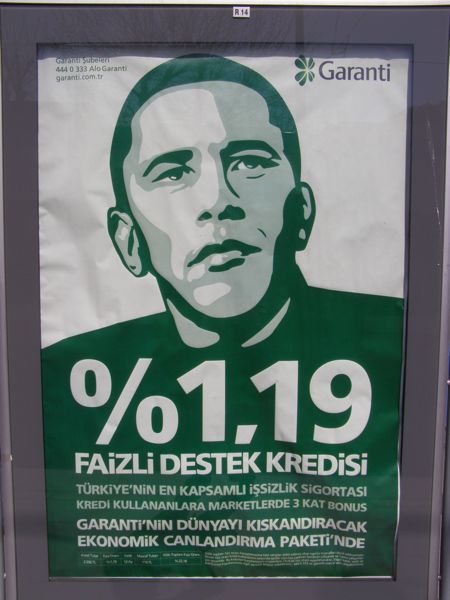
The bigger surprise, though, is an advertising campaign by the Garanti Bank of Turkey, using President Barack Obama to promote their great interest rates. I can’t help but wonder if they got his permission. These posters are plastered all over the city.

Obama unknowingly promotes the Turkish economy.

Yup, you never know what you’re going to encounter on the streets of Istanbul. Never.

A Whirlwind Theater Tour

It’s all about theater—well, friends first, then theater. I’ve had my sights on London since I first came to Istanbul, but between the high cost of airfare and hotels, there was no hope. Enter Easy Jet. It’s brought airfare within reach, and with some serious searching, I found a hotel that wasn’t totally outrageous. So—off I flew!

I arrived on Red Nose Day, a huge charity fund-raising day in England. Everywhere you turned, someone was sporting a clown nose. I even spotted a few on Saturday—the day after. This year Red Nose antics raised a total of nearly 58 million pounds—about 82 million dollars. Now THAT’S IMPRESSIVE!!!!

A few red noses on Saturday

Friday night three friends and I met in at the Victoria Theater for Billy Elliot, a truly powerful musical. Set with the backdrop of Britain’s year-long miner’s union strike of 1984, young Billy Elliot traded his boxing lessons for ballet class. His father, already stressed by the strike, nearly blew a gasket when he found out. Elton John’s music evokes feelings from elation to angst to anguish as the story progresses. I doubt there was a dry eye among us as we stepped outside after the show, still shaking our heads in wonder at this gifted young dancer (about 11 years old) and the rest of Billy Elliot’s amazing cast. A GREAT start for my theater weekend.

http://www.workingtitlefilms.com/featurePhoto.php?featureID=18

Saturday my friend Larry and I wandered Covent Garden most of the day— loverly. (It IS where Liza Doolittle sold flowers in My Fair Lady.) Unlike the bevy of flower and vegetable vendors it once was, Covent Garden is now a tourist spot. It still features an open market, but vendors now offer clothing, jewelry, and gift-type items. Pretty intriguing ones, at that. There are also shops, cafes, and restaurants to suit any taste
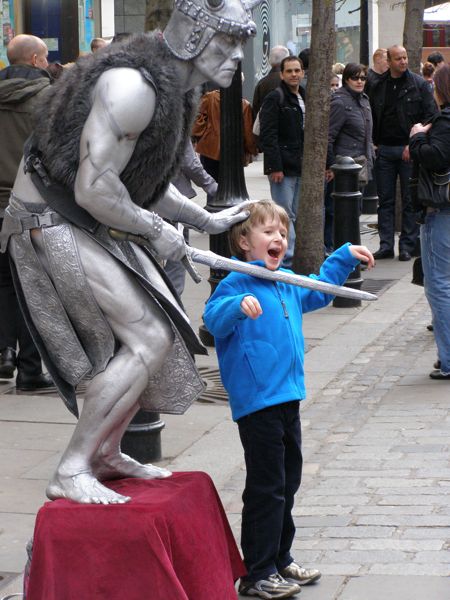
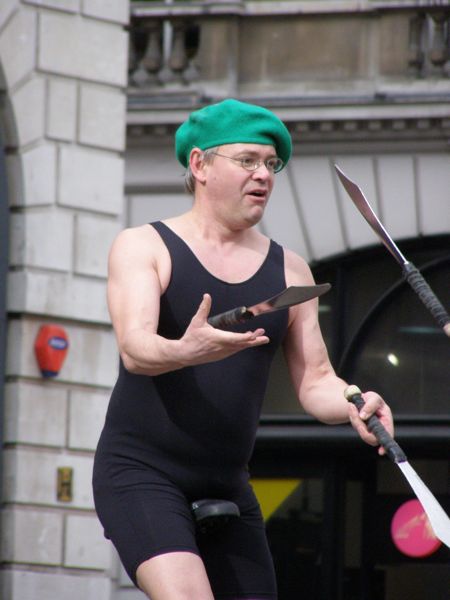
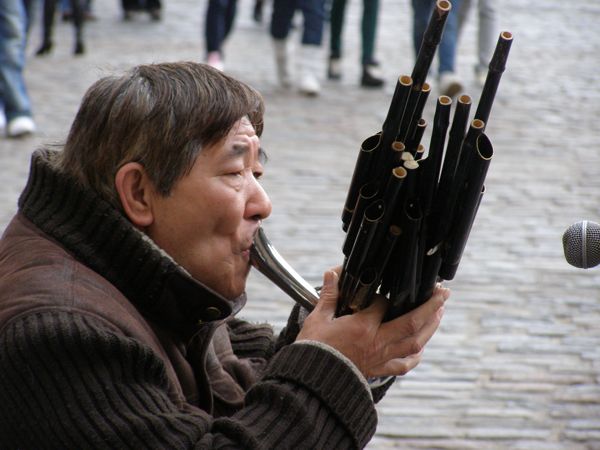
My favorite thing about Covent Garden, though, is the buskers. Musicians, jugglers, mimes, and you-name-it draw crowds of onlookers to every cobbled street and lane.

I’m not sure who’s the better actor!

one of many buskers—the man in the red derby

a knife juggler in a green beret—on an 8-foot tall unicycle!

A Chinese man plays the Sheng, a precursor to the pipe organ and the bagpipes.

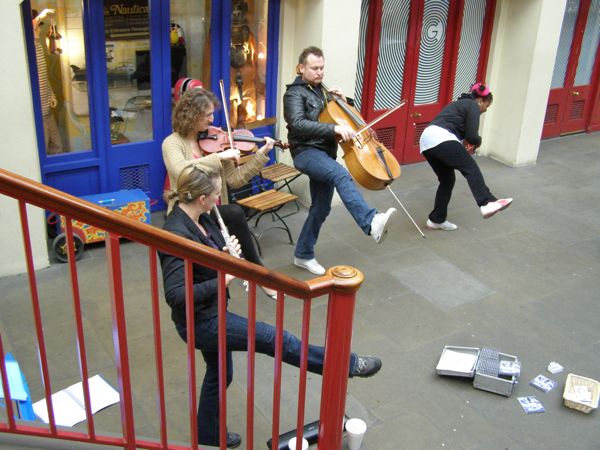
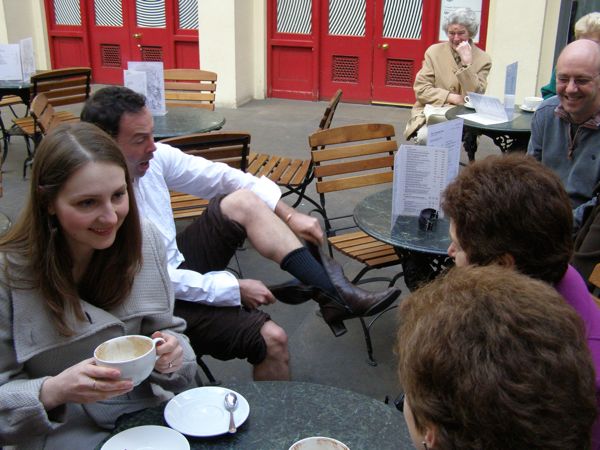
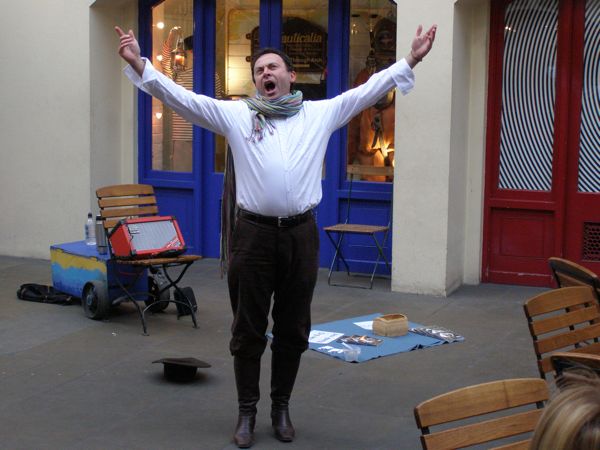
We watched string quintets (very talented) who performed stunning acrobatics as they played without ever missing a note. A brilliant tenor entertained his extensive audience by removing a woman’s boots and donning them himself as he sang an aria from Carmen. Then he wrapped another woman’s scarf around his neck. Go figure! He was sheer delight, and the women he “stole” from were both charmed and charming with him.


a multi-talented chamber quartet performs acrobatics

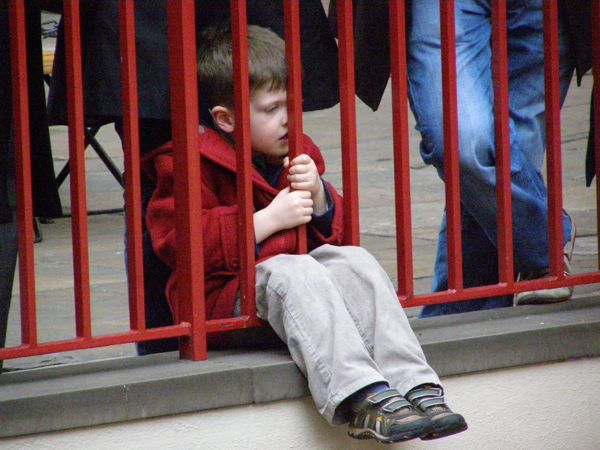
a music aficionado among the masses

the tenorial robber

The tenor sings his final notes—a virtuoso!

After a pub lunch, Deidre, Larry and I trekked to the Noel Coward Theater, where we had box seats for Avenue Q, an x-rated version of Sesame Street. It’s about Princeton, a recent university graduate with no money who is trying to “find” himself. I blushed for the few children in the audience, as the music was more than risqué. In fact, the songs were hilarious. Just imagine puppets and their actor counterparts singing “It Sucks To Be Me,”  “Everyone’s A Little Bit Racist,” and “The Internet Is For Porn”, a spirited dispute between the sweet little monster named Kate and the more earthy internet-surfing Trekky Monster. Need I say more? If you have a chance (and you’re not a prude), be sure to add this play to your list.

You can tell  it’s not a children’s production…

<http://nationaltheatre.org/mainstage/avenueq.htm>

We wanted to catch dinner afterward, but as you may know, England isn’t renowned for its cuisine. Pub lunches are usually good, while the best evening option is ethnic food. We went to an Indian restaurant, the Govinda, where we had a delectably spicy vegetarian meal—cheap (at least for London). The  Govinda is a Hari Krishna restaurant, replete with interesting characters. Later that evening we encountered them again on their evening processions, singing and dancing their way through the streets of Soho.

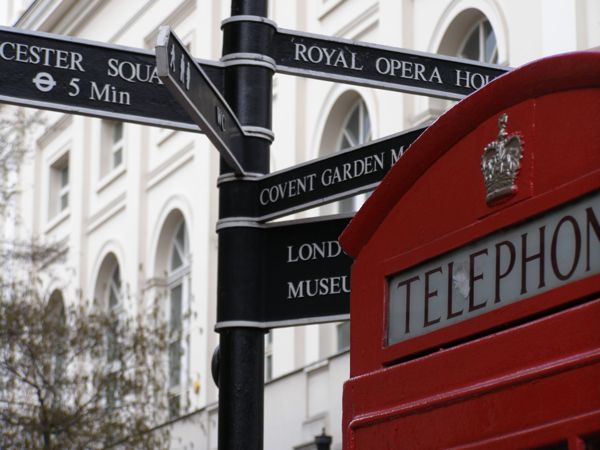
Truly London—the signpost and the phone booth

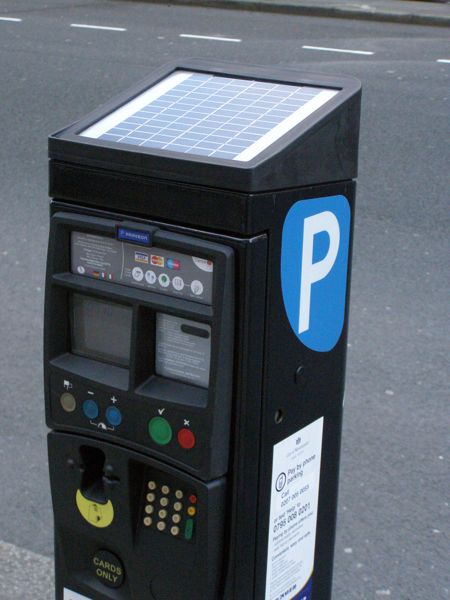
I was so, so impressed with this solar-powered parking meter.

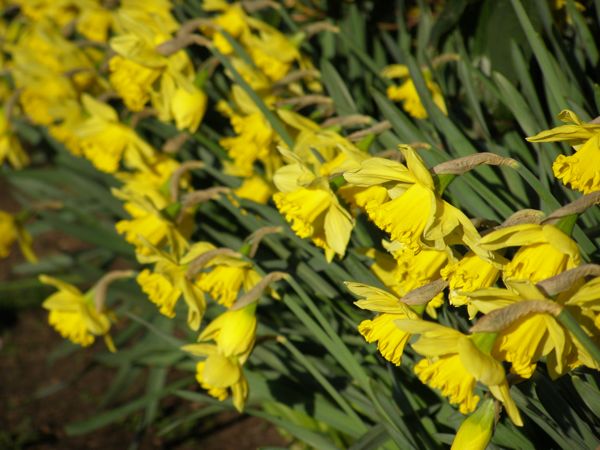
…and in Hyde Park, “a host of golden daffodils.” (Thanks, W.W.)

Sunday morning I was on my own, so I walked Hyde Park in the early morning sunsine. It was great to just walk, walk, walk. The daffodils were “nodding and dancing in the breeze” while the Bobbies were cruised the walkways, ever on the alert. After a long walk to Victoria Station, I found it hard to hop on the bus for the airport. Oh, well. All good things must end, eh? I seriously think I’ll plan one more trek to London. Want to join me?

Fast Food a la Turka

The food in Turkey is incredible—beyond compare, I must admit. It was one of the things I was most excited to get back to. I get a Turkish meal every day at school, and tonight our bartender at the social center fixed us all a delectable meal of grilled fish, four delicious Turkish salads, flat bread, and a dessert. All that for only 12 Turkish Lira (about $7). Incredible! (Actually, I was disappointed to see that the fish was served whole, but once I took a bite, I could have cared less. It was çok lezzetliı (delicious).

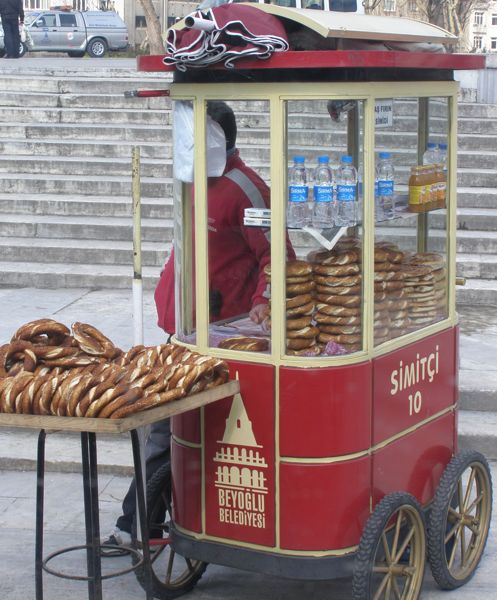
One thing that always amazes me, though, is the convenience of the fast foods these people put out. You can always pick up a bite on the road, at least a simit—a large bagel-like bread coated with sesame seeds, sold all day long from glass-encased street vendor wagons.

a shy simitçi—simit seller
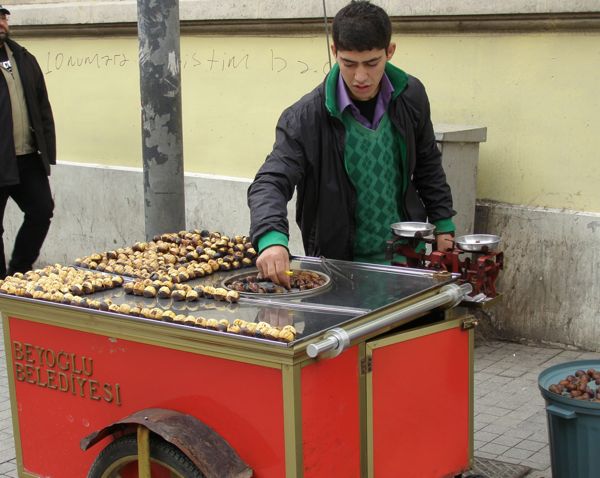
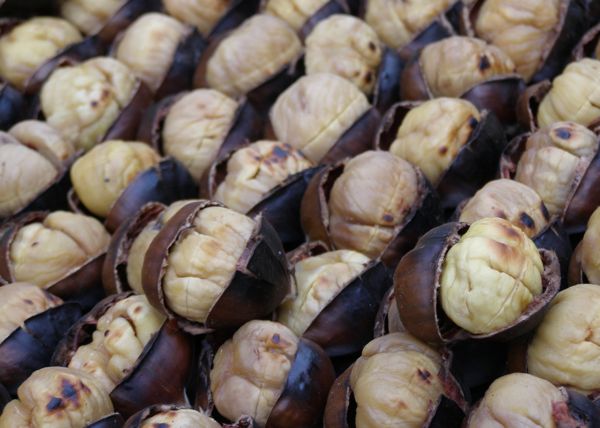
The other two things you can often pick up along the way are rice-stuffed mussels and roasted chestnuts. I don’t actually like either of them, but they’re certainly popular fare here.

Chestnut vendor on Istaklal near Taksim…

…and his wares.
The Turks are masters of fast food. The two things I’ve often succumbed to are börek and döner. Börek is a pastry made with thin layers of filo-like pastry (yufka), often layered with cheese, spinach, or other delectable treats. They slice it from huge pans in a flash, then cut it into bite-sized pieces, bim-bam thank-you-ma’am. Brushed liberally with olive oil, it carries the rich flavor of that delectable fat.

The börekçi—börek vendors.

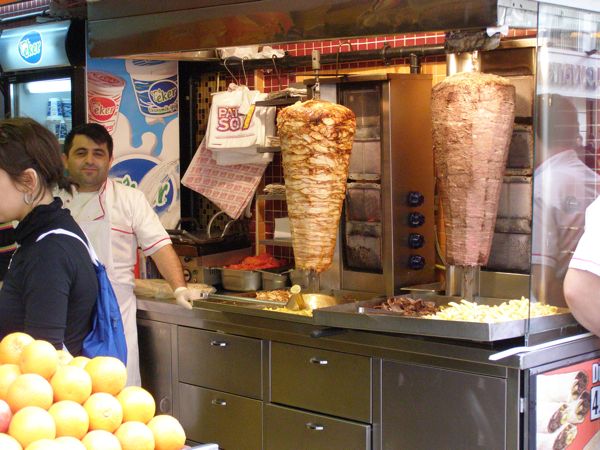
Döner is a favorite of nearly everyone. It’s sliced from a huge conglomeration of meat  (usually lamb or chicken) that’s spiced and stacked on a vertical skewer. We’re talking a LARGE skewer, anywhere from 3 feet to 6 feet high. The meat turns around and around next to a vertical heat source, and the chef cuts thin slices from it as the meat cooks. It’s usually piled into a small French loaf or a piece of pita bread, complete with tomatoes, peppers, and onions. YUM! You can get a half-loaf döner for less than a few lira (about a dollar). Lots of people are familiar with Greek gyro sandwiches—well, döner is nearly the same thing, but without the yogurt sauce. In fact, sometimes they put French fries in the sandwich as well, which DOESN’T appeal to me in the least. Sort of like a mashed potato sandwich. Starch!

Döner, either lamb or chicken. Note the French fries in the tray…

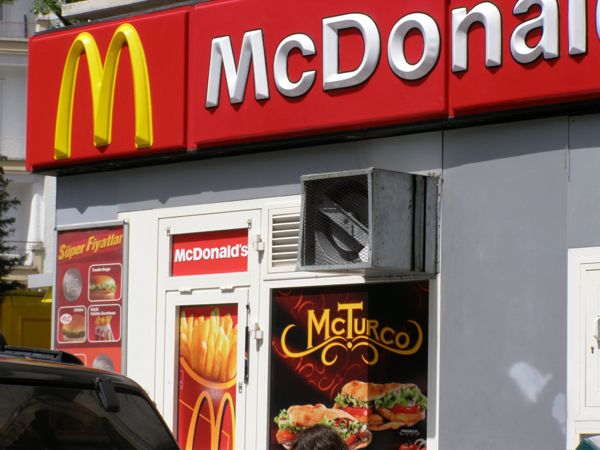
Unfortunately, McDonald’s and Burger King have caught on here as well. McDonald’s has come up with a McTurko, which must be a lamb-wich, but I don’t know. I refuse to patronize them over here. It seems a bit sacrilegious somehow.

The famous McDonald’s McTurko—What? Never heard of it?

One interesting thing about the Istanbul McDonald’s, though, is that they deliver. Yup. Every fast-food restaurant, Western or Turkish, has motorcycles with little delivery boxes on the back. Last year at Robert College I had Turkish meals delivered to me numerous times—they’ll even deliver an inexpensive meal for one person. Turkish hospitality, I guess.

No one should starve in Turkey, let me tell you!

Checking out Istanbul’s Ads

Teaching at Koç (pronounced “coach”) is similar to teaching just about anywhere. I have motivated kids and lazy kids, bright students and slower ones, and everything in between. For the most part, though, I have to say that Turkish kids are wonderful. They’re warm and respectful (for the most part), though a titch chattier than their U.S. counterparts. Usually it’s an endearing feature, though. Turkish charm. I teach both 10th and 11th graders, and right now I’m enjoying it.

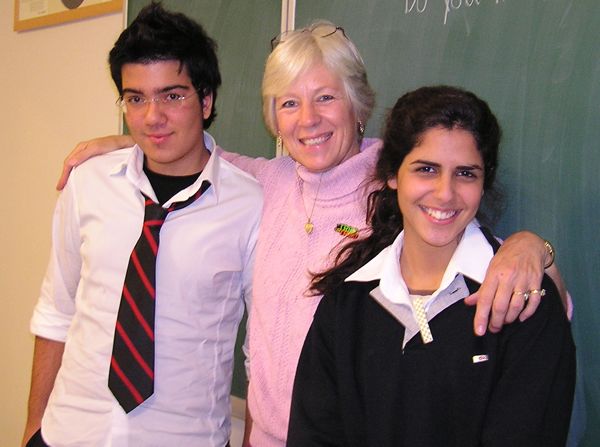
Yağiz, me, and Pinar

My juniors just finished a whirlwind poetry survey, and now we’re diving into a lengthy media unit—the businesses behind it, the advertising that promotes it, and the social propaganda that pervades it. This is a weighty and interesting unit, to say the least. We started with a PBS video called “Merchants of Cool,” which investigates the researchers behind marketing to teens, the group with more discretionary income than anyone else on the planet. Not only do they spend over 150 billion dollars a year (in America), but each teen filters over 3000 discrete advertising messages a day. EVERY day! Unbelievable.

So—I made it my mission to document how that translates here in Istanbul, this ancient, beautiful city. Actually, the real truth is that I needed an excuse to go into the city last Sunday. The sun was finally out after three weeks of clouds and rain, and the weatherman had promised a full day of sun. How could I resist? After a leisurely Turkish breakfast with a friend at the Marmara Café (egg, tomato, cucumber, cheese, olives, and bread), I headed out, camera at the ready.

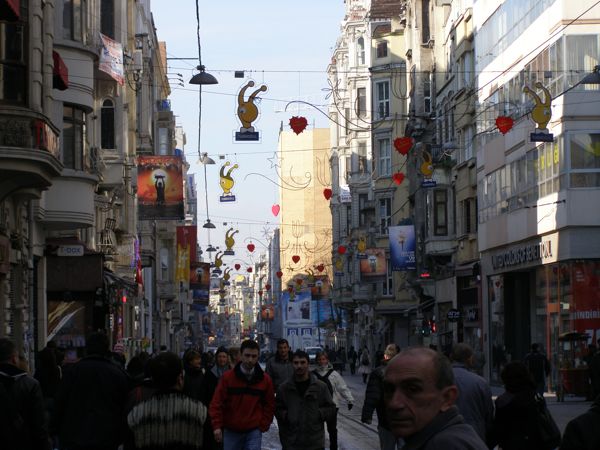
Istiklal Caddesi, early Sunday under hanging decorations and Turkcell bugs

İstiklal Caddesi (Liberty/Independence Street) is a mile-long pedestrian street that may well be the busiest street in the city. It’s about 30 feet wide and paved in marble blocks, with a quaint red tram clanking up and down its center. Early on Sunday morning Istaklal is relatively quiet, but by noon it’s mobbed.

Decorations are strung overhead year-round, with both seasonal symbols and ads hanging from them. In past years red coke bottle cut-outs graced the skies (embarrassing to Americans), but now it’s the Turkcell logo—some kind of a cutesie little bug. In case you’re wondering, Turkcell is the major cell phone company here.
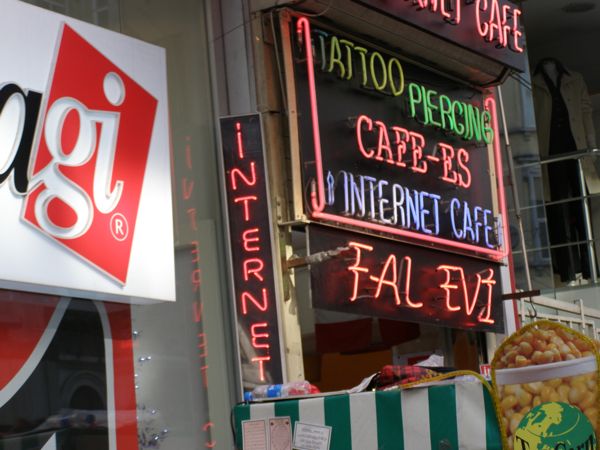
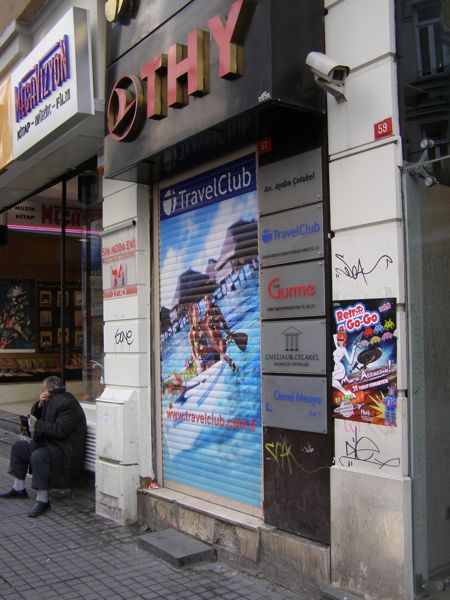
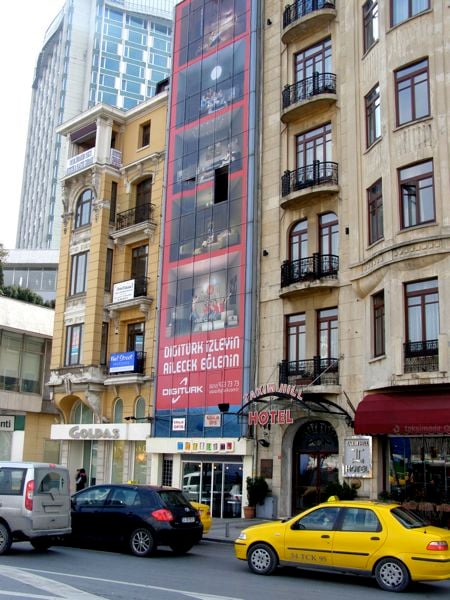
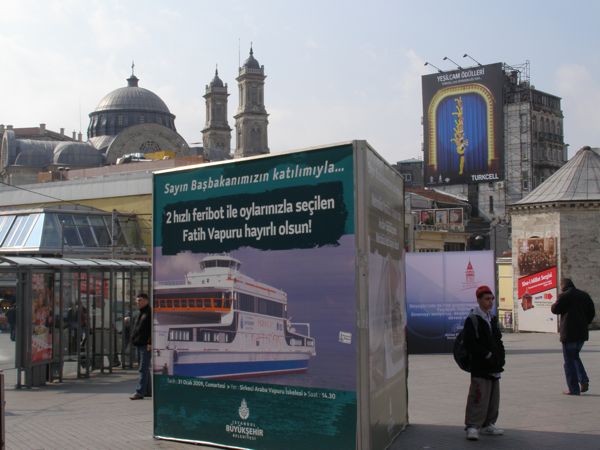
Everywhere I looked, I found ads: neon ads on storefronts, ads painted on metal roll-down doors, banners, billboards, and entire buildings covered with humongous ads—even over the windows!

Istiklal’s neon signs

a roll-down door ad

The full-building “billboard” ad

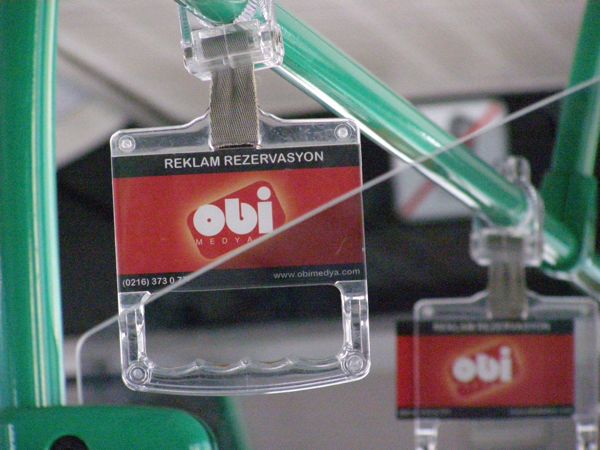
Everywhere I looked, there were ads, ads, ads. I took a bus to Ortaköy, a magical spot on the Bosphorus, and even the handles on the bus (for standing passengers) sport ads. Imagine!

…and even the “handles” on the bus!

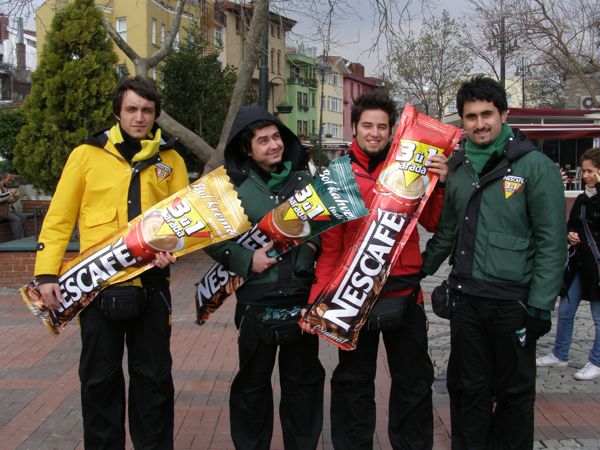
While wandering the weekend arts market in Ortaköy, I came across a group of young men promoting Nescafe (something they love over here) with yard-long  pillow-like Nescafe envelopes. When I explained that I was taking photos for a media and advertising unit, they were happy to pose for me. AND—I came away with a pocketful of Nescafe Cappucino envelopes (little ones). Go figure!

A Nescafe Marketing ploy—cute guys!

I’m particularly intrigued with the contrast between the old and the new here; it’s no surprise that glitzy ads compete with the city’s historical sites. Photos say it best, I guess.

Turkcell bugs invade Ortaköy.

Can you find the Russian Orthodox Church behind the ads?

Unfortunately, the advertising here is mostly clutter—just visual noise—while the lines of Istanbul’s centuries-old buildings are striking and awe-inspiring. Gosh, which do you think will endure?

A busy, sunshiny day in Kurtköy

First off, a language lesson. The closest city to our campus is Kurtköy, which means “Wolf village.” The o has a sideways colon over it (ö if your computer reads Turkish), so you should purse your lips and push your tongue forward when you say it. To pronounce Kurtköy correctly, then, first say Kurt, then pretend you’re kissing someone (maybe considering a French kiss), and say the last part as though it rhymes with BOY. Enough of that. Suffice it to say that Turkish isn’t all that easy.

THE KURTKÖY MARKET

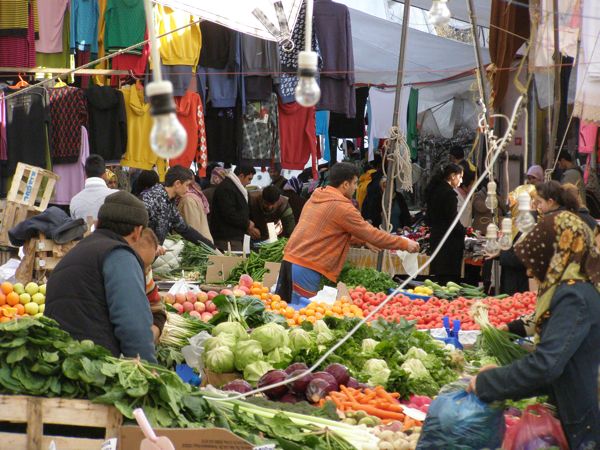
Well, the sun FINALLY came out last Friday, nearly all day, as I recall, and my spirits were high. (We’ve had sunshine two days of the last 19, so it was a welcome respite from the rain.) At 2:15 I hopped on the Kurtköy street market bus with a plan to spend about 10 Turkish Lira (around $6) and not bring too much home. Everything here is sold by the kilogram, which is 2.2 pounds, and I often buy too much. I try to limit myself to a half-kilo, and even then I’m ashamed to admit that my delectable veggies are known to rot in the fridge. Sigh…

The VERY busy Kurtköy Market

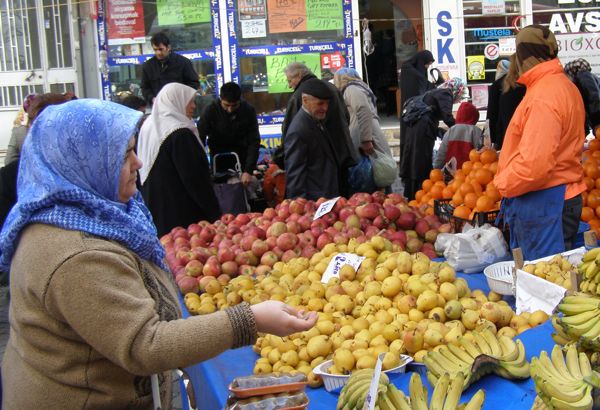
As I stepped under the high-strung tarps of the market street, I was first drawn to a display of fresh strawberries. They were early berries, quite expensive, maybe about 6 or 7 lira/kilo. Not too bad, I guess. As I was considering, the vendor smiled and handed me a çilek. Sweet, firm, and red through the middle. DELICIOUS!  I was in his power. I bought a half kilo of berries and added two pomegranates; my total bill was a whopping 6 lira (about $4). Then off to the veggies. I bought a half-kilo each of carrots (6) and tomatoes (9) for another 4 lira ($2.50).

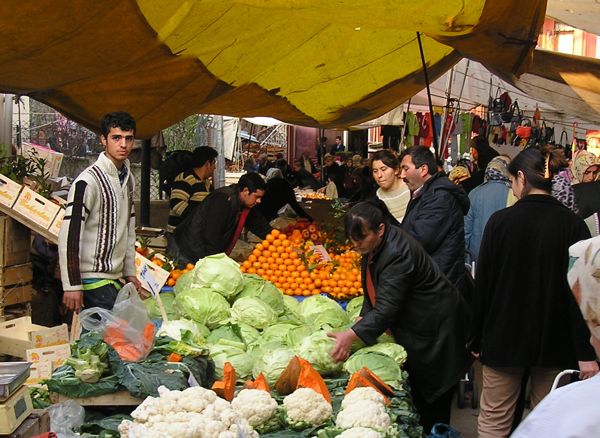
A careful shopper squeezes the cabbages.

A few spices, some Turkish string cheese (better than any you’ve tasted), and six sheets of yufka (a thin phyllo-like pastry) cost me another 4 ytl. I was over my limit. Ah, well. Amazingly, the Turkish words I thought I’d forgotten came back as I needed them. Whew!

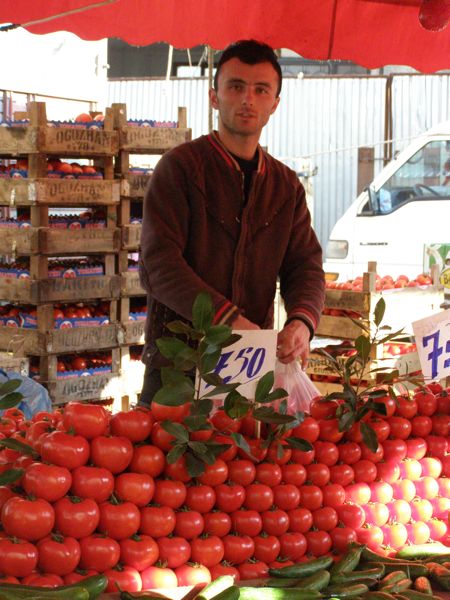
The more expensive beefy tomatoes at 7.50 TL

For the next half hour I wandered, reveling in the sights, sounds, and smells of the Friday market. Tarps were strung high over the cobbled streets, protection from both rain and sun. Vendor after vendor called out in sing-song, “Bir Lira! Bir lira!” (one lira), some in deep booming voices, and others in clear, shrill tones as shoppers strolled by. The entire market is a cacophony of voices. It amazes me that the reserved, scarved women can make themselves heard over the din, but somehow they get their shopping done, often bargaining with the vendors. (At these prices, I don’t bargain.)

A Friday shopper pays a lira for her bananas.

Many of the shoppers pull little two-wheeled carts, much like a nylon wastebasket on wheels, and occasionally someone rolls by in a wheelchair. The street market is by far the cheapest way to buy produce, sundries, clothing, linens, and even shoes; many Turks can only afford to shop on market day. We teachers go because it offers the most delicious produce, and we just plain love being there. Maybe lots of people feel that way.

Many of the vendors stopped their barking to welcome me (an obvious yabanci—foreigner) to the market, and others invited me to snap their pictures. Could it be my permagrin? Who knows? It’s just all great fun.

And for goodness sake, the SUN was out!

Of COURSE I’ll take your photo, boys!

…and the egg vendors…

As well as one last cheerful vendor. Guruşuruz! (Goodbye!)

Another rainy Sunday in Istanbul

Let’s see. I’ve been in Istanbul for 12 days now, and I think it’s rained for 10 of them. Today was looking good for a while (sunny while we were in school), but it clouded over before we got out, and I had to drag out my umbrella for the walk to study hall tonight. Sigh… It frustrates me that the weather affects my mood, but it seems to be all about sunshine for me.

Last Saturday (damp) my friend Dee invited David, Andrea and me (all singles) to a VDS dinner (Valentine’s Day Sucks). Great food, delightful company, and a little too much wine. Oh, well…

In spite of a steady drizzle on Sunday morning, I decided to hop on the service bus to Taksim. It leaves bright and early, and believe me, I wasn’t all that bright so early. Since my only off-campus visits had been to malls (4 times) since my arrival, I needed a CF—a city fix.

A typical corner “convenience store” in Istanbul

There’s no traffic on Sunday mornings, so we got to Taksim in less than an hour. First I took the funicular down to Kabataş, then caught the tram to Sultanahmet (the old city). My goal was to visit my friends at the Harem 49 rug shop to share my amazing Mexico experience.

Here’s my tale:

When Susie and I visited Cozumel in January, we noticed a shop called Istanbul Carpets. Right. “What are the chances that anyone speaks Turkish in there?” I asked. Susie urged me to check it out, so I stepped inside and said, “Merhaba. Nasilsiniz?” (Hello. How are you?) Well, one of the two men sitting by the window jumped up and strode over to me, answering in Turkish, grinning warmly, and extending a hand for a handshake that became a hug, complete with cheek-kisses. Very Turish. We continued a short conversation in Turkish, which was about my limit (I’m not exactly fluent yet). To make a long story short, Engin, the shopowner, used to work for Hussein at Harem 49, my favorite Sultanahmet rug shop. Not only that, but his cousin Ümüt works there now. I mean, what are the chances of meeting a man in Mexico who knows the same people I know in Istanbul, a city of over 15 million? Amazing.

Engin and I pose in his Cozumel rug shop

After chatting with Ümüt over a cup of tea (admiring photos of his beautiful son), I headed off to do more exploring. I wandered my beloved cobblestone streets, snapped a few photos, then climbed to a rooftop restaurant to enjoy a cappuccino and warm my toes (not only was it wet, but damnably cold as well.)

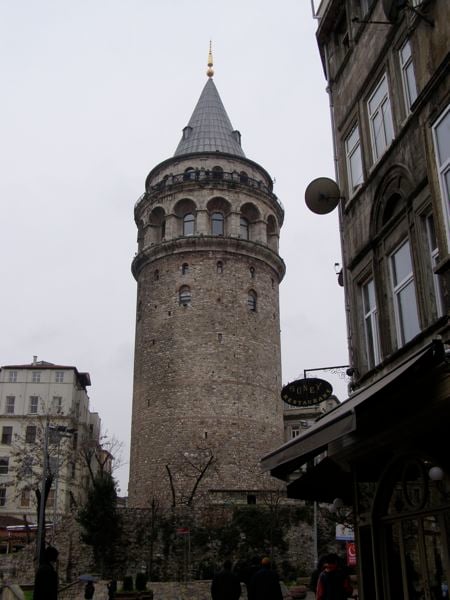
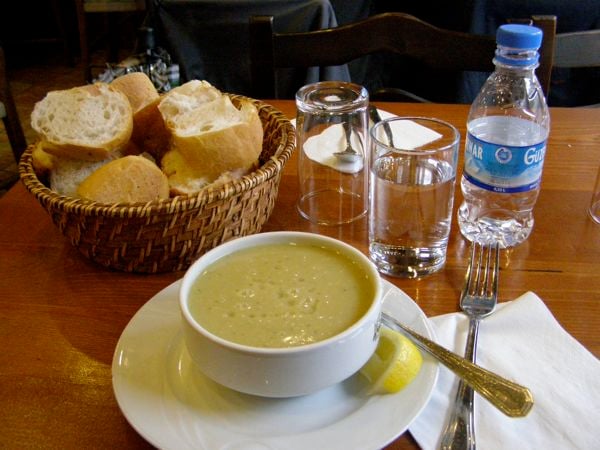
After buying an evil-eye keychain for my new lojman (apartment) key, I hopped back on the tram toward Taksim. I still had three hours, but no point in pushing my luck. The drizzle had abated, so instead of taking the funicular back up the hill, I opted to hike up and pay my respects to the Galata Tower along the way. I ducked into a little restaurant for my first bowl of mercimek soup, my FAVORITE—a lentil soup beyond compare. They serve it with a mountain of white bread for a whopping 3 Turkish Lira ($2). I didn’t eat all the bread.

The famed Galata Tower

Ah, mercimek soup!

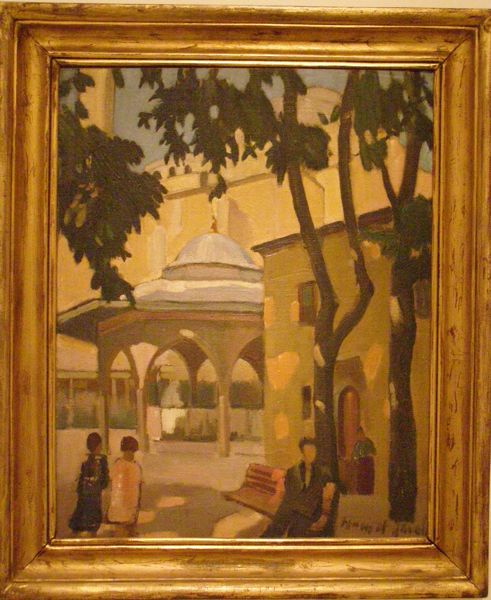
When I got back up to Istaklal, I still had plenty of time, so I decided to check out the new exhibit at the Pera Museum, a Koç family art museum. This museum is a class act, with rotating exhibits on the top two floors and permanent exhibits of Turkish art and ceramics on the lower floors. The featured exhibit was a collection of impressive storyboard paintings by Japanese filmmaker Akiro Kurosawa, but I was most taken with the Turkish artwork this time. Maybe because I’m so happy to be back.

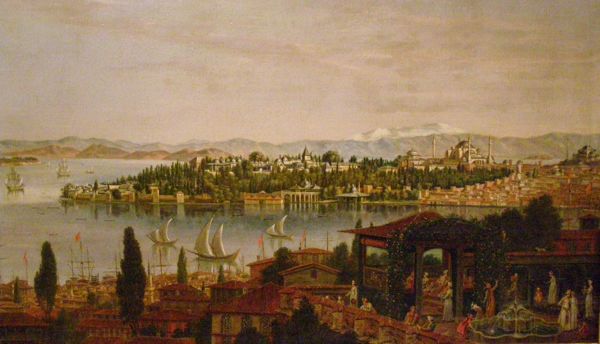
Now that I know the city well from working on a guidebook of historical walking tours, I actually feel like I’m stepping back in time when I see these centuries-old paintings. I’m fascinated with what the seaside and city once looked lik


Stepping back in time through Ottoman art at the Pera Museum

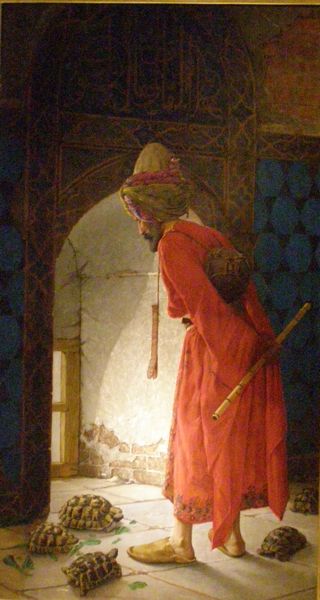
My favorite painting is a mere century old: the “Tortoise Trainer,” probably the most famous (and valuable) painting in Turkey ($3.5 million).

It was painted by Osman Hamdi Bey, an amazing man who was not only an accomplished painter but also an archeologist. He established the Istanbul Archeological Museum, no small task. I’ve read that this painting depicts Osman Hamdi Bey’s frustration with getting the Ottoman rulers to change with the times. The implication is that it’s like training tortoises with a flute, and tortoises have very poor hearing. Interesting analogy, huh?

The Tortoise Trainer, by Osman Hamdi Bey

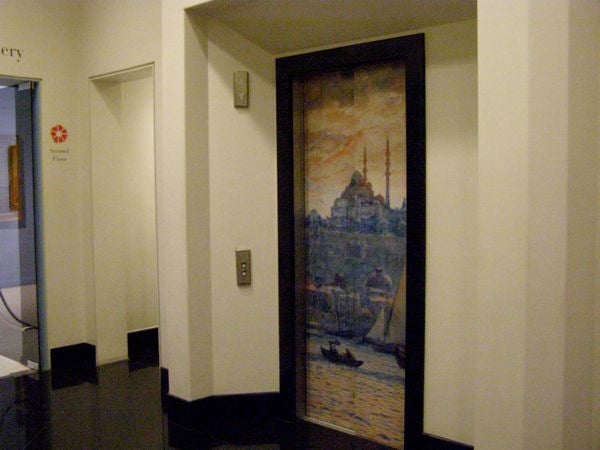
Even the elevators at the Pera are painted!

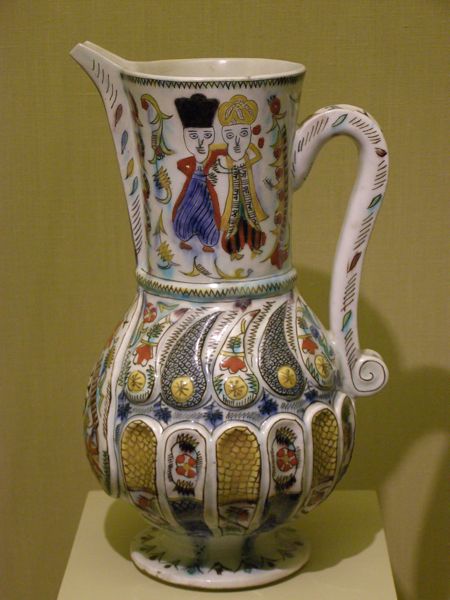
A quick hello to the ceramics display, then off…

Finally, a trek through the rain to the service bus, provided at no cost by the school. Lucky us.

So—there’s my rainy Sunday in Istanbul. Here’s to sunny days ahead!

CHANGES…

Changes. Yes, many changes. A new president, for one. (We DID it!!!!) This new year has brought smaller changes, too. I’ve grown a titch bulkier and developed a few more wrinkles (I’m nearly 60, you know). I also acquired a new car, which compelled me to pursue another stint of teaching overseas. Where? Well, where else? Back in Istanbul, of course.  I said goodbye to family and friends, skis and snowshoes, and…

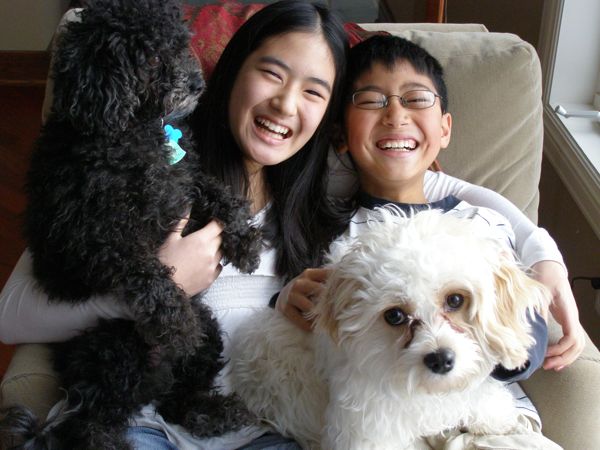
Goodbye Libby, Erin, Matthew, and Mitsy!

Goodbye Libby, Erin, Matthew, and Mitzy!

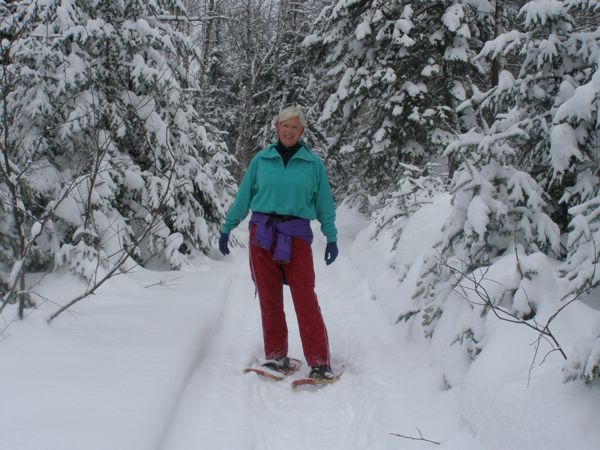
Goodbye, snowshoes!

Goodbye, snowshoes (and snow)!

I just arrived at the Koç School campus on Saturday—a drizzly, sopping afternoon. I was detained FAR too long at customs (an expired residence permit necessitated much discussion among the police and a hunt for the official stamp to CANCEL it). I was greatly relieved to find that my driver had waited the extra half hour for me. I dozed through most of the hour-long drive to campus, waking for a few moments just as we crossed the Bosphorus. It’s always a joy to gaze up and down that incredible waterway and marvel at the the Rumile Castle just beneath the bridge. Ah, Istanbul!

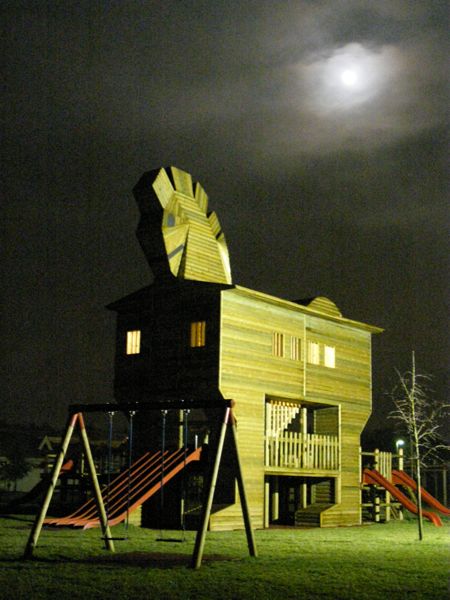
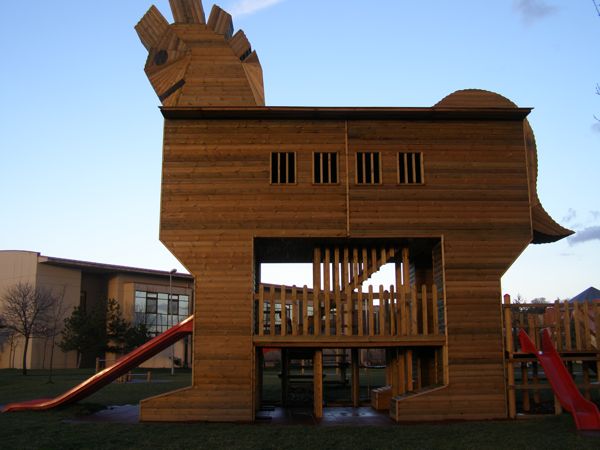
After settling into my lojman, a cozy little two- bedroom just like I had before, the sun peeked out. Hooray! I tried to shake myself awake with a walk around campus (about 3K). Things are pretty green here, with iris shoots pushing up and rosebushes leafing out. Everything looked pretty much the same as before, except for a recent addition to the high school. As I continued around toward the elementary, though, I wondered about the huge wooden structure looming ahead. My goodness—A HORSE! I kid you not. There’s a monstrous Trojan horse planted on the elementary playground overlooking the tennis courts. It has a wooden mane and tail, and its body is a vast room with barred windows (apparently to prevent accidental falls), easily large enough to hide a hundred soldiers.

The HORSE by moonlight

I assume you realize that Troy is located in Turkey, southwest of Istanbul where the Aegean Sea meets the Dardanelles Strait. I haven’t been there yet, but it’s on my list. Previously thought to be a mythical city, Troy first appeared in Homer’s Iliad and Odyssey (these works date somewhere between 600 and 900 B.C.). You know, Helen of Troy and Odysseus and all that? Well, the actual remains of 4,000-year-old Troy were discovered in the 19th century, and many of its treasures now reside in Russia and Germany. Yes, my friends, Troy is right here in Turkey. AND—on the Koç campus.

The HORSE by day

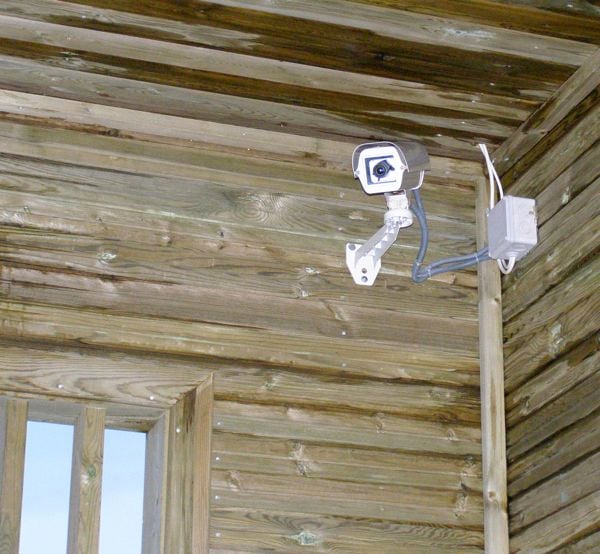
I’m not sure who masterminded this structure, but I understand it’s been rather controversial. Can’t imagine why! They had to install lights and a closed-circuit camera in the beast’s belly to prevent untoward evening dalliances by students living on campus. Maybe teachers, too, huh? Who knows?

I can’t help but chuckle as I think of the shenanigans that may have ensued before the camera was installed. Here in Turkey we tend to react to situations in a knee-jerk fashion, so I assume there was some impetus for the expense of a surveillance camera. Ah, Istanbul!

Big Brother is watching you—Troy or 1984?

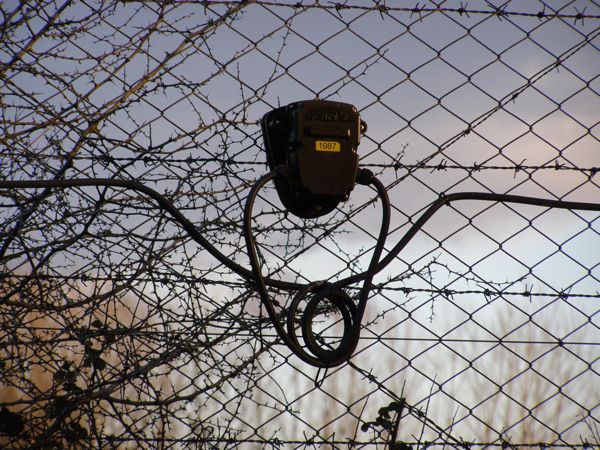
There’s one more notable change here at Koç. We have security systems for every lojman (apartment) with a blinking red light above the door. Apparently in spite of our much-appreciated 24/7 guards cruising campus, someone discovered a prowler in their house one night. We’ve been warned to keep all our doors locked, there are new motion sensors on the chain-link fence that surrounds the campus, and every lojman has an alarm system, complete with a blinking red light over the front door.

Our added security…

I haven’t done too much walking yet, as it’s been raining most of the week. My friend Ileyn joked that she expects to see pairs of animals queuing up on a nearby hillside. Did you know, by the way, that Turkey is also where Noah supposedly built the ark? Mount Ararat is in Eastern Turkey, and I hear that’s the place. Check your National Geographic archives. I just hope this rain doesn’t continue another 35 days and 35 nights. I mean, enough is enough!

I’ve noticed a few other changes here, too, thanks to our new high school director, Koray Özsaraç. He’s improved the climate of the school: the kids are in uniform, the teachers seem happier, and the halls are quieter. He’s also put an end to students butting in the lunch lines (though I’m still waiting for the day that teachers get to step ahead of the kids).

Well, it’s good to be back with people I know and love. My classes are rolling along, and I look forward to my first trip into the city this weekend. Ah, Istanbul!

Dalyan, sea turtles, and adventures

An English teacher on a biology trip? Go figure! I just returned from a school ecology trip to Dalyan, on Turkey’s Mediterranean coast. Lovely. More than lovely.

We arrived late, just in time to hear Turkey’s soccer team beat Croatia in overtime, winning a spot in the European Cup semi-finals. The streets immediately filled with celebrating fans honking, chanting, singing, and waving flags. The owner of the Metin Hotel found it a bit deli—crazy. We loved it.
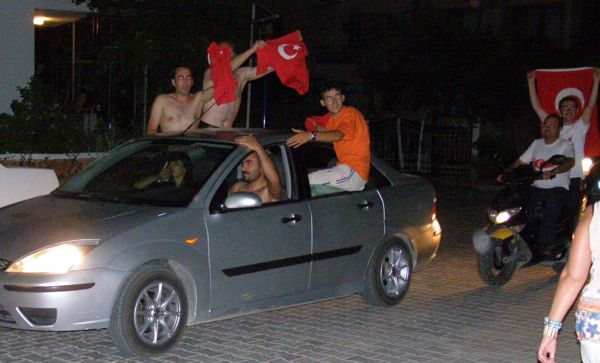
Celebrating soccer fans in the streets of Dalyan

The first morning dawned bright—and hot. Temps were in the high 80’s and 90’s all four days (28 to 35 C.). Luckily, we were mostly in and on the water, the focus of this biology trip (the fourth annual) expertly organized by Gaby McDonald, a South African biology teacher at Robert College. Our eight students were joined by seven science teachers-in-training from Bilkent University (with supervisor Margaret Sands). The plan for the week included two days of hands-on biology activities with follow-up sessions, then two days of recreational adventures. We were also privileged with a night visit to the beach to see loggerhead turtles lay their eggs; the beaches are off-limits to anyone but researchers during the nesting season.
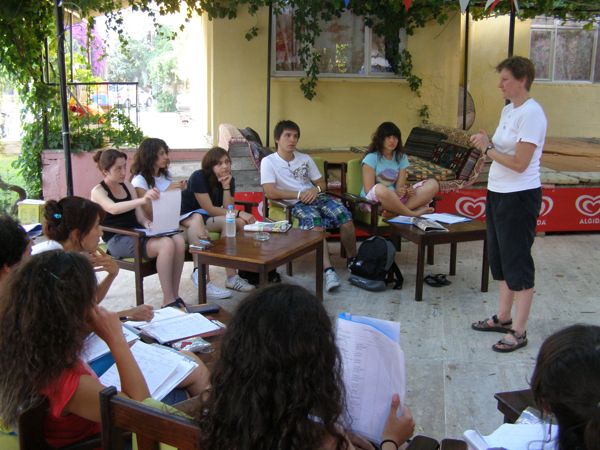
Gaby runs one of many information/feedback sessions on ecological studies.

Back to the first day. After an introductory session by Gaby and her assistant, Noah Billig, we slathered ourselves with sunscreen and walked three blocks to the wharf. Students carried the two huge wooden crates filled with scientific gear. Captain Ramazan welcomed us to our boat/classroom, and we marveled at the ornate tombs carved into the marble cliffs across the waterway. Gorgeous!
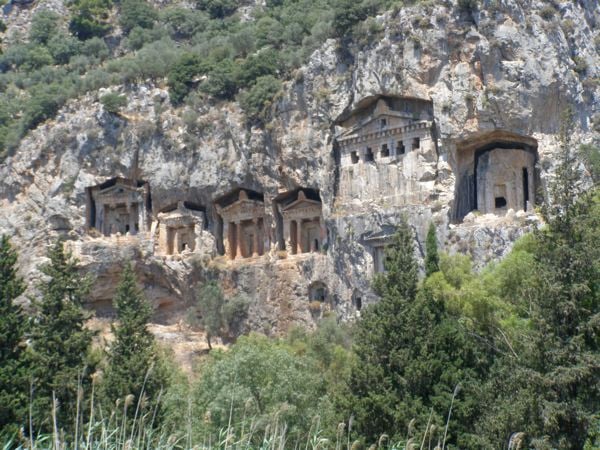
Picturesque marble Lycian tombs dominate the veiw from Dalyan.

The day was devoted to water samplings, vegetation surveys, and river current measurements—a mammoth task, in my mind. We moored near a group of sheep clustered in the shade, and from there the work began. One team hopped into a small boat with a long rope to measure the width of the river, then measure the depth at 5 meter intervals as they rowed back from the far shore.
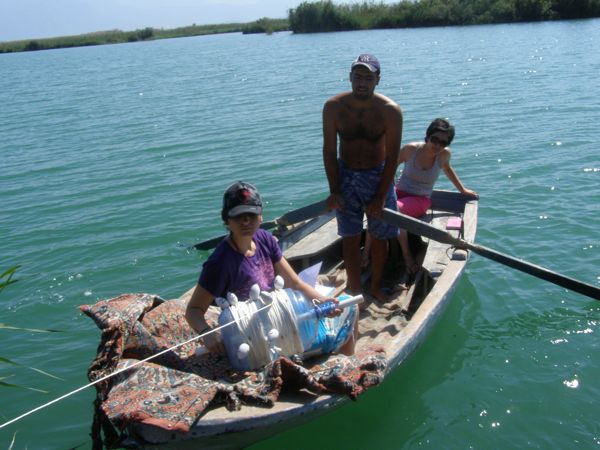
Captain Ramazan rows two girls across the river to measure width and depth.

Another group set up meter-sized quadrants to survey the vegetation along the shoreline (and in the water).
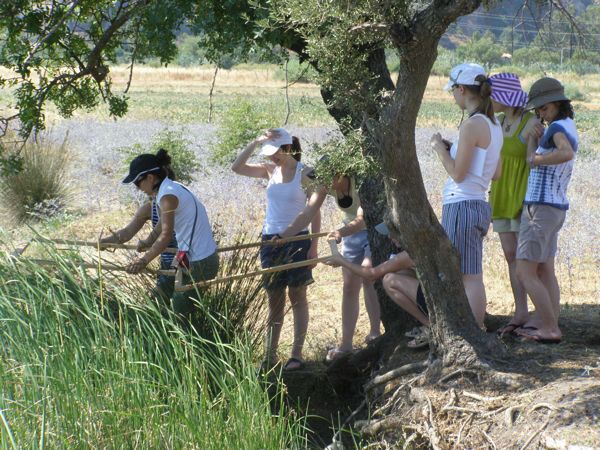
Investigating vegetation within randomly-placed quadrants.

Once those tasks were completed, we headed out to the middle, where water samples were taken at varying depths and analyzed on a number of scales to determine clarity, salinity, phosphate content, etc.
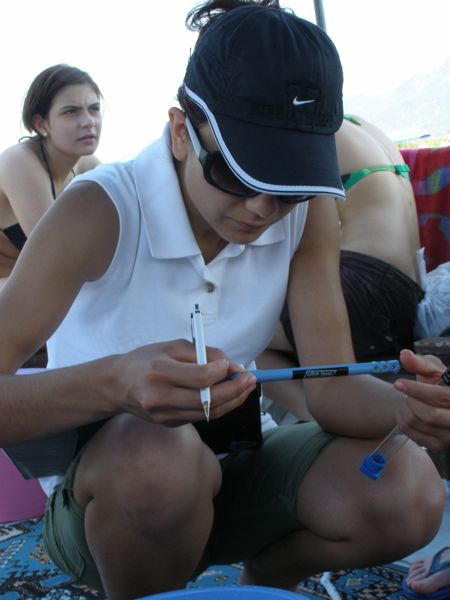
Scientific equipment aids water measurements.

Lastly, six students jumped into the river to help measure the current. The rope with meter measurements was stretched along behind the boat, and pairs of students were posted at 5-meter intervals. Another student dropped two oranges into the water while a second used a stopwatch to time the oranges’ progression along the rope. The process was far slower than expected, and one orange did little but circle below the boat. Our determination was that the wind was counteracting the current or there was little current. We’d discuss possible reasons for it later.
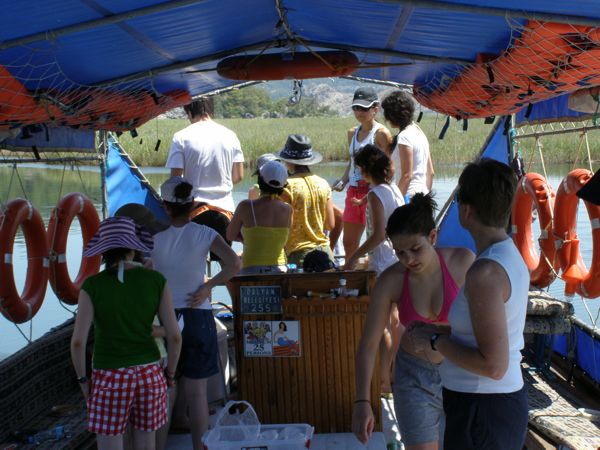
Students continue water samplings from the boat/classroom.

We repeated the water quality tests halfway down the river, where we also wolfed down our lunch of tomato, cucumber, cheese, and salami sandwiches. The Turkish bread is always fresh and crusty, and beyaz peynir (white cheese) is delicious—YUM!!!

Finally, we reached the Mediterranean, where we were set free for a few hours to enjoy the beach and the waves. The sea was much more refreshing than the river’s warm water. We did one final water test just inside the inlet, then motored home with many exhausted students fast asleep.
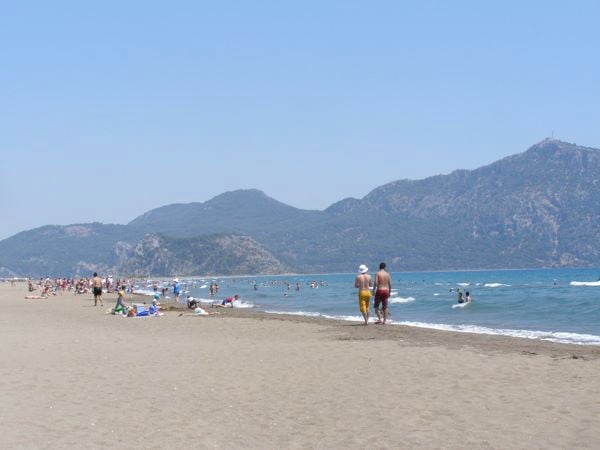
Tourists enjoying Dalyan beach

After returning home we showered, napped, and held a follow-up session to analyze our data. It was clear that water temperatures, phosphates, and turbidity levels (lack of clarity) were higher upstream, away from the sea. Of course, this also contributed to higher vegetation levels. Students discussed the importance of controlling pollution in the river to maximize the populations of aquatic animals that contribute to the ecosystem.
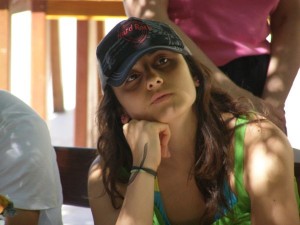
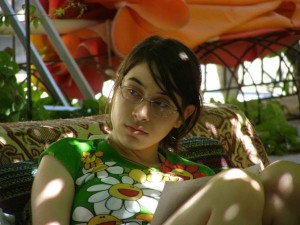
Pensive students (Squeak and Ayse) during a feedback session.

We then enjoyed the hotel’s scrumptious buffet (mezes, Turkish hors d’oeuvres, are my favorite, so I focused on those). Later we gathered at a local karaoke bar for Gaby’s powerpoint on sea turtles, a focus of much of our research. Loggerhead turtles are amazing. They can live up to 200 years (though the average is 30-60) and can weigh up to 350 pounds. They reach sexual maturity at about 30, and females nest every three years, laying up to 35 pounds of eggs, often in three separate nests. Loggerheads often migrate thousands of miles, although the females return to the beach of their birth to lay their eggs. Recent satellite transmitter data has shown that Turkey’s turtles migrate to Tunesia. It’s interesting, too, to note that loggerhead hatchlings increase their weight more than 6000 times from birth to adulthood. If we did that, we’d weigh about 42,000 pounds.
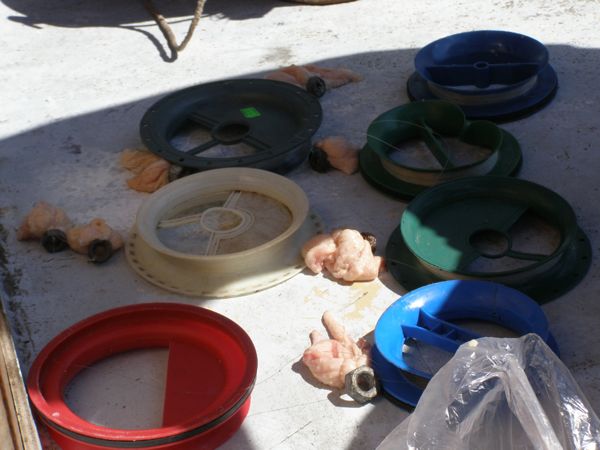
Crab bait awaits.

Sunday was crabbing day. Ramazan piloted the boat as he tied chicken skin and a heavy nut (hardware) onto lengths of fish line. Once we were anchored in a choice location, the eight lines were thrown into the water around the boat.

Within minutes, five students were reeling in blue crabs, which Ramazan expertly netted and brought to the surface.
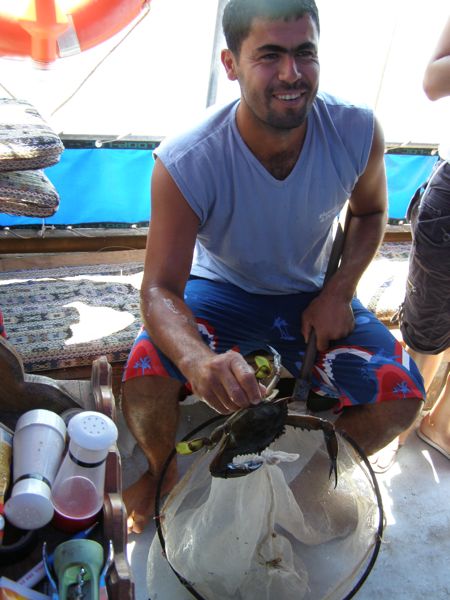
Captain Ramazan beams after netting a blue crab.

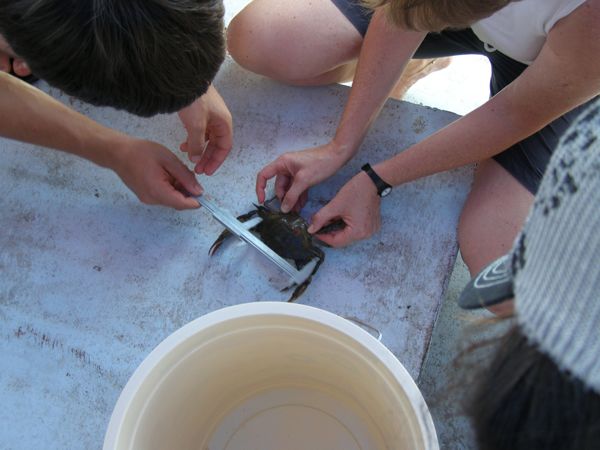
Gaby taught us how to determine the sex (yup—it’s pretty easy), whether the females were in berry (with eggs), and how to measure the carapace (shell). After noting all the features of each crab, its shell was marked with fingernail polish and it was placed in a bucket, where the morning’s catch soon became a knot of inter-connected pincers and shells. After an hour and a half, a mere 14 crabs had been caught. Ramazan dumped them back in the river to burrow into the mud.
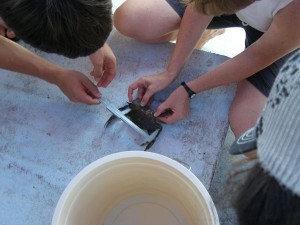
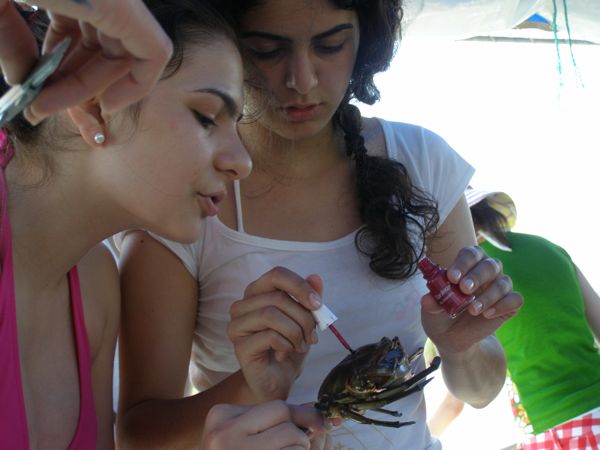
Students measure and mark blue crabs (Ayça and Lal)

We once again headed to the beach for lunch and a swim—ah, the refreshing Mediterranean! The beach, by the way, has rules against putting up sun umbrellas, as they might bore into a turtle nest. They have permanent wicker umbrellas with wooden beach chairs available, otherwise it’s full-sun exposure.
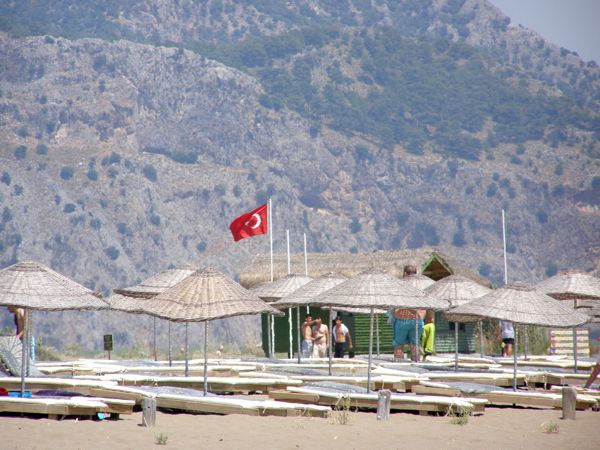
Dalyan beach’s “official” beach umbrellas and chairs

We returned to our crabbing spot to catch crabs again, though with disappointing results—only 4 crabs caught. One of the four was already marked, so using the ratio of pre-caught to repeatedly caught crabs, we computed the population of the 100 square meter area to be about 52 crabs, the same computation as the previous year, although they had caught 50 (compared to our measly 18.) Interesting. Our biggest concern was that none of the females were in berry. Why?

After we returned to the hotel, we had another session to evaluate the results, and groups of students proposed methods of preserving the crab population (the loggerheads’ favorite food).
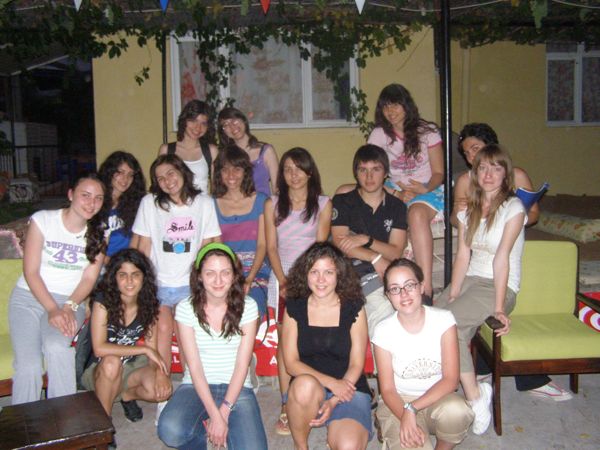
A post-discussion group photo of young biologists

That night half of us left for the beach with Bekir Bey, a ministry official who Gaby has worked with over the years of this project. Under his escort, we were able to get past the gates onto the beach, where a team of researchers from Pamukkale University are studying loggerhead turtles. They scout the 3-kilometer beach every night, watching for turtles that come in to nest. It’s important to catch each turtle before she covers her nest, as she does an incredible job of throwing sand behind her and over the nest, making it difficult to determine where it is. Although loggerheads are easily frightened away as they search for a nesting spot, once they begin laying, they are in for the count. As they lay their eggs, researchers take measurements and either mark new turtles or snip a sample of tissue from the hind flipper of turtles that have already been marked. Once the turtle has returned to the sea, the researchers dig down about six inches toward the well-covered nest and lay a metal grid over the nest to protect it from fox or other predators. The grid is spaced wide enough to allow the hatchlings to wriggle through, though narrow enough to prevent animals from stealing the eggs. In 55 days the researchers will revisit the nest, then try to protect the hatchlings as they head toward the sea. Unhatched eggs are used for study. Did you know that a sea turtle’s sex is determined by the temperature of the egg’s environment? Let’s see…I think the females are the hotter ones… (29 degrees is the dividing line.)

//upload.wikimedia.org/wikipedia/en/e/e7/Loggerhead_close_up.jpg” cannot be displayed, because it contains errors.

Photo from Wikipedia: http://en.wikipedia.org/wiki/Image:Loggerhead_close_up.jpg

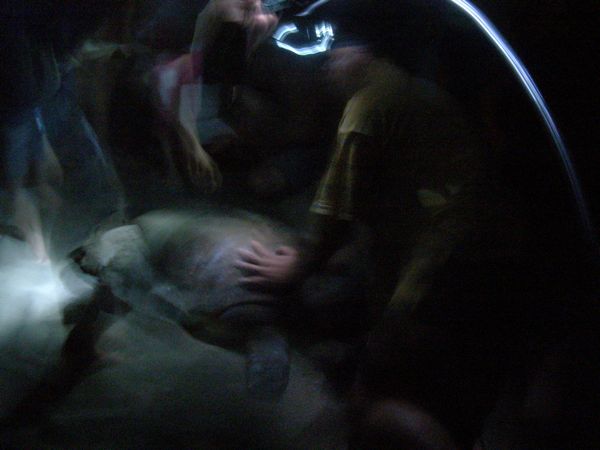
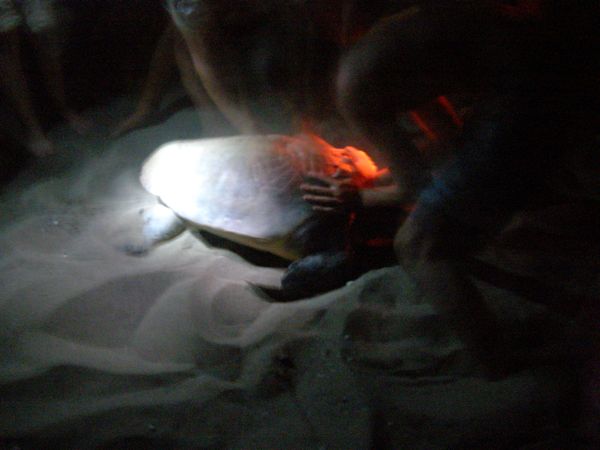
The moon rose around midnight, charming the beach as we waited to see our turtle lay her eggs. She laid her eggs quickly, so researchers had to do measurements as she headed back to the sea. I wasn’t allowed to use a flash, but I got a few time exposures in the dark that showed the her silouhette as they worked with her.
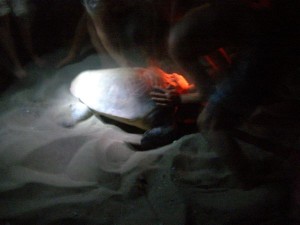
Time exposures of our female loggerhead turtle being measured after leaving her nest

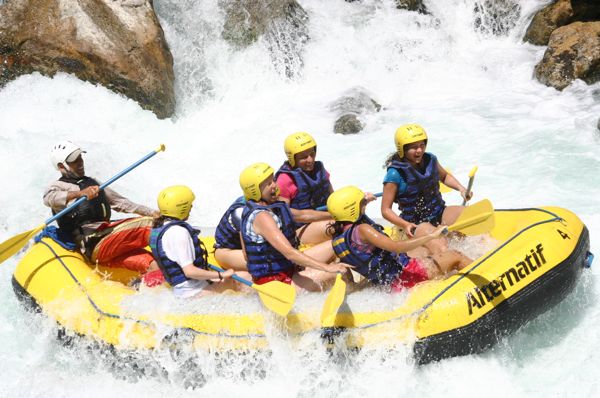
Our last two days were fun, fun, fun. Monday we went white-water rafting (a 3-hour drive, but WELL worth it.)
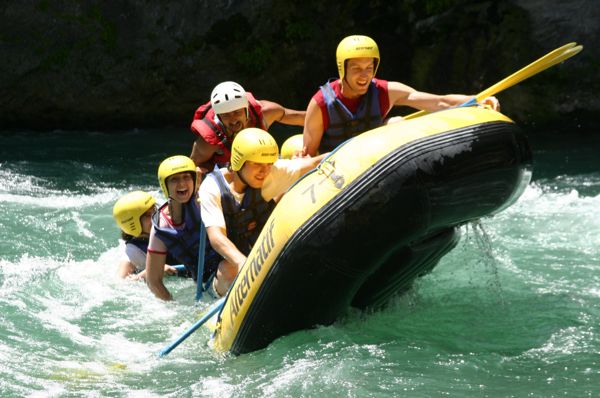
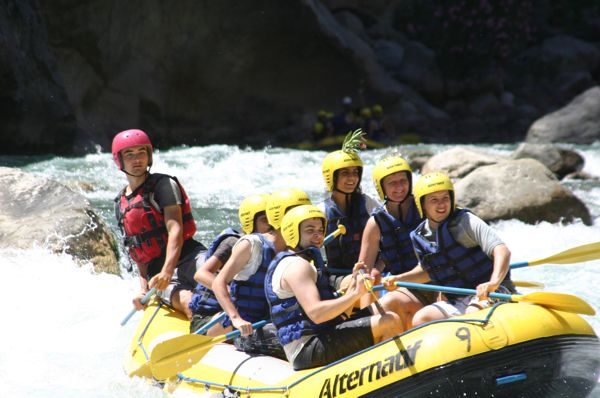
Rafting photos by Alternatif Outdoor Rafting

On the last day we went sea kayaking, a new adventure for most of us. I could have stayed out there all day, but we paddled for only a few hours, exploring one of the most picturesque coves of the area.

Too much information, I know—but it was WONDERFUL! I learned a lot about turtles, about ecological balance, and about traveling and adventuring with Turkish kids. I was once again reminded of Turkey’s varied and spectacular scenery.

Thank you, Gaby!
Ah! The Bosphorus!
I’m going to the Asian side to visit friends this evening (about 8 miles as the crow flies), and believe it or not, it’s FAR faster to do the trip by ferryboat than to hazard the Istanbul traffic. It’s one of the beauties of living on the Bosphorus. Let’s see…would I rather stand, sweating, on an overcrowded bus as it creeps along the shore road, or sit on the open deck of a ferry boat with a fresh Bosphorus breeze on my face? Hmmm…

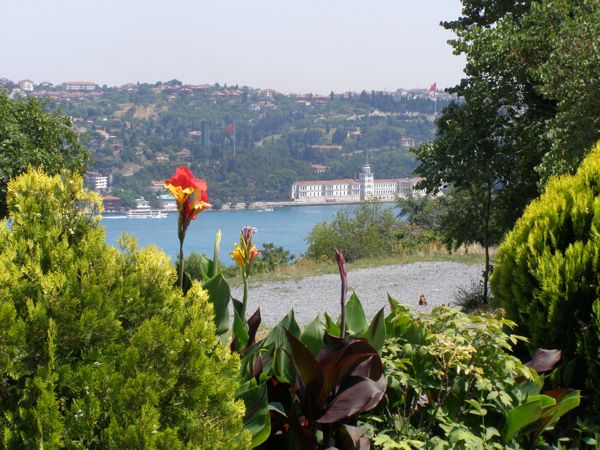
My view overlooking the Bosphorus

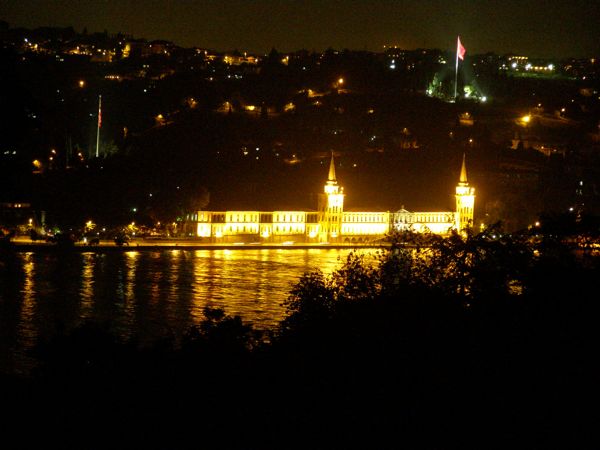
My view overlooking the Bosphorus (Kuleli Military Academy)

The Bosphorus has become a huge part of my life here in Istanbul. Not only does it provide transportation and a lovely place to walk, it offers a spectacular view from the Robert College campus. What a lift it is to look out over the Bosphorus from the school each day—unreal! Though it’s an altitudinal challenge, I have resolved to walk down to the Bosphorus every day—just because I can. My record is slightly less than perfect, but it’s been great.

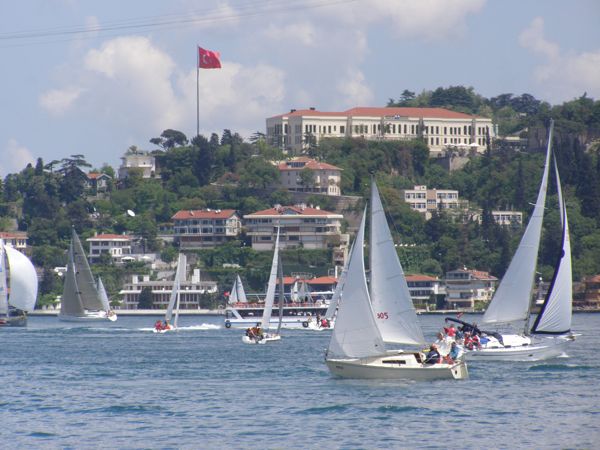
A Bosphorus sailing regatta—a rare occurrence, happening only a few times a year.


It’s amazing to live above the busiest waterway in the world. Although it’s actually a strait, it looks more like a huge river with hills towering on each side. Twenty miles long, the Bosphorus is always busy with tour boats (speakers blaring in every language), ferries (much quieter), day/night cruises (traveling cocktail and dinner parties), and commercial ships plying the lanes both north and south. Some of the container ships are of mind-boggling size, to say the least. And believe me, they leave a mega-wake.

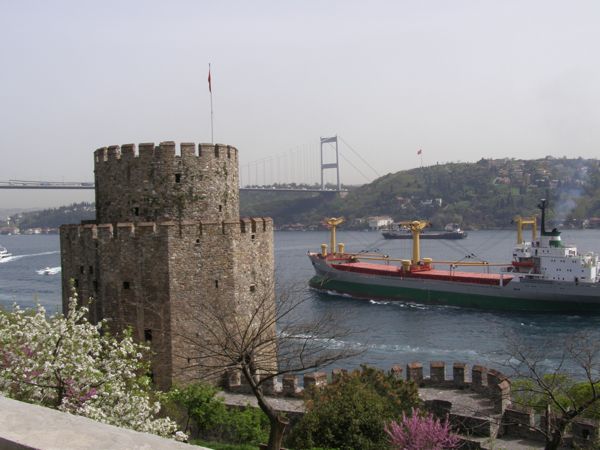
The bustling, busy Bosphorus–at Rumeli Castle

The Bosphorus connects the Black Sea with the Sea of Marmara (about the size of Lake Superior). It has formidable currents—I often see the water’s surface churning. Apparently there are double currents, with less saline waters flowing down from the Black Sea at a velocity of 1-2 m per second, while the Maramara’s more saline, denser water flows north at lower depths nearly four times as fast (from the Encyclopedia of Ukraine). Expert Bosphorus pilots are ferried out to each ship as it enters the waterway to guide them up (or down) the Bosphorus, disembarking at the other end to board another ship for the trek back.


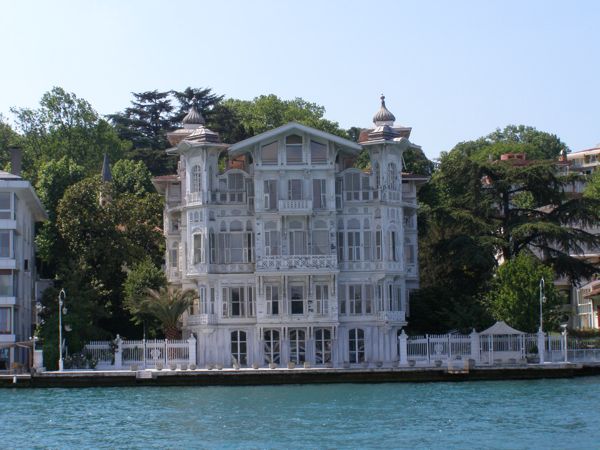
A spectacular yalı (Bosphorus waterfront mansion)


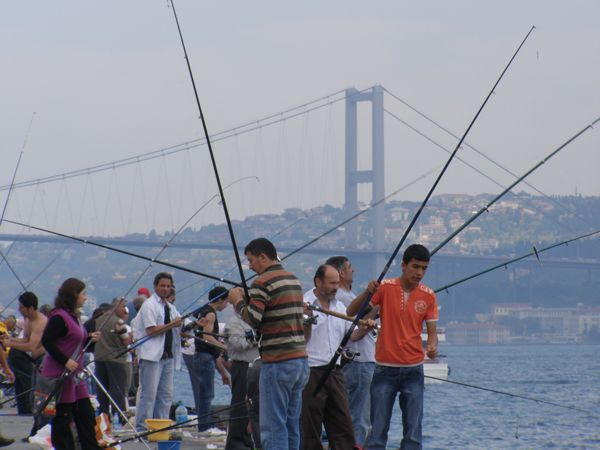
But the charm of the Bosphorus is more than that; it’s the lovely yalı (old mansions) along the water, the fishermen (and women) casting along the quay, and the pleasure boats.

Fishermen on the quay…

…and others fishing from boats.

It’s seaside restaurants and tea gardens, the ever-changing lights on the first bridge, and the ornate Ortaköy mosque. It’s beautifully lit historical buildings at night—ah, the Rumeli Castle (I just learned that “rumeli” means European, with roots back to the Orthodox Christians), and the moon rising over the hills.

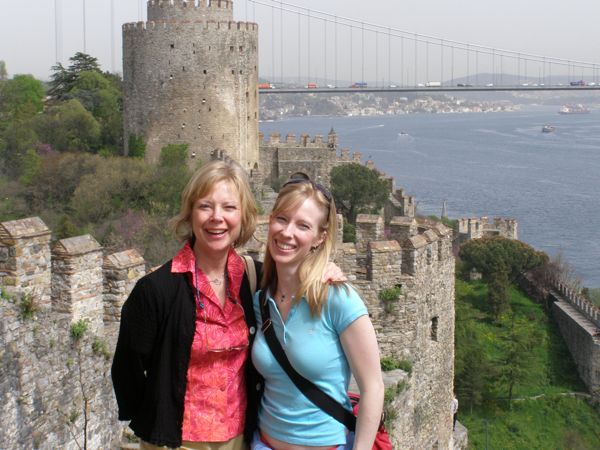
My friend Annie and her daughter, Jess at the Rumeli Castle

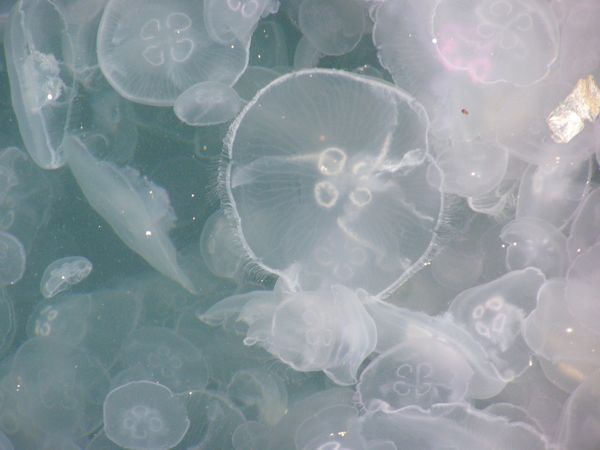
Unfortunately, it has some problems. It’s choked with jellyfish and too much trash, which will hopefully change before long. (Istanbul is making great strides in recycling and clean-up.)

Jellyfish abound in the lee of the yachts along the quay.

My home at Robert College in Arnavutköy overlooks the Bosphorus, with the Kuleli Military School dominating the view, especially when it’s lit at night.

It’s amazing. It’s inimitable. It’s the Bosphorus.

My night view—Ah! The Bosphorus!

Brooks, good friends, and great music

In early April my friend Marnie told me to set aside May 27th for a big event at the Koç School. When I realized it was a Tuesday I was disappointed. The trip from my home on the European side of Istanbul to hers on the easternmost Asian side is long; though only 20 miles, it’s about 3 hours on public transport— a daunting trip for a school night. I changed my attitude, though, when she said it was a live music event. THAT would be worth the trek!

I caught a school service bus to the Asian side of the Bosphorus (only 45 minutes), then hopped on the train to Pendik (another 45, including the wait). I walked four blocks up to the bus “station,” where I was the first to board the next blue mini-bus. Another 20 minute wait, and I was on the 40-minute ride to the Koç School. It had taken me 2 ½ hours from Robert College to the Koç School, record time for afternoon rush hour. Lucky me!

As I checked in at the gate, familiar smiles greeted me, eager for news of my life since Koç. In my limited Turkish I managed a short account before starting the trek across campus to the Paulus’ house.

The guards’ warm welcome brightened my walk along the familiar sidewalks and lawns—nostalgia hit as I cut through the student commons, a huge glass pyramid that joins the major wings of the high school. On my way through, I noticed a poster for Brooks Williams, the headliner for the school’s upcoming talent show. Hmmm…


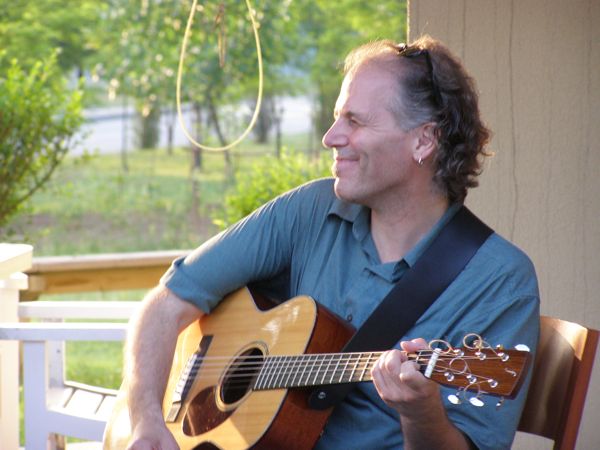
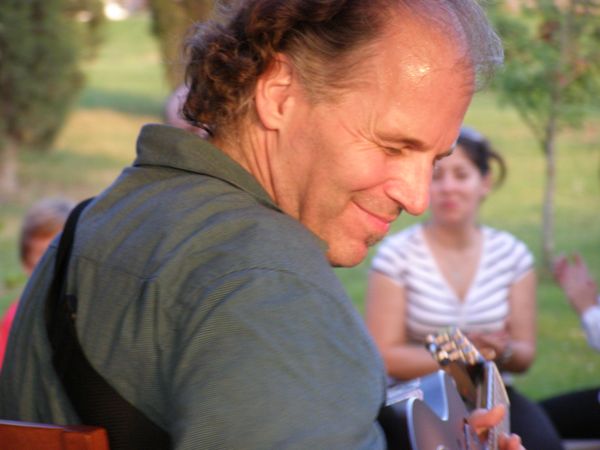
Brooks beams at his audience.

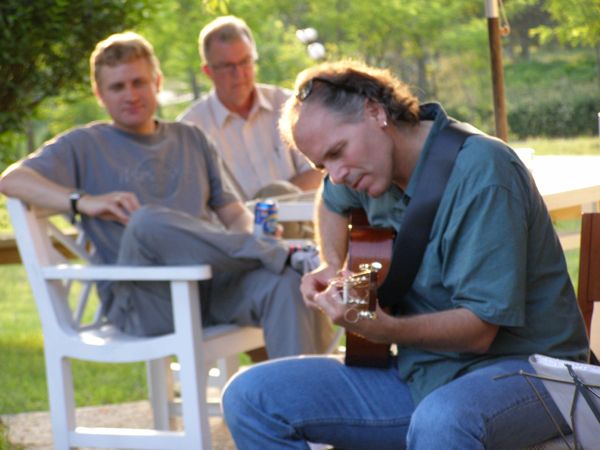
Marnie and Tony welcomed me with warm hugs and introduced me to their friend Brooks Williams. In the flesh. He’s actually just a regular guy, though I was soon to learn an incredibly talented one. Brooks was the featured event for the evening of backyard music. The Pauluses have known him for years, and he interrupted a musical tour of England to buzz down and join them in Istanbul for a week. An accomplished acoustic guitarist and folk singer, his music is reminiscent of Leo Kotke or John Fahey—my favorites—and he’s that good, too. (Check him out at http://www.myspace.com/redguitarbluemusic .)

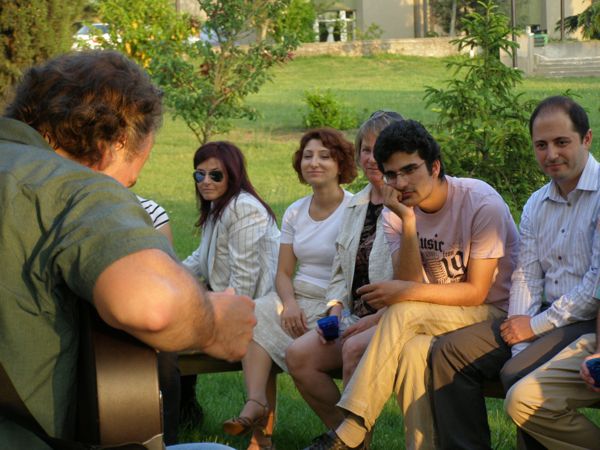
Brooks and music lovers
The Koç School’s two Davids enjoy Brooks’ folk strumming.

I basked in the warmth of good friends at Koç—about 20 or 30 teachers, staff, administrators, and their lovely children. We were wined and dined with an impressive spread of fabulous mezes (Turkish hors d’oeuvres), then congregated outdoors for music. Ahhhh…Music!

The perfect way for folks to enjoy guitar…

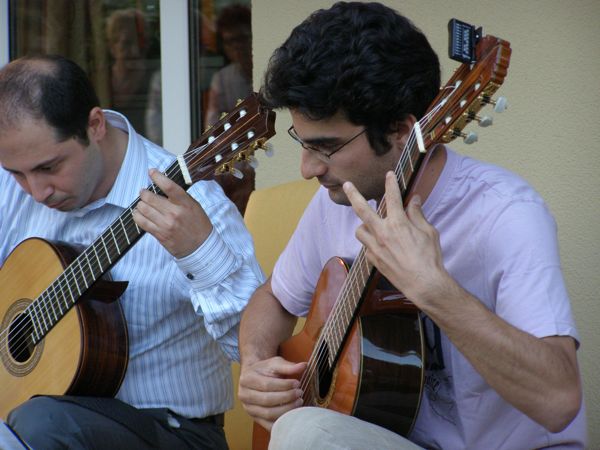
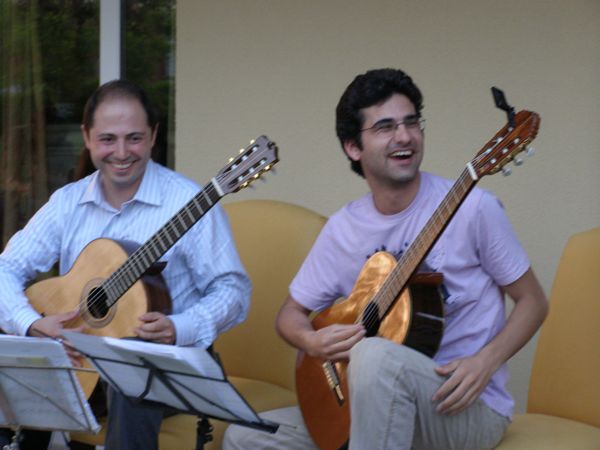
Brooks awed us with both voice and guitar for nearly an hour as the sun sank over the hills of Istanbul, then two local musicians, Tolga and Erdem, took center stage with Turkish folk music. They demonstrated some fascinating percussive techniques, which were great fun. Then, of course, the three guitarists joined together for a jam session, a delightful finale to the evening—which ended far too soon for my tastes.

Tolga and Erdam “strut their stuff”.

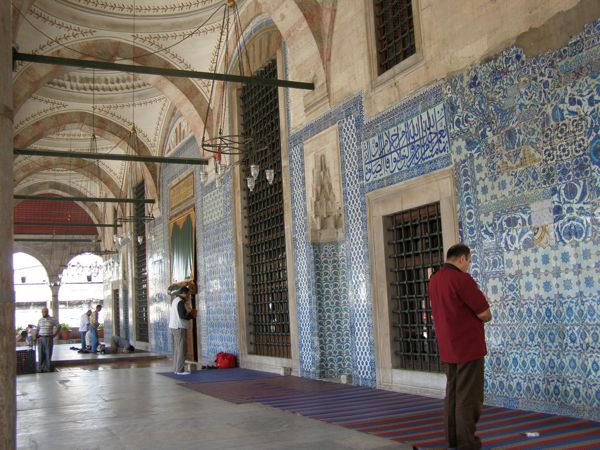
The next night brought more live music, this time on my side of the Bosphorus for dinner and jazz. I arrived at Eminönü about an hour early (you never know how long a trip will take with Istanbul traffic), so I headed for the Rustem Paşa Mosque (a favorite spot) to relax in the breezy shade of its second-story courtyard. Lo and behold, who should walk in but Tony, Marnie, Brooks, and Mesure (a Turkish friend from Koç), also early arrivals to the city. Speaks to the charm of the Rustem Paşa, doesn’t it?

The outdoor prayer terrace at Rustem Paşa Mosque

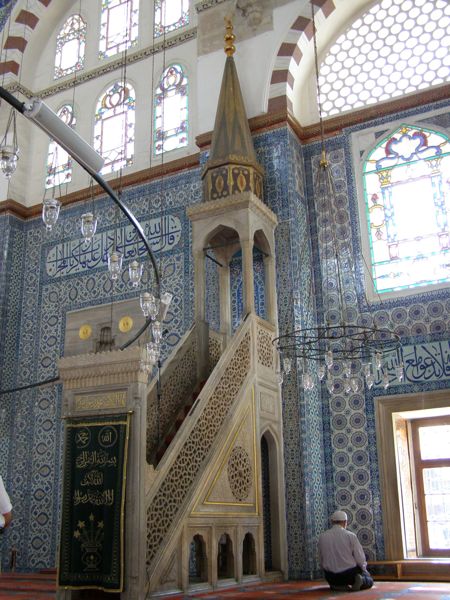
Rustem Paşa interior: a man at prayer

After enjoying the mosque, Mesure treated us to a delicious array of culinary delights at the Hamdi Restaurant (a traditional favorite), then after dinner Brooks and I worked off a bit of our dinner with a trek across the Golden Horn and up the cobbled lanes to Nardis, a night club just below the Galata Tower, where we met others for an evening of jazz (and, of course, rakı—a traditional Turkish drink).

The Nardis was great, but how can you beat the intimacy of good friends at a backyard concert? It just can’t be done, not even in Istanbul.

Brooks\' is The Man

Yup! Great tunes!

And—tonight I’m going to a Jethro Tull concert. Imagine that!