Navigating Istanbul with my brother
This past weekend I shared Istanbul with my brother Steve, who was easily the most enthusiastic guest I’ve hosted. He LOVED the city, probably as much as I do. Sharing my world with my big brother reminded me, though, how diverse and cumbersome transportation in this city actually is.
I started Sunday morning by taking our school service bus (no cost–hooray!) to Taksim. Though it’s intended for church visits, we use it for everything, and on Sunday mornings it takes less than an hour. After coffee at Starbucks and breakfast at the Marmara Cafe, I hiked down Istaklal (a favorite form of transport) to the Tunel, a funicular that connects Istaklal Caddesi (Freedom Street) with both the ferry boat and the tramway to Sultanahmet. From the bottom of the Tunel I jaywalked to the tramway entrance. Transportation, by the way, is cheap here. A train, ferry, tunel, or ferryboat ride costs just over a dollar, and if you use an akbil (an electronic pass), it charges you for only one ride even if you use multiple forms of transportation.
I rode the tram (state-of-the-art, and ALWAYS crowded) to Sultanahmet, the historical part of the city, then visited the Museum of Turkish and Islamic Arts (free admission for Turkish school teachers). It’s a museum I’ve always wanted to see but never had the time. Sunday I had time to spare. I chatted with an American who turned out to be an economics professor, just like my brother Steve. Small world!
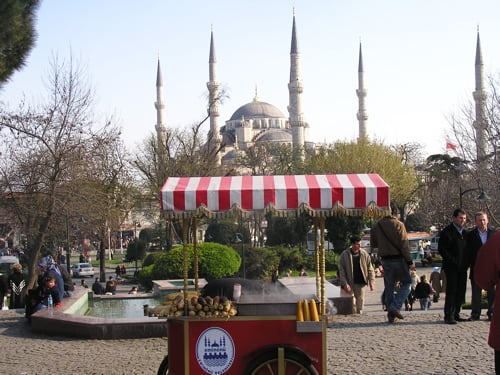
I walked (free transportation) the five blocks to the hotel and checked in. It was a bit early to head for the airport, but I decided to go ahead and relax with a cup of coffee while I waited for Steve’s plane. I took the tram to Aksaray, where I could catch a metro to the airport, and a friendly young couple guided me the five blocks to the metro station (not marked at the tram, of course. Welcome to Turkey). The whole trip took me about an hour (to go a whopping 21K).
Of course, Steve’s plane was late arriving from Kiev, so I had coffee, then did laps between terminals for an in-terminable hour and a half. ARAUGHHH!!! What was I thinking! Once Steve arrived (BIG hugs!) we hopped a taxi for Sultanahmet. Mistake. It took us an hour to get to Sultanahmet, where the traffic was at a standstill, so we paid our kind driver, hopped out, and hiked the last seven blocks to the hotel, Steve exclaiming in amazement all the way along the steep cobbled street. As I said, walking is the most reliable form of transportation in this city.
We settled into the hotel for three minutes, then headed off to Ortakoy to friends for dinner at 7:00. We took the tram to Kabatas, then hopped on a bus to Ortakoy (after nearly a 20-minute wait), where they have a renowned Sunday bazaar. We were soon packed literally like sardines (one man kept getting his head klonked every time the back door opened), and the bus was moving at about a mile an hour. Finally, we hopped out and again took to our feet. We walked the rest of the way in about ten minutes, leaving our bus in the dust. Yup, feet work best in Istanbul!
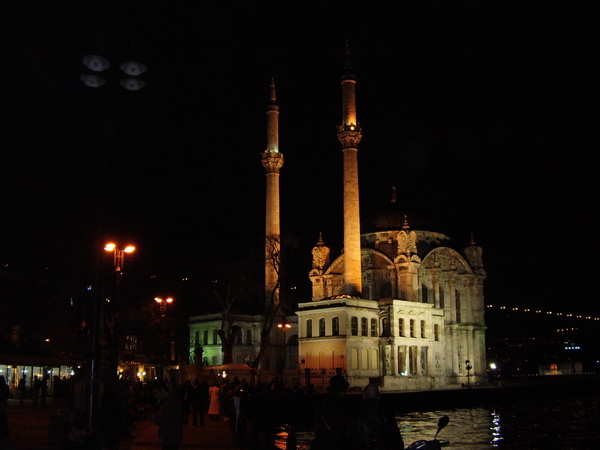
We had a delightful dinner at the Sedir Restaurant, then wandered a bit, taking photos of the lovely Ortakoy Mosque against the night-lit Bosporus. Lovely!
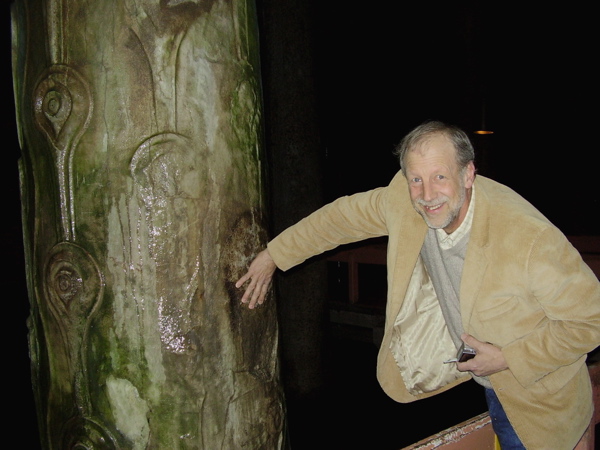
Monday we mainly just relied on our feet for Steve’s whirlwind tour of Istanbul: the Basilica Cistern, the Blue Mosque, Musa’s rug studio, lunch at the Sefa (on Musa), the Grand Bazaar, the Egyptian Spice Bazaar, the Rustem Pasa Mosque (lovely tiles!), and the Sulimaniye Mosque overlooking the entire city.
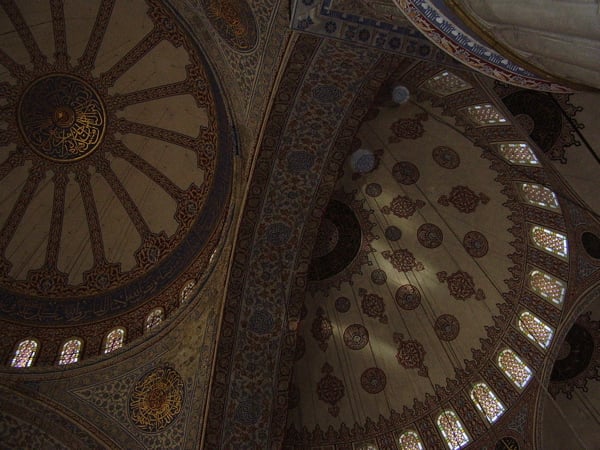
We were BUSHED by the time we found our way (on foot) back to the hotel to pick up our packs for the trek home.
The 3-hour, 5-transport trek home:
Tram to Karakoy: 20 minutes (10 minute wait)
Ferry to Hydarpasa: 20 minutes (10 minute wait)
Train to Pendik: 40 minutes (15 minute wait)
Mini-bus to Koc School gate: 40 minutes (20 minute wait)
Walk to my lojman: 10 minutes.
That means we left the Side Hotel at 5:20 and arrived at my lojman (to a very happy LIbby) at 8:30. Three hours. Steve was astounded, and a good sport the whole while.
So here’s how the cost stacks up:
Tram to Karakoy: 1.5 Turkish Lira
Ferry to Kadikoy: 1.5 Turkish Lira
Train to Pendik: 1.5 Turkish Lira
Walking Istanbul with my brother: Priceless.
A Weekend in Istanbul
A WALK ALONG BAGDAT STREET
People are what keeps our world interesting, don’t you think? I continue to be
amazed at the variety of people I run across in this very different world of
Istanbul, where security guards and service bus drivers are an integral part of
our lives. I enjoy getting out into greater Istanbul, away from
the quiet, predictable life on campus.
After school last Friday I took a staff service bus to a doctor’s appointment
near Bagdat Street, and from there I headed off with my camera. I met a
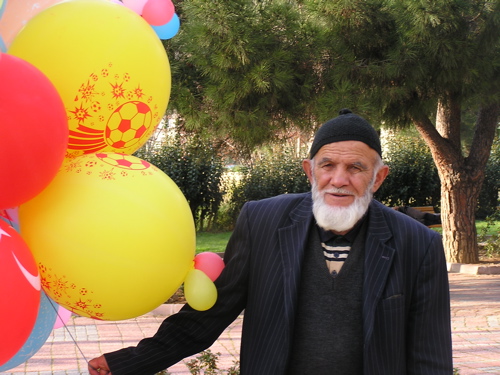
balloon man in Goztepe Park, who kindly posed for a picture. Of course, he
didn’t really smile until AFTER the photo—I think a lot of the older men here
see photography as a formal portrait thing, which is very sweet.
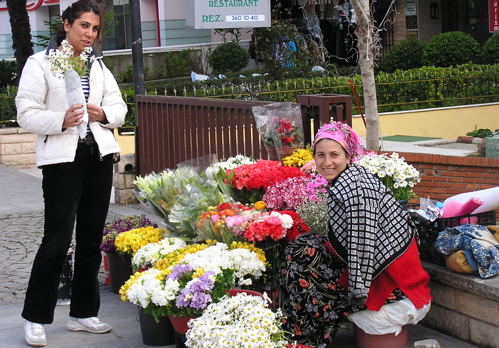
The next person who caught my camera lens was a flower seller, one of many
along Bagdat Street. Instead of using florists, people pick up their household
bouquets from flower stands along the sidewalk. This flower seller was a
lovely young woman; usually they’re older. Maybe she was sitting in for her
mother or something.
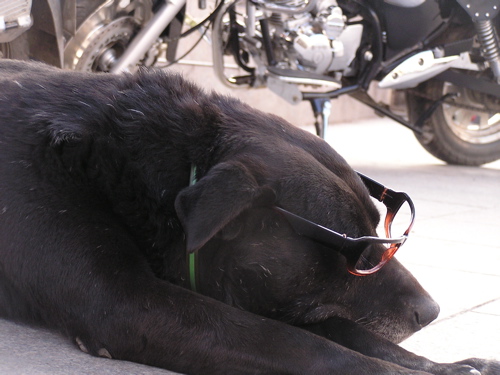
In the next block I was surprised to find a tired old black lab asleep on the sidewalk with
glasses perched on his nose. It was too cute. He was advertising for his
cheerful master, who sat beside a table strewn with sunglasses and reading
glasses. We exchanged pleasantries, I resisted the temptation to purchase yet
another pair of reading glasses, and I continued on my way.
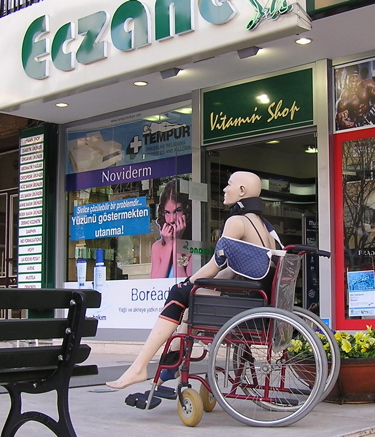
Down the block I found an even more creative advertising ploy: a hairless
woman sitting in a wheelchair with a knee brace, a wrist brace, a neck brace,
and various other therapeutic devices. Poor thing didn’t have much else on.
Fortunately she was a mannequin, cleverly posted outside a drug supply store.
Hmmm… (note the flowers out already—eat your hearts out, Minnesotans!)
I met my friend Sarah for dinner, and she came back to campus with me for our Saturday adventure,
which brought quite a different kind of people. Our Angelic
Ileyn had arranged a service bus to the Halk Art copper factory on the far
side of Istanbul. You have to understand that the Koc School sits on the far
eastern edge of Istanbul, 30K from Sultanahmet. Well, the copper factory is on
the far western edge of the city, probably equally far on the other side. It took us
two hours to get there (Istanbul traffic).
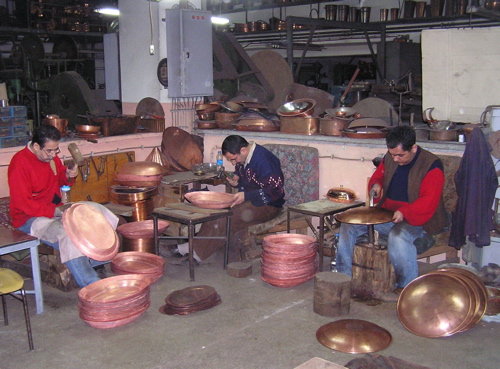
Our first stop was downstairs, where the air reverberated with pounding,
drumming, and thrumming—the sounds of copper craft. It took some time to
adjust to the racket, then we fanned out with our cameras, each eager to capture
the feel of the copper works. Each man sat in a chair pounding a different
type of copper pot, tray, or pan.
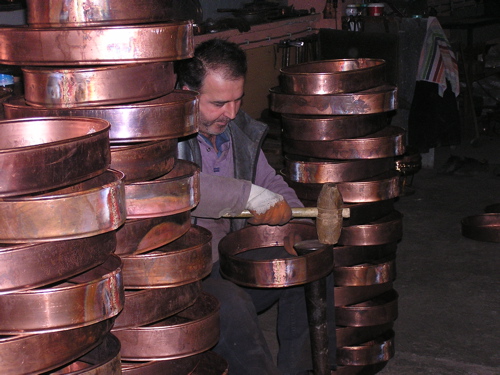
One sat between tall stacks of oval
cylinders of copper, tamping each rim even along the circular edge, preparing
it, no doubt, for a bottom. Surrounded by piles, stacks, and bins of copper
materials, these men could take a flat sheet of copper and make it into a work
of art in minutes. Pretty amazing, if you ask me.
We went upstairs and chose our wares—items that normally sell for two or three
times as much in the States. I bought a few frying pans, a colander, a
sunburst for my door, and a few other little things. We had taken a tour bus
with storage beneath, a lucky thing, since three people bought huge
mirrors, and five others emerged with huge copper tray tables. Tracy bought
a wooden trunk! Go figure! (The shop also has an upper floor of antiques.)
It was a people weekend, all right. We finished it off with a trip back into
the city to celebrate St. Patrick’s Day at a Irish Pub. The ride there was an
adventure in itself. We took a dolmus (a van-like taxi) from Bostanci for what
is usually a half-hour ride to Taksim. Unfortunately, the Friday night traffic
was horrendous. Our driver (clearly an aficionado of Mr. Toad’s Wild Ride)
tore through the back roads of Istanbul at a deadly pace. We eight passengers
swayed and bounced in the back, clinging to handholds and praying for
deliverance. I never had any idea where we were, though we did dart across
main streets occasionally along our route. An hour later we were
deposited at Taksim, a little rattled, but injury-free. (We heard later
that the normal route would have taken two hours.) We were greatly relieved
to finally mount the steps to the Cadde I Kebir pub, where we drowned our
anxieties in green beer and rubbed elbows with international folks like ourselves.
Did I say it’s all about PEOPLE? (Well, maybe people and beer.)
Bolu and Istaklal
I had a lovely weekend in Bolu. I experienced my first long-distance bus ride getting there on Friday, and believe it or not, the Turkish equivalent of a Greyhound bus has an attendant (or two) who serves tea, coffee, snacks, and water–free of charge. That’s better service than we get from the airlines in the States!
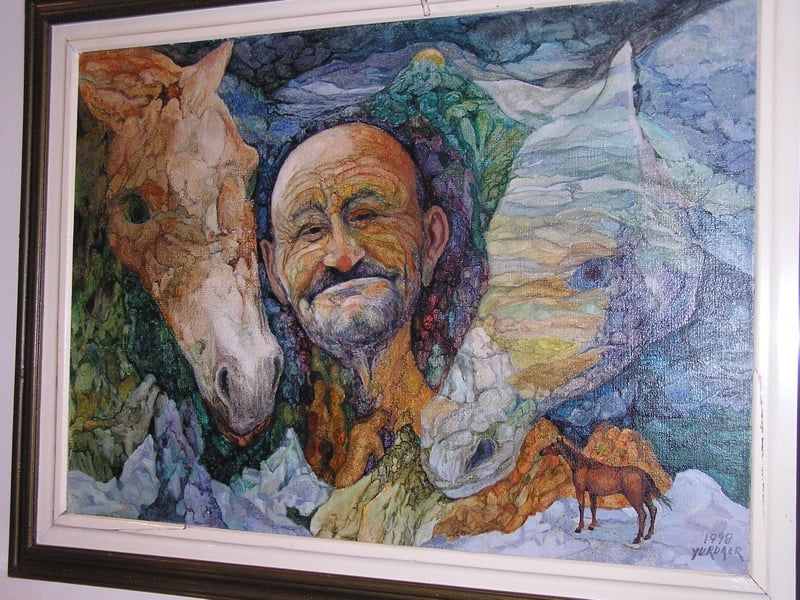
We stayed at the Yurdaer Hotel, which impressed us with an amazing art collection, all originals by the hotel’s owner, Yurdaer Kalayci, who keeps his easel set up in the hotel lobby. (Check out his art online–it’s fascinating).
I made the trip with another teacher, Sibel Butterworth, to present English teaching ideas to 15 elementary and middle school English teachers. The Bolu teachers were enthusiastic about the teaching strategies we shared with them, some fun classrom activities to enhance their grammar-focused state curriculum. We shared ideas for speaking, listening, reading, and writing that they can adapt to their classrooms.

We learned, too, that they have no supply budgets for English materials, so I plan to send them English picture books to use for reading and writing activities. Our teachers reported having 25 to 35 students per classroom, while teachers in Ankara have classes of 60 students. Can you imagine? We in America (and at the Koc School) have it good!
After the presentation, our hosts, principal Ahmet Kyrdemir and English teacher Fatih Ozcan drove us to a picturesque mountain lake perched high above Bolu before we caught our bus home.
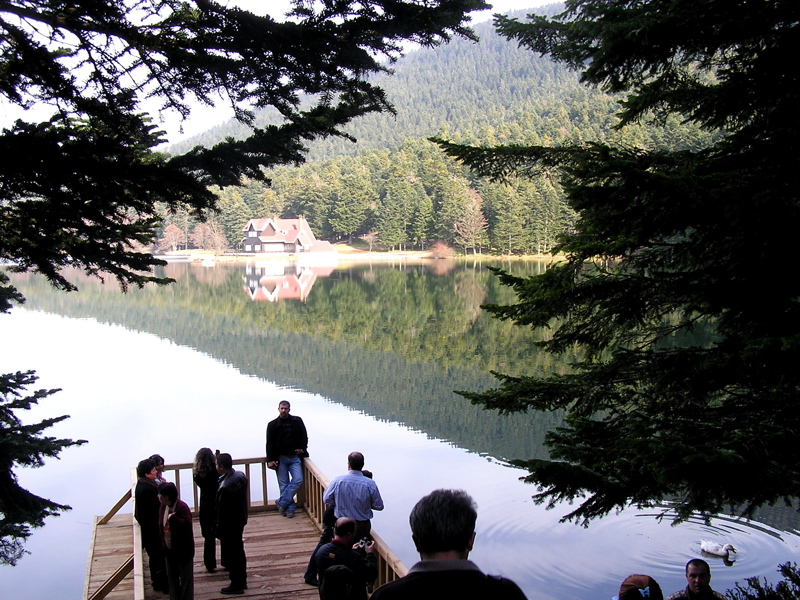 Bolu is a city of 800,000 situated in the Mountains, a major potato-producing area known for its downhill skiing. None of the teachers in our seminar were skiers , though—teachers in Turkey are poorly paid. We enjoyed our lazy trek around the lake, reveling in the brilliant late-afternoon sunshine along with many Turkish families, friends, and couples (Muslims all) strolling, grilling, picknicking, and playing soccer around the lake. People are the same everywhere!
On Sunday I took the service bus into Istanbul
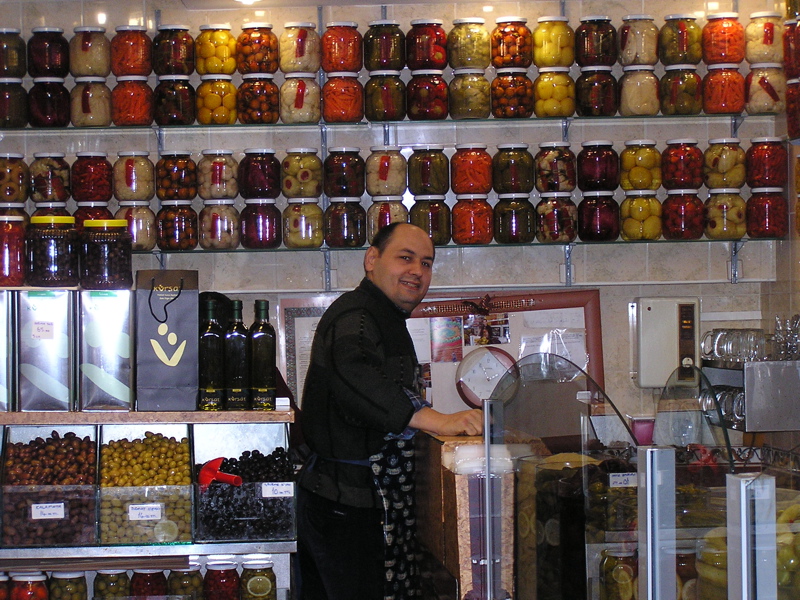
After a visit to the Pera Art Museum, my friend Cristi and I were walking up Istaklal (in the city) when we heard a demonstration ahead—something we’ve been warned to avoid. We backtracked and walked around the area , discovering a charming pickle shop en route.
 In spite of our fascinating detour, we ended up in the middle of it anyway, since it had moved up the street. It was a peaceful but noisy demonstration by the CHP, the left-wing People’s Republican Party. There’s a movement in this country to promote religious (Isamic) governance rather than the current secular system, and it’s disturbing to many who believe in Ataturk’s dream (including the CHP and me). Turkey’s secular democracy holds a strong position as a bridge between the Western and Arab worlds, and many Turkish citizens fear its secularism may be at risk. In May the parliament will select a new president, and a likely candidate is Recep Tayyip Erdogan, the present prime minister. He’s a religious conservative whose appointment as president would assure a move toward Islamic politicalism. Hence, a demonstration.
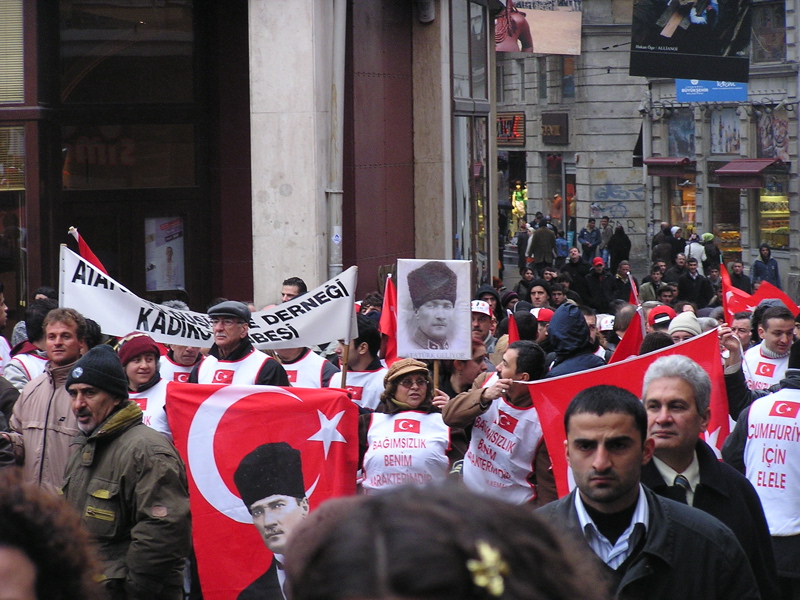
I hope the parliament hears these voices, as it seems giving more power to the religious right would be problematic. Turkey had a painful coup in 1980, and the military had to intervene. At the inception of the Turkish Republic, Mustafa Kemal Ataturk set up the military as a separate entity to assure the secularism of the government, and if secularism is at risk, the military will intervene once again.
I pray that it’s not necessary.
Peace.
Istanbul Meanderings
Life is settling down a bit, though I just made my sixth trek to Termal, my favorite little hot springs community on the other side of the Sea of Marmara. We were a small group, but we had a great time shopping, scrubbing, soaking, swimming, eating, drinking, laughing, and hiking, even in a light rain. A good time was had by all.
–
I’ve decided to share some smaller things from my life here–things I never think to write, things that tickle my fancy or get my goat.
–
Here goes…
–
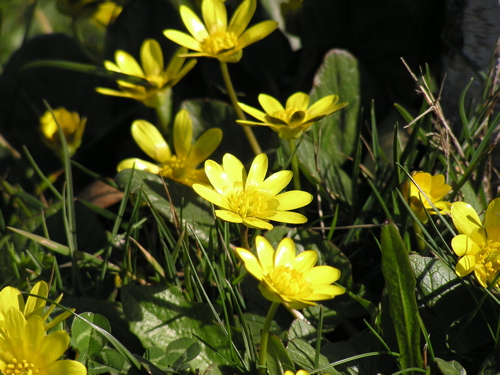
Our non-winter well behind us, we already have about twenty types of wildflowers on campus, and I have no wildflower book to help identify them. Every daytime walk is an adventure if you keep your eyes on the ground–some of these flowers are wee things. The roses have bloomed here all winter.
–
We took a trip to a new nearby sports and fitness facility last week, where they plied us with cocktails and hors d’oeuvres. Unfortunately, their fees were too steep. I was a little suspicious when I saw that they sell every brand of cigarettes at the front desk. Welcome to Turkey. (Did I complain about the cocktails?)
–
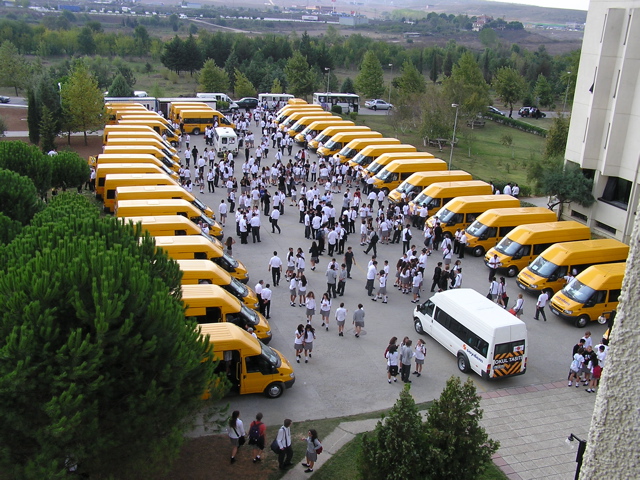
We have a new “No teacher left behind” policy with our service busses, which is a bit confusing, since the mysterious left-behind person hadn’t signed up to ride the bus in the first place. Anyway, it means the bus schedules will be STRICTLY adhered to in case some errant teacher didn’t sign up but wants to partake. Departure times will no longer be observed Turkish fashion (when it seems reasonable), but more in the German mode (ON THE DOT!) Whatever!
–
The sun is up for my morning walk with Libby and Leah–and Toby, lately. It’s a joy to watch the sky painted brilliant shades of rose to peach. Spring is on its way! We’ll lose a bit of light when daylight savings time comes, but I’m hoping my days of departing in darkness are behind me. Libby agrees.
–
My little twin buddies, Katrina and Carmen, helped me walk the doggie-dogs lastThursday after school, and we lost one. Two, actually: first a dog, then an almost-five-year-old. I’m some babysitter, eh? Katrina can’t resist unhooking the leash, and little did she know that Toby would hotfoot it home. Oops! I was buying myself a beer to sip on while the girls played with the beasties, when I spotted Toby running by dragging his leash, followed by a panicked Katrina. I ran around the building but couldn’t find either of them. Double oops. It all worked out though; Serge and Sue (Mom and Dad) had heard the ruckus and were most understanding. They joined me as I finished that beer.
–
Another campus couple, David and Elizabeth, added a fourth member to their family last week: Laura Terassa Deniz Cansu Lemoigne. All I can say is, someone is going to be sorry when she has to write out her name for kindergarten! Of course, chances are she’ll be a genius.
–
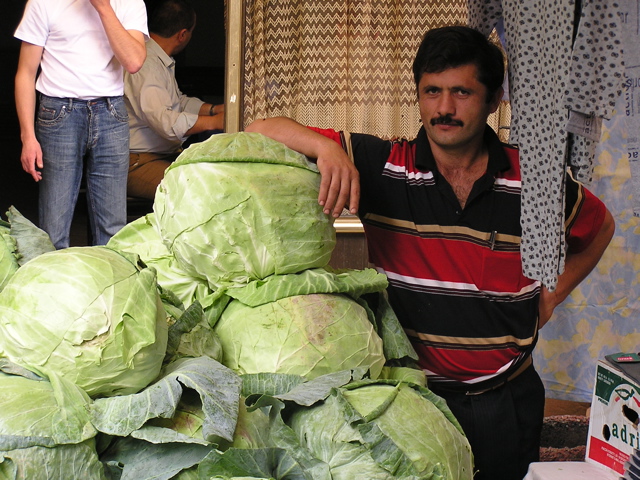
When I go to the markets in Turkey, I’m amazed at how eager people are to have their pictures taken. I used to always ask, but I’ve learned that they don’t mind. I wish my camera were quicker, but it’s delightful to have people clambering to be included in the photo. Even the shyest women beam at my lens with toothless grins. If they seem uncertain, I just say, “Iyi gunler” (Good day), and they smile. Turks are always tickled to hear foreigners attempt their language.
–
Though the Turkish people are easily the kindest in the world, their personalities change dramatically when they’re on the highway or standing in line (and I use the terms “standing” and “line” loosely) for a ferry or bus. They are masters at “butting”, both figuratively and literally. Their generosity disappears in any race for entry or exit. Sometimes I miss “Minnesota Nice”.
–
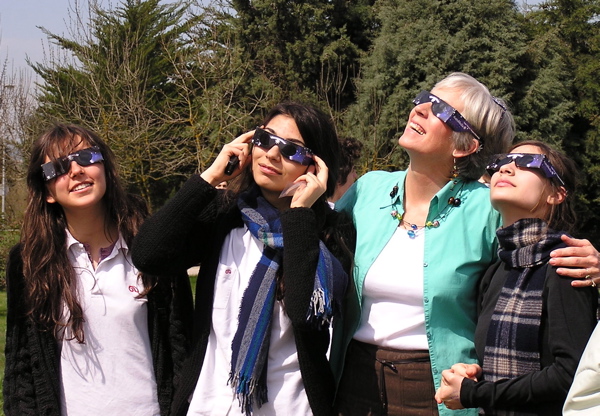
My seniors will be done with school on April 6th. Unbelievable. They get the last two months off school to study for their big college entrance exam, the OSS. Turkey has a LOT of young people and not enough slots in their universities, so only about 15 percent of them will qualify. It’s a big deal here, the highest of high stakes exams. Most seniors have OSS workbooks in their laps during class, and it drives us all nuts. I love my seniors, and I’m sorry to see them so stressed. It’s absolute cruelty to give them homework, but sometimes we have to.
–
The good news about that is that I’ll only have to teach 14 periods a week for the last two months (that’s down from 20). My friend David will only have 7 periods–poor guy! He’ll be so BORED! 🙂
–
I’m thinking about retirement a lot these days–freedom is only months away. I can’t believe I’m that old, though I’m always reminded when I look in the mirror. Hi, Mom.
So…that’s my weekly meander. Have a good one!
Grading in Turkey
IT DEFIES LOGIC
I never understood why we couldn’t chew gum in school. I thought my parents were crazy for forbidding me to ride with a driver until he or she had been driving for a year. I’ve never thought it made sense for poor people to pay taxes that get refunded anyway. Life is full of those irritating mysteries, and we just learn to live with them.
Turkish Ministry of Education rules are like that. Ataturk, the Father of Modern Turkey, mandated education for all, and the Ministry of Education was established to make sure that happened in a thorough and egalitarian way. Good plan.
Of course, I’ve had to adjust from one educational system to another, and I admit that our Western methods often deserve the criticism that we aren’t exacting enough or that we put too much energy into making education fun. Point taken. Perhaps that’s why the U.S. is now putting so much energy into establishing graduation standards; we must assure that our graduates are both literate and knowledgeable.
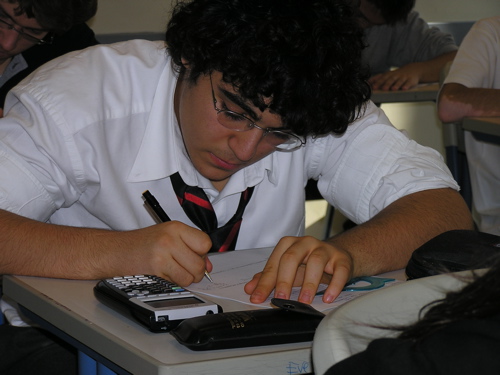
In Turkish education, standardization is not only required, it dominates every facet of education. Students take a pre-determined set of subjects, with a heavy dose of science and math. Turkish students are eons ahead of their American peers in science and math, though much of their learning is rote rather than theoretical. In the Western system students work with the theories behind equations, while Turkish students tend to memorize the equations. These kids are masters of memorization. If I give my students a sample essay to review before an exam, many of them will memorize the entire essay and adapt it to the prompt on their exam. Only in Turkey!
I guess what I mostly want to say is that Turkish students work their tails off—at least many of them. (Of course, we have lazy kids here, too.) Education is highly valued, though it’s more about grades than learning.
And therein lies the conundrum. Grades.
In a country that demands excellence from its students, the grading system defies logic.
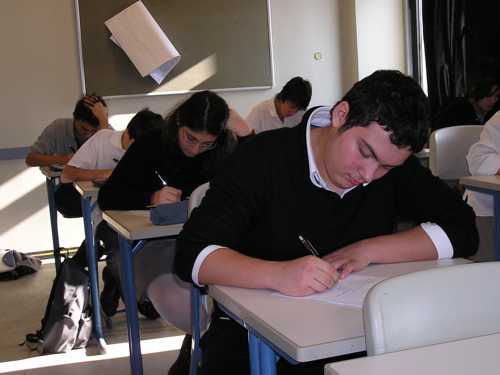
Let me explain. In the U.S., we grade on a percentage system, usually with 60 percent required to pass, and ten percent each for A through D. Turkey grades on a percentage system as well, but with a passing grade of 45%. (Eat your hearts out, American teens!)
Of course, teachers grade tougher in Turkey, so I think a 45% might be close to a U.S. 60%, though I can’t say that for certain. Instead of giving letter grades, the Turkish system is numeric:
85-100%=5
70-84%=4
55-69%=3
45-54%=2
25-44%=1 (failing)
0-24%=0 (failing)
Here’s the rub, though. A student’s final grade is not the average of the two semester percentages–it’s the average of the two numeric grades. For instance, if a student gets a 4 (as low as 70%) one term and a 5 (as low as 85%) the second term, the average is 4.5, which is rounded up to a 5, in spite of the fact that this student actually has a year average of 77.5, a mid-four.
In reviewing this system, I’ve computed that it’s possible to get a passing grade in Turkey with a course average of 27.5%. If a student did nothing one term (it happens) earning 0% (a 0 grade), then kicked in to earn a 55% the next term (a 3), the 0 and the 3 are averaged to make a 1.5, which is rounded up to a 2, a passing grade. This student has only earned 27.5% overall for the year (nearly 18% below a passing 45%), yet he/she passes. I stand amazed.
That’s not all.
If that student didn’t quite make a 55% grade the second semester, he could take an exam the following August, a “grade raising exam”, to pass the course. Any student can opt to take an exam to change their grade, and this 90-minute exam can override an entire year’s course grade. What that means is that you could fail a year with zero points, yet pass a course through the exam. There are students who bank on this. Some don’t pass the test, which puts them in deep doo-doo with baba and anne (dad and mom).
As you can see, this system defies logic. Grades are paramount in this country, and every step is taken to enable students to be successful. Cheating is rampant, and it’s the rare student who resists the temptation. I value honesty highly, so this has been a struggle for me. (I admit that I’ve lied in my life, but I can honestly say that I never cheated in school–my students don’t believe me.)
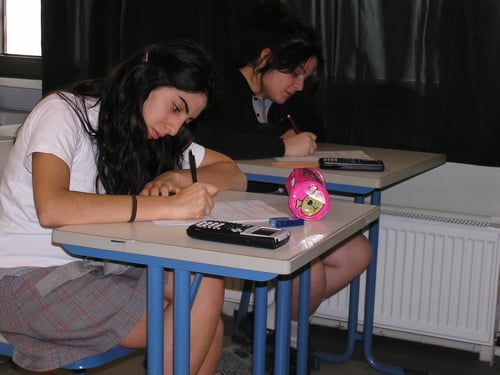
Law suits are common here, too, not over teacher behavior, but over what is seen as unfair grading practice. That’s why it’s so crucial for teachers to moderate exam grades so that grading is equalized across the entire grade.
Students here are constantly computing their averages, and at the end of the term, they will openly announce the exact grade they need on their exam or class grade to meet their goal. “I need a 73 on this exam, Ms. Mershon,” expecting me to take that into consideration as I grade it. One student asked me how much it would cost to “buy” a few percentage points. I grinned and said, “Oh, a million dollars or so.” I think he was serious. I wasn’t.
I love Turkey and I enjoy teaching here, but I can’t help feeling professionally compromised by their grading system. I imagine all the teachers do. We just hope our doctors didn’t squeak through on grade-raising exams.
AND THEN THERE WAS JORDAN
It wasn’t easy getting to Jordan; the winds were high, and the ferry delayed. In fact, our ferry from Nuweiba, Egypt, to Aqaba, Jordan, sat out on the Red sea overnight. The only thing worse than waiting, waiting, waiting must have been sitting out on that ship—seasick, seasick, seasick.
We got to the ferry landing about ten o’clock Monday morning and waited all day. The back window of our van exploded (high winds?), and Mollie, Allana, and Leslie treated us to a hilarious sock-puppet show in the empty back window. “Put a sock in it!” “Do they let Red Sox into Jordan?”, “Once again, you’ve put your foot in your mouth!” What joy to travel with young people.
We finally gave up waiting for the ferry at 6 PM and found ourselves rooms at a quaint beachside hotel where they treated us like royalty. After a delicious Egyptian dinner, our host encouraged us to check out the beach (VERY windy), where we discovered a thatched-roof, adobe-walled disco that became our home for the night.
Our waiter spun the tunes and played the lights, while the owner pulled out water pipes. The chef grilled corn and sweet potatoes and brought out spiced nut and bean snacks. We danced off our huge dinner, then laughed ourselves silly at the cross-dresser-belly-dancer. Leslie raved, “I had a crush on him before his act, but now I’m CRAZY about him!” Too funny!
We finally boarded the ferry the next day after waiting in the station for three hours. We waited two more on board as they loaded, took three hours crossing, waited another hour to disembark, and stood yet another at customs—10 hours! Passport distribution in Aqaba was a joke. A guard read off passport names one-by-one as he held them aloft for anyone to grab. ARAUGHHH!!!! One of our travel companions quipped, “They couldn’t make this system less efficient if they tried!” Too true.
On Wednesday morning we finally made our way to Wadi Rum, a desert preserve in southern Jordan. It was BEAUTIFUL! We rode on benches in the bed of a 4-wheel-drive Toyota pickup, soaking in the moonscape terrain. We’d been outfitted in Arab red-and-white scarves, protection from sun, wind, sand, and cold as we raced across the sands.
A Bedouin rode up and offered us rides on his camel. (Mere coincidence?) We took a break to indulge. That was when I learned that our driver, Abu Kamel, had two wives. According to our guide, “He drinks camel milk, which gives him too much ‘energy’ for one wife.” Hmmm…
We explored the steep dunes barefoot, racing down and trudging back up. We drank Bedouin tea and relaxed with a HUGE outdoor lunch of countless dishes, my favorite a grilled eggplant salad. My goodness, it was GOOD! For about ten dollars we ate like kings.
There were two other things I loved in Jordan. The first was Petra, which must be seen to be believed. The most impressive scenes of Indiana Jones and the Last Crusade were filmed there, and I felt like an ancient explorer stepping into a secret world. Petra is a hidden valley in southwestern Jordan with spectacular classical facades carved right into the valley’s sandstone cliffs (by the Nabateans and the Greeks, for the most part). It’s spectacular, especially after hiking through the Siq, a narrow rock gorge (1.2 K long and 3 to 12 meters wide) that serves as the main entrance to the ancient city. Our guide, Mahmud, pointed out niches and carvings as we strolled down the Siq, but I’ll never forget my amazement as we viewed the impressive 3-story treasury building through the slit of rock ahead. Amazing!
We were awed at the many structures carved from the rock walls of Petra, but the most fascinating part of the day was our guide. Mahmud had grown up a Bedouin shepherd, shoeless and with one set of clothes. He shared many stories of growing up in a Petra cave, moving to the desert for the summer. His father had chosen him, the middle of nine children, to attend school in the winter. Mahmud hadn’t wanted to leave his world of goats and camels, but his father urged him to travel the 15 K to school, each morning saying, “just one more day.” Day after day, Mahmud hiked up the Siq and found a ride to school. Obviously a very bright man, he had been singled out by King Hussein as one of the top students in Jordan. He told of his anxious trip to Amman to meet the king, who paid for his high school education in England and university in Amman. “I was the only one of my siblings able to get an education,” he told us apologetically. “We all still struggle with the cultural shifts. My mother still lives in a tent, though the government has built her a house. When I’m feeling stressed, I visit her and find great peace in the smells of my childhood,” he said. Mahmud now has a wife and three children, and he feels stress about providing for them, just as his parents did.
So many stories, and so little space to share them.
Our last adventure was an afternoon at the Dead Sea. My goodness, if you ever wondered what it’s like to be a cork, go to the Dead Sea. It’s the most dense, most saline water in the world. While most oceans have 3.5% salinity, the Dead Sea has 30%. A jump into the Dead Sea evokes immediate hysterics, let me tell you. I never imagined it could be such a hoot to lie on TOP of the water, rolling like a bobble toy. You can lie in the water with arms and legs up in the air and STILL float! We met a film crew slathering themselves with Dead Sea mud along the shore, so of course we joined them. It was a blast, and Allana agreed to being buried in the heavy black stuff. (Of course, our skin is now beautiful.) People pay thousands of dollars for the same treatment, and we got it for free, including laughter therapy.
Well, all good things must come to and end, and we eventually left the water (and mud), said goodbye to Jordan, and flew back home to Istanbul.
I do love this life!
FROM THE BEACH TO MOUNT SINAI
Ask me why I never realized that Mount Sinai was in Egypt. Never a great geographic or Biblical scholar, I still could have figured it out. I knew that Mount Sinai was the site of the burning bush where Moses received the tablets of the ten commandments as he led his people out of Egypt. Sinai peninsula—yup!
Our well-loved guide Moustafa met us at the Sharm el Sheikh ferry station and brought us to Dahab, a popular Red Sea diving community. We stayed in a luxurious beachside hotel, where we took full advantage of the pristine beaches and sunshine. We’d be leaving to climb Mount Sinai at 2:00 AM so we could experience the night sky and the spectacular Sinai sunrise.
Or not.
We climbed into our van bleary-eyed, shocked that we had our own private security guard, Khalef. He was a clean cut young man sporting a formal suit, and we didn’t realize until two days later that his jacket concealed a considerable weapon. He charmed us through five (count them) security roadblocks, one where we had to show our passports. Mount Sinai is well-protected.
Just our luck, the weather had turned cold, and St. Catherine’s Monastery at the foot of the mountain would be closed (Sunday), so there would be few hikers on a trek usually made by hundreds.
When we were told that the peak was snowy, my warm-weather friend Terri announced, “I have no burning desire to do this climb,” and returned to the van to sleep for the six hours we’d be gone.
The rest of us donned our warmies and started up the wide, dark, rocky path. Our Bedoin guide, Mahmud, often climbs the mountain two or three times a day (6 K each way to the 7,498 foot summit) . We smelled camels and were offered camel rides from the darkness, but we refused.
It took us a while to get used to the slope, and breathing was hard. The cold was shocking, too–about five degrees Fahrenheit with a major wind chill. Quite a change from lounging on the beach that afternoon. We were FREEZING!
Moustafa had never climed Mount Sinai and he’d never seen snow, so when spots of white appeared along the path, he was excited. Within an hour of climbing our shoes were soggy from the ever-increasing snow.
Rock hut refreshment stops are scattered along the path, but most of them were closed. About halfway up the mountain, Mahmud led us into a hut and lit a lamp. Lo and behold, there was a young Bedoin man curled up under blankets in the corner of what seemed like a little corner store, complete with a gas burner. Moustafa treated us to coffee, tea, and candy bars while we chatted with our guide and his friend.
Once again warm, we braced ourselves to continue our trek, which grew steeper, icier, and more difficult. Determined to get to the top, stars or no, we picked our way carefully up the mountainside, avoiding icy spots. We had flashlights, and the moon cast a pale glow through the fog and snow.
I thought we had 149 rock steps to climb near the summit, so you can imagine my dismay when I learned there were 749. Mahmud called them the Steps of Repentance, and believe me, I repented every stupid thing I’ve ever said or done. That’s a LOT of steps (and I’ve done a LOT of stupid things).
Actually, there’s another route up Mount Sinai, 3750 steps straight up the mountain, built by a monk as repentance for his transgressions, (which must have been considerable). Imagine how much repenting you’d do on THOSE steps!
Along the way we came across a small group trying to revive a man who had passed out from the altitude. THAT was a bit unsettling, but our guide seemed unruffled, so we continued. We saw the man later, helping a woman as she slipped down the path. Unfortunately, a number of hikers were underdressed and wearing slick (though fashionable) footwear. Oops!
In any case, we finally made it to the top, where there’s a small mosque (12th century) and the Chapel of the Holy Trinity. A group of young Egyptians were huddled under blankets on the lee side of the chapel, and they invited me to join them. They enjoyed practicing their English, and I found them very entertaining.
The sun rose while we were on Mount Sinai, the only sign a hint of light through the enveloping clouds. We shivered at the summit for about 20 minutes, then headed back down. Sun peeked through the clouds a few times, and the girls attacked Moustafa with snowballs. He was a fast learner and insists that he won in spite of getting snow down his neck. It’s a guy thing.
When we finally got to the bottom, Moustafa negotiated a private tour of the St. Catherine’s Monastery to see the reputed Burning Bush, a huge weeping rosebush. The monastery houses a Christian church, a Jewish synagogue, and a Muslim Mosque. All three faiths share the Old Testament, and at least in that one monastery, they cohabit peacefully.
Would that it happened everywhere!
Exploring the Nile
I’ve just spent ten days in Egypt, exploring Cairo, the Nile River Valley
(on a cruise ship), and the Sinai peninsula, which was my favorite.
Actually, i’ve had a lot of favorite experiences. It goes without saying
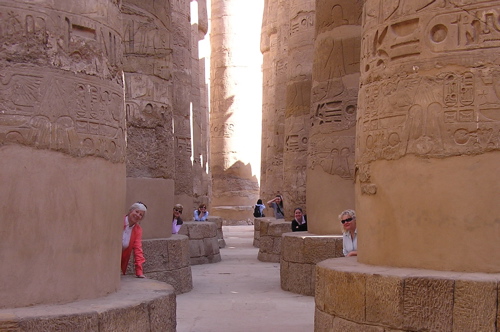
that 4000 years’ worth of pyramids, tombs, and temples are awe-inspiring. We
even visited the Temple of Karnak, which should bring smiles to anyone old
enough to remember Johnny Carson.
Anyway,one of our most interesting experiences was a felucca ride on the
Nile. A felucca is a fairly primitive sailboat used along the Nile.
It has one sail that hangs at a bit of a slant from its single mast, much
like a sailfish sail, and one man runs the boat, which can hold as many as
12 or 14 people. Anyway, we had two delightful felucca rides in Aswan (which
is LOVELY), so when we had a free afternoon in Luxor, we decided to hire a
felucca on our own. We did that before checking the wind. DUH!
My friend Allana negotiated a great price–the equivalent of 9 dollars for a
two-hour sail to Banana Island, exactly half of what the young captain
requested. Of course, he initially refused the price, but when we walked
away, he agreed to it. Business was slow.
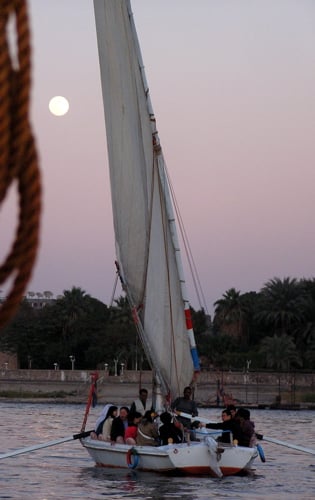
Captain Fox hoisted the sail, but he had to row out of the dock using hand-
crafted oars made from 2 by 4 lumber, painted. They were pretty worthless,
particularly for a 20-foot long and 8-foot wide boat. He assured us that he
would get out onto the river and catch the wind. What wind? Our tour guide,
Aiman moved in to row with him, and they were both working hard. Captain Fox
removed his sweater, then his shirt. He kept a t-shirt on, though. (I never
saw an Egyptian man shirtless.) They rowed us all the way across the Nile to
a group of people who were standing by some motorboat ferries, so we felt
confident that we’d get a tow. Nope.
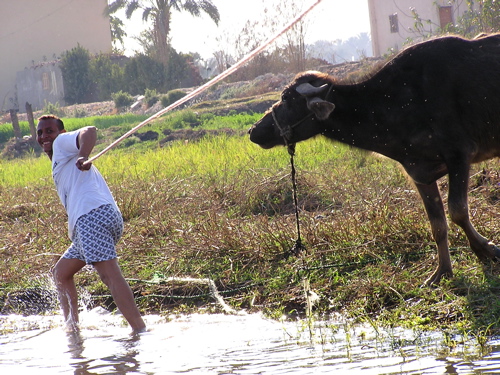
Captain Fox removed his jeans (He had patterned boxers, which were quite nice),
hopped off the boat, and began TOWING us along the shore. We felt terrible.
it had been well over 45 minutes, and we begged him to give up and we’d help
row back. No dice. he was pulling toward a water buffalo, which we thought
might be enlisted to service the boat. he pulled on by it, sloshing through
the muddy riverbank, sometimes up on the prickly grass banks. He pulled us
by a few camels who looked at us curiously, but Captain Fox continued. He
was determined to get his fee–and to get us to the promised Banana island.
Allana reminded us that he had been well aware that there was no wind, and
that he knew what he’d been getting into. True, but it didn’t make us feel
much better.
He enlisted Aiman (our guide) to wave a white scarf as boats came by, which
became quite a production. Who could resist?
A tugboat finally came by towing two other feluccas, and they sidled up to
pick up a tow rope. There we were, three sailboats lined up behind a
tugboat. ‘The Nile Felucca Choo-Choo” Dee dubbed it. It was pretty
hilarious.
All good things come to an end, though, and the tow rope came
untied, so once again we were stranded in the middle of the river. Captain
Fox let us ‘woman’ the oars, which was fun–we rowed back to shore, and our
intrepid hero jumped back into the water and manned a new tow rope.
We finally arrived at Banana Island, after a farmer chewed out our Captain
for treading on his land. I think he wanted money or something. Captain Fox
pulled his jeans back on and escorted us up a path away from the water.
There we were treated to a serviceable bathroom, a banana plantation tour,
and a few bunches of delicious (though tiny) bananas. When we got back to
the felucca, Captain Fox scrubbed down the decks and pulled out a little
stove to brew us some tea. Nile water tea? Though we weren’t sure about
drinking it, we were all too polite to refuse. he had a little table on
board for serving, and he spooned in sugar from a china sugar bowl.
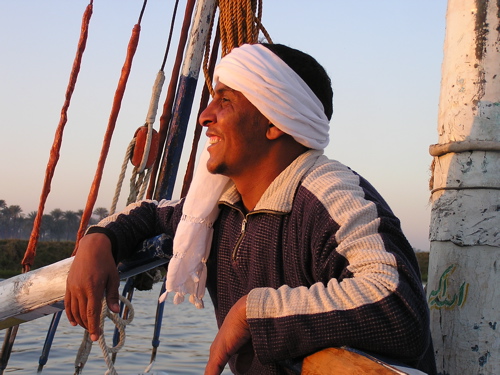
WE assumed we’d be towed back to the dock, especially since Captain Fox took
endless time cleaning up, tying up the sail, putting his shirt back on, etc.
We were pretty astonished when he pulled out the oars again.
No one offered to tow us, and we all took turns rowing the boat back across
the nile. Fortunately, this trip was downstream, so it wasn’t as strenuous.
There was no towing, just rowing.
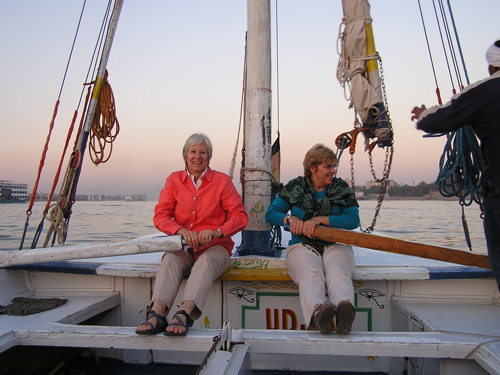 We watched the sun set over the Nile,
laughed as we raced to escape the path of an oncoming cruise ship, and bid
our friendly captain a fond farewell. of course we gave him a big tip. A
HUGE tip. He had known exactly what he was doing. We negotiated a great bargain,
we had a delightful adventure, and he was well paid. Everyone was happy.
Istanbul from the inside—Hrant Dink & Musa Başaran
I spent the weekend in the city with my friend, Jamilah, and we experienced the best and the worst of Istanbul from the inside. After a relaxing few hours knitting in a coffee shop (I had promised Jamilah a knitting lesson), we trekked off to meet my Turkish friend Bilge for dinner. She met us with the horrifying news that an outspoken and well-loved Turkish-Armenian journalist had been murdered outside his office just hours before. “This is terrible news for Turkey,” Bilge said with tears brimming in her eyes. “Murder is a terrible thing, but this one is bad for our whole country.”
All weekend we discussed Hrant Dink’s murder with both Turks and ex-pats, and it’s clear that everyone is concerned. At a time when Turkey is clearly the most open and democratic country of the Muslim world, this casts a dark shadow over the country that Dink was attempting to unite. Turkey’s constitution has a clause against “insulting Turkishness” which has brought many outspoken writers to the court system, including Hrant Dink and Orhan Pamuk, although recent court decisions have relaxed this rule in favor of freedom of speech. Now a rabid young nationalist has taken the law into his own hands to quiet Dink’s comments with bullets. This is unconscionable. In a world where most people want peace, what is happening? Where has tolerance gone?
Enough of that. On to the brighter side of our weekend.
After a sunny Turkish breakfast in our hotel’s terrace restaurant on Saturday, Jamilah and I headed off to meet Tania Chandler. She had promised us a visit to her artist/weaver friend, Musa Başaran. Tania goes to weave a few times a week in his studio, a building overlooking the Marmara just blocks from the Blue Mosque. Tania rang the buzzer and pushed open the heavy cast-iron door into a weaving wonderland.
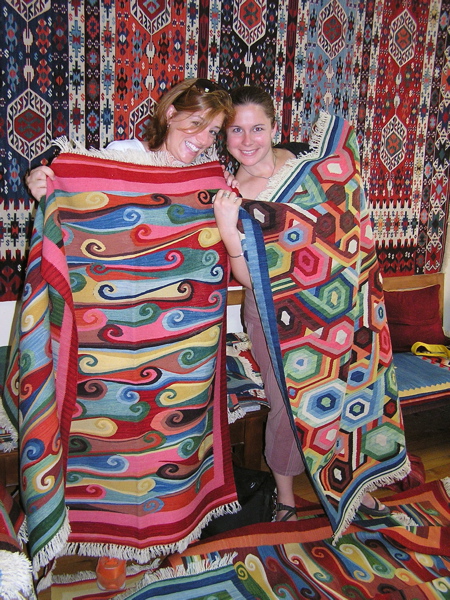
LESLIE AND MOLLIE MODEL MUSA’S KILIMS
Musa greeted us warmly with, “Come in and take off your clothes.” Our astonished laughter revealed his mistake. Blushing and laughing along with us, he proffered the usual cup of tea.
I was entranced with the kilims hanging in his studio. His designs are both traditional and modern, but I was particularly taken with Ottoman Tulips embroidered in silk on textured wool backgrounds. Musa’s colors are vibrant, and his designs captivating. I’d landed in kilim heaven.
He spent an hour sharing the vast array of kilims in his present stock, finishing, of course, with the silks. Silk is the ultimate in carpeting.
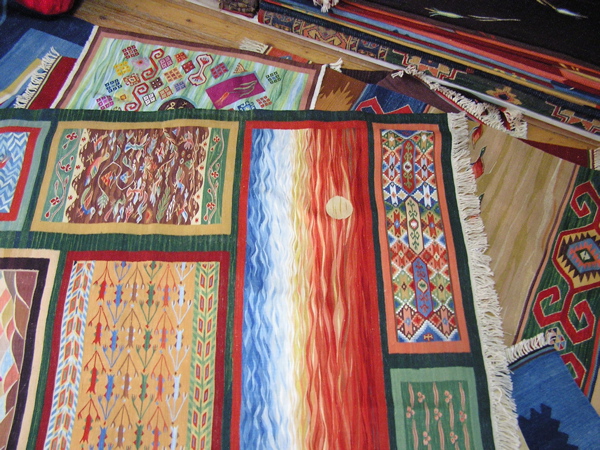
MUSA’S MAGNIFICENT SILKS
After sharing his work, Musa explained his process. He creates designs in his head, then weaves them himself. He dyes all his wool with natural dyes in stainless-steel vats, then stores it in a basement room, a weaver’s dream. It reminded me a bit of the wall in my yarn shop where I displayed hundreds of shades of Persian needlepoint wool. “We can’t make so many different colors with natural dyes,” he told me, indicating the 20-30 bags of dyed wool yarns. “These are all the colors I can create.”
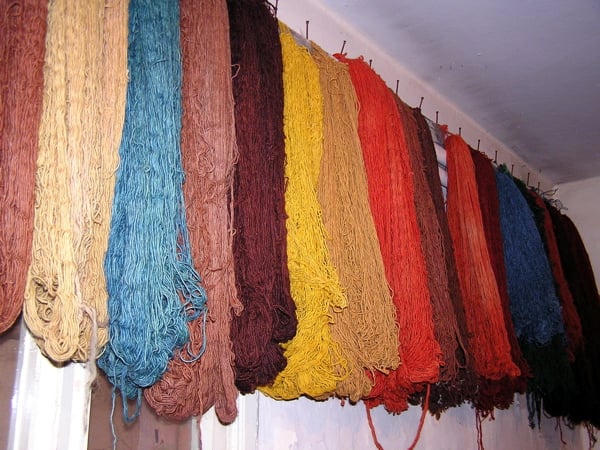
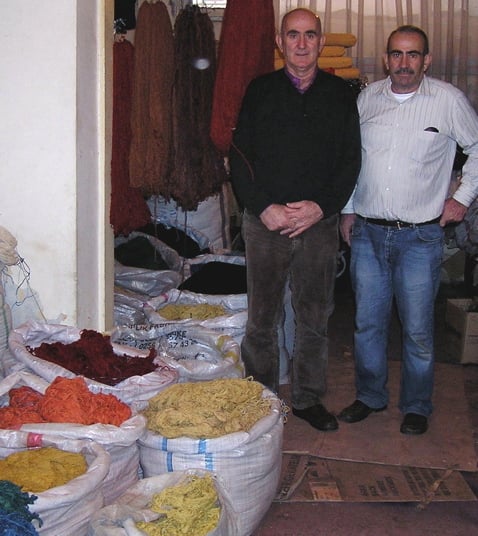
MUSA’S WOOL PALLETE MUSA AND HIS BROTHER HAYDAR POSE NEAR BAGS OF DYED WOOL
One feature of his weaving that fascinated me was a wavy techique that adds depth and texture to a weaving. Different shades of the same hue are woven irregularly through the weft, creating a stunning wave-like effect. It can be done subtly with very close shades, or in contrasting colors and shades for more drama. In any case, it’s lovely.
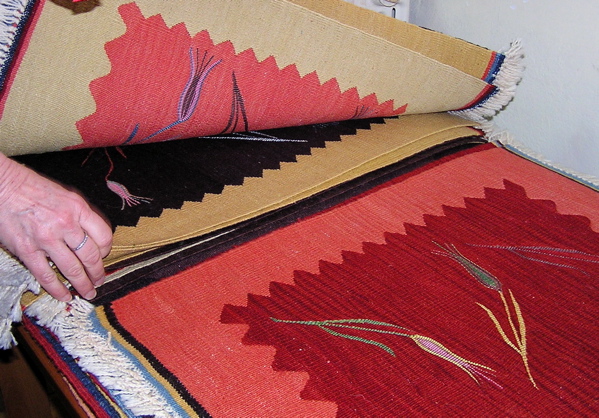
TIPTOE THROUGH THE TULIPS–NOTE THE AUBRAGE TEXTURES
Musa shares his designs with rural village women, who weave copies of the patterns, some with slight variations. It takes from a few weeks to six months for a woman to weave a kilim (depending on the size and pattern), then Musa pays for and transports them back to his workshop. The next steps are to burn them (yes, burn), clean them, and press them. Musa and his brother Haydar comb out the fringe, then carry the heavy kilims up to the fifth floor terrace, where they use a blow torch to burn loose fibers and straw from the surface of the kilims. I must say, I was taken with the terrace’s commanding view of the Marmara, a perk for hauling those kilims up that long spiral staircase. We could see all the way across to Yalova under the brilliant azure sky. My goodness, this winter has been like spring. Last year at this time we were buried in a blizzard.
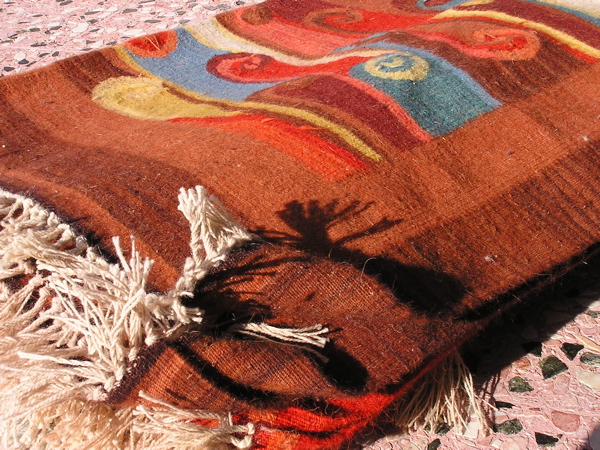
A RUG READY FOR TORCHING OFF THE “CHAFF”
Back to work.
After burning, Musa’s kilims are hauled back down the winding marble staircase and sent out to be cleaned and pressed before they’re ready for sale. Musa sells at wholesale prices from his studio and does occasional rug shows; his clients come to him by word of mouth. “I don’t sell to carpet shops,” he says. He doesn’t need to. Musa’s doing just fine. I was surprised to learn that he started his career as a corporate economist, but he prefers this creative life, which gives him precious time with his family.
I’m impressed.