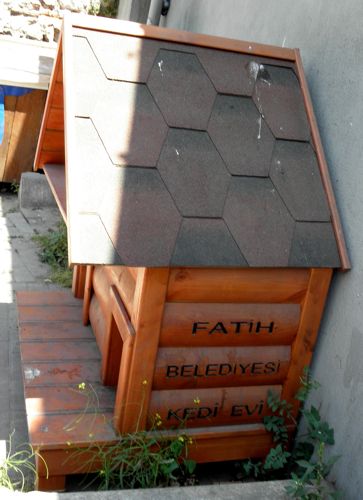
Ann Marie’s Istanbul

experiences in and around Turkey

Tulips abound in Istanbul

Some friends told me last weekend that I should find my way up to Emirgan to see the spring tulips in bloom—incredible, they said. Spectacular! Unforgettable!

Yup, it was.

Of course, getting there was an adventure in itself. After waiting all morning for my laundry (wash only, as the dryer is hardly better than piling wet clothes in the bathtub and waving a hair dryer at them), I draped sheets, clothes, and sundries around my apartment, then headed out to enjoy the sunshine and 70-degree day. Ah, heaven!

Libby is always game for a walk, though I didn’t warn her this would be a long one. (Not that she’d have minded.) We headed down the hill (puppy poop stop), through the security gate (puppy pee stop), and off to the north along the glittering Bosphorus. Our walk, as usual, was punctuated by curious street dogs, quayside fishermen, simit sellers, a balloon man, and countless Sunday strollers. Sunday is “Pazar” here—it means what it sounds like: bazaar. The traffic was “çok kalıbalık”—very congested; we walked faster than the cars.
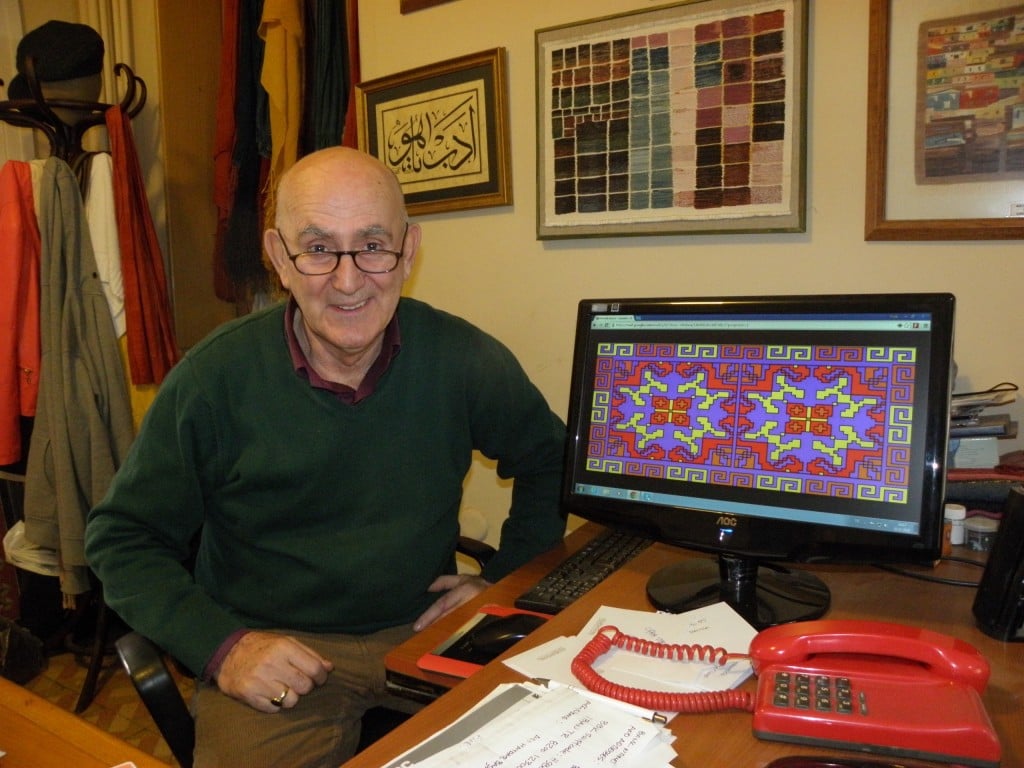
p3160121.jpg

After an hour we passed the Rumeli Castle, which I have to visit again, asI’ve lost all my photos in a computer meltdown (actually, a laptop wine-down).

After about two hours of walking, we stopped for a breather, a cup of tea and “tost”, sort of a panini-style grilled cheese, in an open street tea garden in Emirgan. The wide cobbled street stretched up from the Bosphorus, filled with tables, chairs, and happy Turks. I was the only “yabancı” (foreigner) in the whole area, which was nice. I chatted with some older men at the next table who were tickled that I knew some Turkish, and of course they loved Libby. They gave me directions to the park up the hill, and soon my little black buddy and I trekked off.

p3160120.jpg

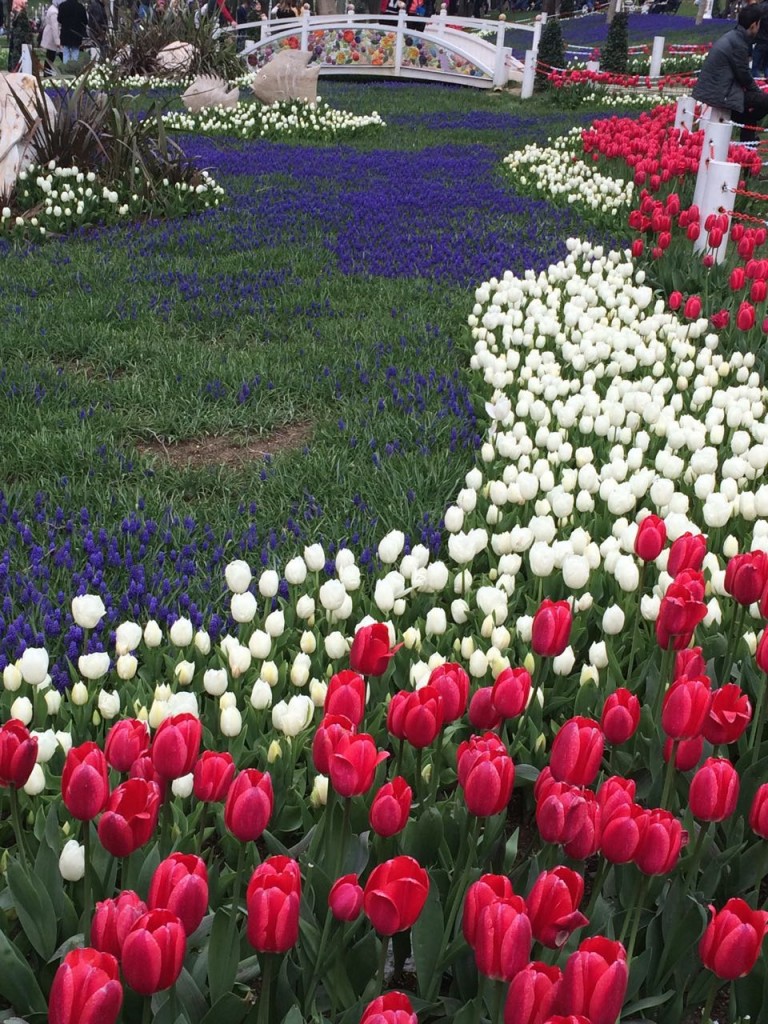
The park was filled with plots of tulips, daffodils, hyacinths, and other blossoms unfamiliar to me, all in superb displays.

p3160178.jpg

I recently learned that tulips originally came from Turkey. (News to me!) They were cultivated as early as 1000 A.D., and they became a symbol for the Ottoman Empire during the 1500’s when Sultan Süleyman popularized them. The bulbs (seeds?) were exported to Europe later that century, though it wasn’t until the 1700’s that tulips became a symbol of wealth and prestige.

p3160190.jpg

The first tulip festivals are charmingly depicted on a gardener’s web site, Tesselaar:

“It was during the early 1700’s that the Turks began what was probably the first of the Tulip Festivals…held at night during a full moon. Hundreds of exquisite vases were filled with the most breath-taking Tulips, crystal lanterns were used to cast an enchanting light over the gardens whilst aviaries were filled with canaries and nightingales that sang for the guests. Romantically, all guests were required to wear colours which harmonised with the flowers!”*

It was during that era that the Dutch began experimenting with tulip bulbs, though the Turks outpaced them in their love of the blossoms for years to come.

p3160181.jpg
Well, our wanderings through the park at Emirgan were enchanting—that is, until my camera batteries wore out. After that, we succumbed to the attentions of countless children charmed by my little black Libby. It was darling. I never cease to be amazed that Turks either love dogs or they’re petrified of them; there’s no middle ground.

p3160204.jpg

Friends for Libby Lou

After four hours of walking, I decided a bus ride home would be in order. Unfortunately, bus drivers aren’t particularly enamored of dogs. Bummer! Plan B was the ferry, scheduled to arrive at Emirgan at 5:15. At 5:30, those of us waiting for the ferry realized that there was tiny red writing at the bottom of the ferry schedule: “begins April 15th” ARAUGHHH!!!
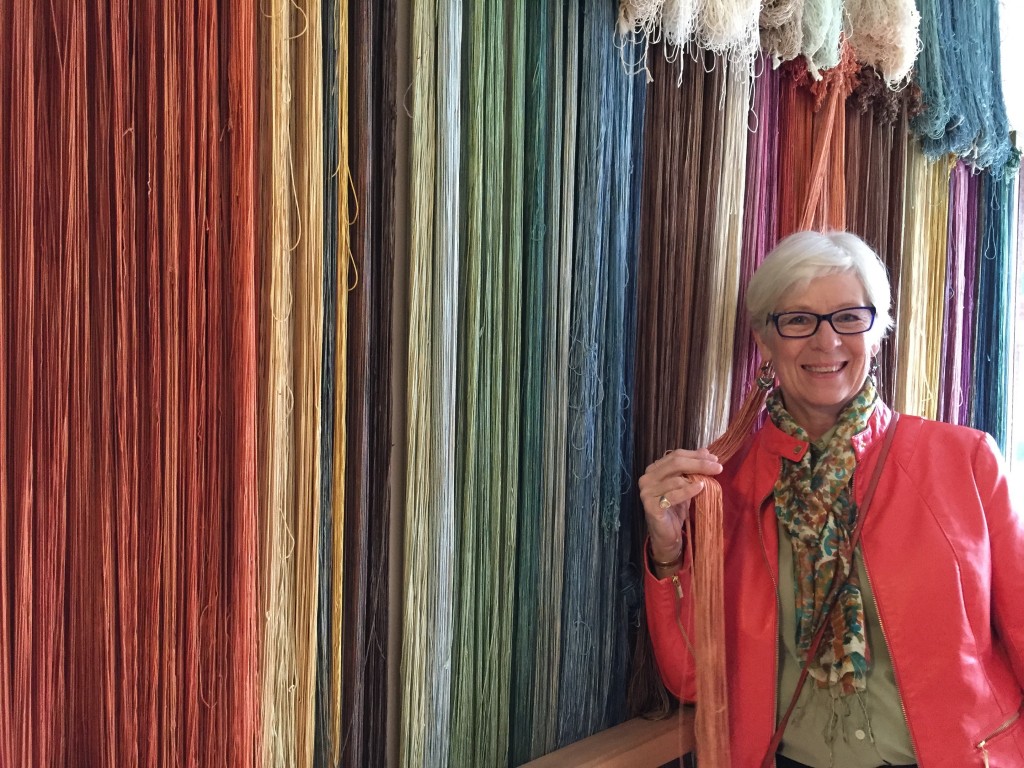
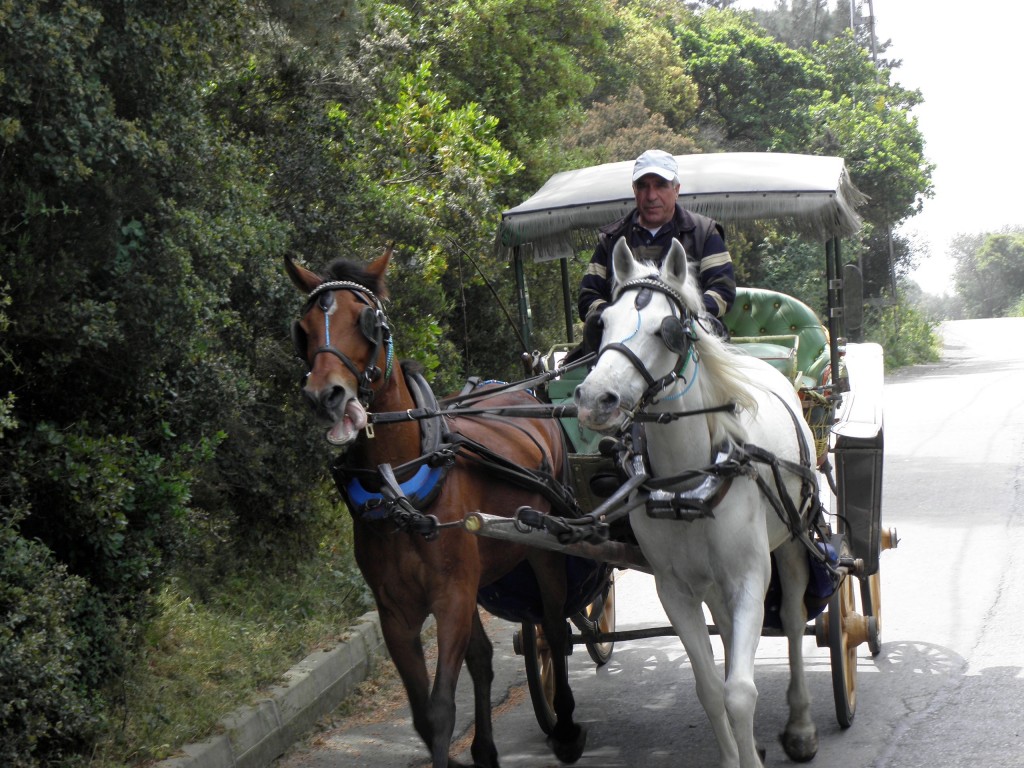
p3170223.jpg

Maybe a private boat?

So—Libby and I began the long trek home, me feeling a bit chilled and hoping to make it before dark, Libby no longer straining at her leash. After about a half hour I gave in to a taxi driver who honked as he approached. It felt GREAT to sit, though it was a slow trek, probably nearly as slow as walking. It was a treat to chat with the driver in my limited Turkish. He’d had a rough day, but he was happy to be down on the Bosphorus. So were we.

“Yavaş, yavaş” (slowly, slowly). My Turkish is improving!

- - - - - - -

*”The History of the Tulip.” Tesselaar gardening at its best. 20 Mar 2008
<http://www.tesselaar.net.au/flowerandgarden/thetulip.asp>.

Ortaköy—gem of the Bosphorus


Last weekend my quiet (NOT!) world on the Bosphorus was sparked by two delightful young women: my Australian niece Laura and her friend Anna, university exchange students in Vilnius, Lithuania. When I arrived home Friday they were happily ensconced in my apartment, thrilled to be in Istanbul. Needless to say, their visit was a whirlwind. Friday afternoon we caught a bus and tram to Sultanahmet. The bus was PACKED—sardines-ville. And HOT. (They don’t believe in opening windows here, but that’s another story.) What with an evening of restauranteurs, shopkeepers, and carpet sellers, the girls got a good dose of Turkish hospitality, making Anna a new convert to Turkey. Laura and I already love it.

p3080023.jpg

Anna and Laura Marie

After a huge dinner and a trek to see the Blue Mosque in its night-lit glory, we hopped back on the tram to head home, collapsing exhausted into our beds after the steep hike up the infamous Robert College hill, a fair trade-off for a great location.

Saturday the girls slept in, and after a late breakfast we headed off on foot (with Libby) to Ortaköy, one of the the Bosphorus’ glittering treasures. Just a half hour walk from my lojman, it offers an artisan’s market, tantalizing street foods, a striking many-windowed, water-side mosque, and a Bosphorus ferry. What else could we ask?

p3080088.jpg

One of many jewelry displays

After an hour browsing displays of jewelry, linens, clothing, and trinkets along the cobbled walkways, we relaxed with a cup of tea, watching children feed and chase pigeons on the cobbled square. The sun brightened every cranny of this quaint waterside village. Actually, Ortaköy feels much smaller than it is—with about 200,000 people stretching up the hill from the Bosphorus, it’s one of the most popular spots in Istanbul.

p3080020.jpg

Pigeon chasing can’t be beat!

After tea, we ambled over to where a Bosphorus ferry departs every 20 minutes. Ours was a smaller ferry, a quaint, friendly vessel for our one-hour water tour to the Rumeli Castle and back. Libby loved it (of course), and we all reveled in the stunning early-spring sunshine, in spite of the occasional chilly breeze. Thank goodness for clear plastic zip-down windows. Homes on the Asian side were significantly larger, newer, and better kept than those on the European side; it’s cheaper to live in Asia. Of course, homes anywhere near the Bosphorus are at a premium. I shudder to think what I’d pay for my little campus apartment.

p3080017.jpg

Hamsi (anchovy) fisherman with the Ortaköy Mosque in the background

-
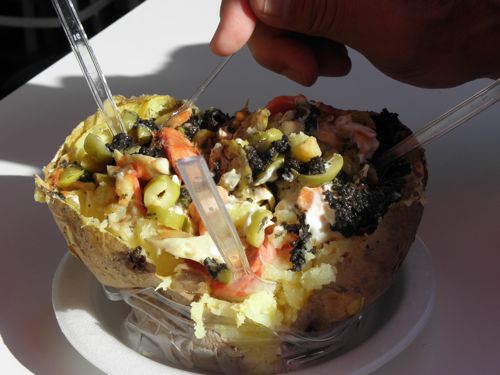
We disembarked famished from the ferry—eager to try the kumpir (stuffed baked potatoes), gözleme (Turkish-style flat stuffed crepes), and waffles (filled with fruits and sweets of every kind). Yum. Again—YUM! I hadn’t been all that excited about the kumpir, but take a baked potato, mash it together with butter and cheese, then add pickles, olives, tomatoes, cream cheese, and whatever else you love, and it’s sheer ambrosia. I’d walk to Ortaköy just for kumpir. The spinach gözleme was nice, and the fruit-and-chocolate-filled waffle was nothing to scoff at. Another YUM!

p3080068.jpg

The delicious, inimitable KUMPIR!

Finally we visited the mosque. Lovely from the outside, I’d never been inside. Big mistake. Laura took Libby so I could go in to take a few pictures, and I was entranced with mosque’s natural light. Though its exterior is striking, its interior is beyond description. A number of men were at prayer while a small group chatted in a window near the pulpit. I peeked into the women’s area, a totally separate room with windows overlooking the Bosphorus. Far less than what male worshippers enjoyed, but sweet in its own way. I have a hard time with that, though; it strikes me as unfair.

p3080070.jpg

Ortaköy Mosque, interior

p3080081.jpg

The women’s room—Ortaköy Mosque

A little girl named Selin walked Libby around the shopping area on her leash, totally enamored with her. Such fun for both! Finally we headed home—on the bus, then succumbed to a well-deserved nap.

That was just the START of our day. We dined and danced in Taksim, catching the last bus home at 2 A.M. It was packed (of course), so we stood all the way home, then climbed the long Robert College hill yet again.

But you know what? It was a great day.

Istanbul ROCKS!

Exploring the Rumeli Castle

On Saturday afternoon I took Libby for a long walk up the Bosphorus to the Rumeli Castle, one of the most picturesque sites along this historical waterway. The sky was clear and the air brisk, a perfect day for a stroll. It took us about an hour to get there, weaving between hamsi (anchovy) fishermen along the walkway. The screams of gulls, the booming of ship horns, and the sparkling chatter of children punctuated our walk as well. No doubt, I live in the most beautiful section of Istanbul.

p3010123.jpg

Stretching up the hill from the water’s edge (now from the road’s edge), the castle is an imposing sight from any vantage point. It’s three medeival towers feel more European than Ottoman, though the very name Rumeli means “belonging to Anatolia”—a certain reference to the once-growing Ottoman Empire on the Asian side of the Bosphorus.

p3010070.jpg

The Rumeli Castle was built by Mehmet the Second, known as Fatih—the Conqueror. It was constructed in the spring and summer of 1452, 40 years before Columbus’s famous voyage across the Atlantic). Built on a European hillside at the narrowest section of the Bosphorus (about 750 yards across), it was built to help the Ottomans conquer Constantinope, now Istanbul. A smaller castle across the water, the Anadolu Hisarı (Anatolian Castle), also helped Mehmet to achieve this ultimate goal of cutting off communication and aid from the Black Sea. Actually, according to historian John Freely, “the castle was originally called Boğas-kesen, a sort of pun which means both ‘cut-throat’ and ‘cutter of the strait.” (The Turkish name for the Bosphorus is “Boğaz”, which means both strait and throat.)

p3010104.jpg

It is believed that Mehmet himself drew the general designs for this medeival fortress, which measured up to 275 yards long and 135 yards wide at its greatest points. The construction of each of the fortress’s three main towers was supervised by a different Pasha (vezir/advisor) of Mehmet the Conquerer, with his Grand Vezir in charge of the main one at the water’s edge. In addition to the three major towers are fifteen subordinate towers of various shapes and sizes. The walls of the larger towers range from 21 to 30 feet thick and the walls range from 16 to 50 feet high. It took 3000 men to complete the project in an amazing four months.

p3010085.jpg

The Ottomans conquered Constantinople within a year after the construction of this castle, toppling the Byzantine capital and claiming it for the rising Ottoman Empire, which was to rule for nearly 500 years until 1923, when the Turkish Republic was established.

p3010081.jpg

We climbed the stairs to the castle entrance, a little uncertain of our fate, but fortunately, the castle welcomes dogs as well as tourists. Whew! What met us inside was spectacular; LOTS of stone stairs up to the towers and ramparts—with NO railings. ARAUGHH!!! Libby’s balance is far better than mine, and she was eager to explore every inch of the castle.

p3010099.jpg

Inside the fortress there is a huge amphitheater, now used for outdoor concerts in the summer. There is also a minaret from a mosque built by Mehmet the Conquerer, although the mosque was destroyed by fire in 1907.

p3010113.jpg

After scrambling around the ramparts for an hour, I decided to stop at a restaurant just outside the gates for a snack of tost (grilled cheese) and çay (tea)—for about five times the usual cost. Live and learn. Of course, it was lovely to relax in the sun by the Bosphorus, and the waiters made a fuss over Libby, bringing her enough cheese for five tost sandwiches.

A good time was had by all.

rumeli.jpg

This photo of the Rumeli Castle at night comes from:

http://www.skyscrapercity.com/showthread.php?t=171587&page=2

This web site has incredible photos of the Rumeli Castle, though I can’t find a name to attribute the photo to. Check it out!

The Scarf: Oppression or Freedom?

THE SCARF: FREEDOM OR OPPRESSION?

When I walk the streets of Istanbul, there are always women in scarves. In more traditional communities it’s a majority, while in more modern, upscale communities, it’s less common. Older women are generally scarved, and younger women less often.

muslim-princess-scarf.jpg

A lovely Muslim “Princess”

On rare occasions I’ll see two women, arm in arm, one scarved and one with tresses flowing free. It makes no difference to their friendship, though I find it a startling contrast.

to-scarf-or-not-to-scarf.jpg

Ceramic artists in Iznik, Turkey

I’ve tried to accept this part of Islamic culture, and I’ve come close, though I still struggle with the unfairness of women being covered when men aren’t.

A book entitled Nine Parts of Desire: The Hidden World of Islamic Women, by Geraldine Brooks, enlightened me somewhat on the topic. Apparently the theory (Islamic) is that women are incredibly sensuous beings; Allah granted them 9 parts of desire, giving men only one. Therefore, women have to cover themselves in order to keep the world from descending into chaos (of a sensual nature).

Since the establishment of the Turkish Republic in 1923, it has been unlawful for women to wear scarves in public buildings, including schools. Mustafa Kemal Atatürk, Turkey’s revered founder, was adamant that Turkey be a secular state even though its predominant religion was Islam. That is still true in this country, which is 99% Muslim. Turks take great pride in their secular government, a model of democracy in an Islamic world.

romance-in-a-scarf.jpg

Sweethearts in Antalya, Turkey

Before I moved to Turkey I read Orhan Pamuk’s book, Snow, a fictional response to the issue of scarves and education. In this novel, a journalist travels to Kars (“snow” in Turkish), a city in Eastern Turkey, to investigate the story of girls whose religious convictions to wear scarves has driven them to suicide because of being denied access to education. Pamuk’s approach is a critical one, though illuminating in its understanding of the issues faced by these young women. It opened my eyes to the passion many of these girls feel about covering their heads.

ladies-of-all-ages.jpg

Scarved women of all ages in Göreme, Cappadocia, Turkey

Well, the deed is done, as you probably know. Amid great turmoil, Turkey has passed legislation allowing women to wear scarves in universities, as long as their faces aren’t covered. There are two sides to this issue, and both make sense.

Proponents of the ruling insist that it’s a move toward freedom for all and access to education for women, not a step towards an Islamic state. That works for me. In America many girls attend school scarved. (Of course, America isn’t a neighbor to a country that requires head-covering.)

Opponents feel that this is just one of many moves toward breaking down Turkey’s secular government, that it’s like a “test case” to amending the constitution away from secularism. They also view the headscarf as a symbol of political Islam. So who’s right?

rug-weaver-cappadocia.jpg

A young kilim-weaver in Cappadocia

I discussed this issue with a few university women, and they find it upsetting. They see both sides, yet feel threatened by the acceptance of scarves in their educational environment. “I worry that the pressure will be on me to take the scarf, or maybe on my daughter. We have a name for that social pressure in Turkey; it’s a lot like peer pressure, and it’s strong in our culture. I don’t want my country to go that way, but what can I do to prevent it?” one of them said.

A teacher friend shared that she’s unhappy with the ruling as well, although only a few of her university students appeared in scarves this week. She’s a liberal-minded woman, like many educators, and she feels the classroom isn’t the place for religious posturing. She commented, “This issue takes attention away from our country’s real problems: a shaky economy, lack of education, and ‘ugly’ world policies.” She’s not alone in this view. Many people have expressed a concern that much broader issues plague Turkey, and this issue has just been a governmental smokescreen to avoid tackling them.

scarves-at-eyup.jpg

Worshippers in the traditional community of Eyüp

Though many people feel that the wearing of scarves is on the rise, a survey of women across Turkey in 2006 showed a decline in scarf wearing. In 1999, 73% of Turkish women wore a headscarf, while in 2006 the percentage had declined to 63%.* It is true, though, that many families choose to keep their daughters out of school once they reach puberty. Turkey has sponsored many programs to promote the continued education of girls, with limited success.

I’m sure the CHP (secularist party) will bring this decision to an appeals court on the grounds that it’s unconstitutional, and no one knows where that will go. The Turkish military, which is charged with the responsibility of upholding the constitution and the secular state, doesn’t look kindly on this action either. It remains to be seen, though, whether they will intervene. It looks for now like things are settling.

goreme-scarf-fashions.jpg

Two generations of scarf fashion in Cappadocia

In the Best of All Possible Worlds, this would be a positive step. The problem, though, is mistrust and unspoken agendas. Time will tell, I guess. Until then, women will be free to wear scarves in Turkey’s universities.

*The survey was conducted by the Turkish Economic and Social Studies Foundation (TESEV)

Snow-blown Istanbul

After a 24-month hiatus, Winter has rediscovered Istanbul—and it’s great fun! We’ve been teased with snow flurries all week, whetting everyone’s appetites for the inevitable cancellation of classes. In recent years school has been called off at any hint of snow (due, I am told, to a child’s death on his way home from school during a snowstorm).

The first year I was in Istanbul, we had a snow day for mere flurries (by Minnesota standards). Then when we had an actual blizzard in January, we got a full week off. Of course, you must remember that this is a city without snowplows—and with precious few snowshovels. People use spades, brooms, squeegies, and dustpans to remove the snow. Believe me, it’s a backbreaker to clear your driveway with a dustpan! I think we had eight snow days that year, then last winter we hardly saw a snowflake. But Winter has returned.

snow-removal.jpg

City snow removal, winter 2006

Yesterday (Saturday) it snowed off and on all day, but since it warmed up mid-day, much of the snow melted away. I went into the city to meet a few former Koç students for a late lunch (such a joy!), then hooked up with friends for dinner. Amazingly, in spite of the storm, I got back to campus in just over an hour, climbing the hill through a mere inch of snow.

p2160019jpg.jpg

Saturday hiking down to Arnavutköy from Robert College

This morning, however, I woke to an amazing winter wonderland: three to four inches of heavy snow, blown by blasts of wind from the Bosphorus. There’s always wind in Istanbul, but particularly after a snowstorm, I guess. As a Northern Minnesotan I’m more than accustomed to snow (we have it five months each year), but here it’s a real novelty, even to me! Robert College has a snowplow (after all, it IS an American school), and the maintenance crew ran it up and down the winding, cobbled roadways all morning long, trying to keep pace with the snowfall.

p2170025jpg.jpg

Libby waiting patiently for our morning walk

As my dog Libby and I trekked through the storm this morning, she was thrilled with the return to “normalcy” in her life, cavorting with the snow like a long-lost friend. We checked out new routes around campus, and I realized how incredibly steep some of the campus roads are. There’s one section that’s so steep the guards set up barriers and plowed around it, across drives behind the buildings. I picked my way down that steep section, which was a little like descending a snow-covered mountain peak. I’ll be amazed if we have school tomorrow.

p2170034jpg.jpg

Deciduous shrubs and trees struggle with the heavy snow.

The guards were jerryrigging chains to their “guardmobile” tires as we walked by the main guard station, and NO one was driving the school roads—except for the taxi we called to bring us to a grocery store. Our service bus to IKEA and REAL was cancelled this morning (weather, of course), so one of the bilingual teachers called for a taxi—WITH snow tires. No thwarting a Robert teacher’s plans!

p2170044jpg.jpg

—a splash of color in a white world

Well, my first week at Robert College is behind me, and my groceries are all put away. Though I’m not sure I need a day off quite so soon, I’m open to the idea, as any self-respecting teacher or student would be. I have papers to correct, planning to do, and maps to finish for my latest book project. I guess I could use the extra time. Who couldn’t?

Welcome back to Istanbul, Winter.

p2170029jpg.jpg
A snow-swept patio overlooking the frigid Bosphorus

F.Y.I.—School was cancelled. HOORAY!!!!

Back for another teaching stint

Well, we’re back in Istanbul! Though I was a nervous wreck about sentencing Libby to 16 hours in cargo (KLM said she was too big for the cabin—what????), we both managed, arriving mid-day Thursday after a 24-hour trek from Grand Marais. We’re settled into our little apartment-with-a-view at Robert College, a highly prestigious and incredibly picturesqe preparatory high school located high above the Bosphorus.

I was warmly greeted by Maria Orhon, Robert College English teacher and Academic Director. Imagine my dismay when I realized that she had a small Toyota (with a driver) to transport the two of us (three with the driver), Libby and her kennel, and five suitcases and crates. Oops! We had to hire a taxi to get everything to the school, though Maria was more than gracious about it. After giving me some time to squeeze everything into my apartment, she chauffered me to a nearby Migros grocery store, then later treated me to a meal of mouth-watering fish cakes and grilled turbot steaks. YUM! And— Eftalia, the lovely Bosphorus fish restaurant, is within walking distance of school! Since I hadn’t had any exercise for two days, I bid Maria farewell at the school gate and hiked back up the hill to my lojman (apartment). I slept like a log, 11 hours straight.

Libby checking out our new digs
-

The word for the day at Robert College is STEPS! Yesterday I walked back down to the Bosphorus, which is 10 minutes (and 167 steps) down the hill. The walk is lovely, with winding sidewalks and stairways lined in lush greenery: lawns, trees, and shrubs, punctuated by the occasional spray of spring blossoms. (Yes, it’s nearly spring here.)

robert-college-walkway.jpg

A bit of the 167-step trek up the hill to Robert College

-

The Bosphorus is amazing, too. The waterway that divides Europe from Asia (I’m on the European side), it has been the source of many a war because it connects the Agean Sea (to the west of Turkey) and the Mediterranean (South) to the Black Sea, providing access to Georgia, Russia, and many of the Baltic states. It’s also beautiful.

bosphorus-view.jpg

A view of Asia across the Bosphorus from our European campus

-

Libby and I strolled the waterfront for an hour, watching fishermen catch hamsi (anchovies), meeting stray dogs (all friendly), and just generally scoping out the scene. Private boats of all shapes and sizes line the quay, and I noticed that many are floating restaurants. Have to check those out later.

boats-along-the-bosphorus.jpg

Boats lining the Bosphorus quay

-

I spent the afternoon working in the English office, preparing for my first week: poetry for the non-fiction classes and Bless Me, Ultima for the fiction class. I’m eager to get back into the classroom, and this new semester offers a new beginning to all of us. I’m replacing a teacher who left (reluctantly) because Turkish law forces teachers to retire when they turn 65. She left things totally organized for me, with little notes everywhere. What a welcome! I feel truly embraced by the people here already. Of course, this is Turkey. They’re like that here.

p2080270.jpg

My five-month office corner

-

After a dicey sleep the second night, I putzed around my apartment, filling the walls with calendar photos (thanks to Aly) and reorganizing the furniture. Then Libby and I trekked up to the upper campus entrance—another 322 steps. Oh, my goodness! I’m going to get my exercise here, believe me. I was of the mistaken impression that the college was perched on top of the hill above the Bosphorus, but I guess it’s less than halfway up. A few very cranky dogs met us just outside the upper gate, but I picked Libby up and we ignored their snarls—well, sort of.

We explored the streets above the school, and I found another little grocery store. I picked up garlic, crackers, and pepper, carrying Libby through the store. I’m hesitant to tie her outside, as one nasty dog could do her in. I don’t think I’ll take her beyond the upper gates anymore. Not a great place for a little dog. (Though apparently it’s still a good place for horses!)

a-rare-sight-in-istanbul.jpg

A rare, yet intriguing sight in Istanbul—Speedy Delivery?

-

So here I am, champing at the bit to teach my four sections of 9th graders at Robert College. It feels good to be back in Istanbul, though issues abound here. (The latest is the parliament’s decision to allow women to wear scarves in the universities, which is upsetting to secularists, who see it as a step toward an Islamic state. More about that later.)

The call to prayer warms my heart, and Libby is now sitting at the window watching for Campus Cats, of which there are many. Each new citing intoxicates her; she’ll be happy here. Not many cats around the woods in Grand Marais. Just boring old deer.


Boreal Access Web Mailer

Finishing the book—all over Istanbul

I’m sitting at Istanbul’s Atatürk airport, waiting for Lufthansa flight 3341. The good news is that there’s an exit row seat for the overseas leg—ah, comfort! (Well, relative comfort anyway.)

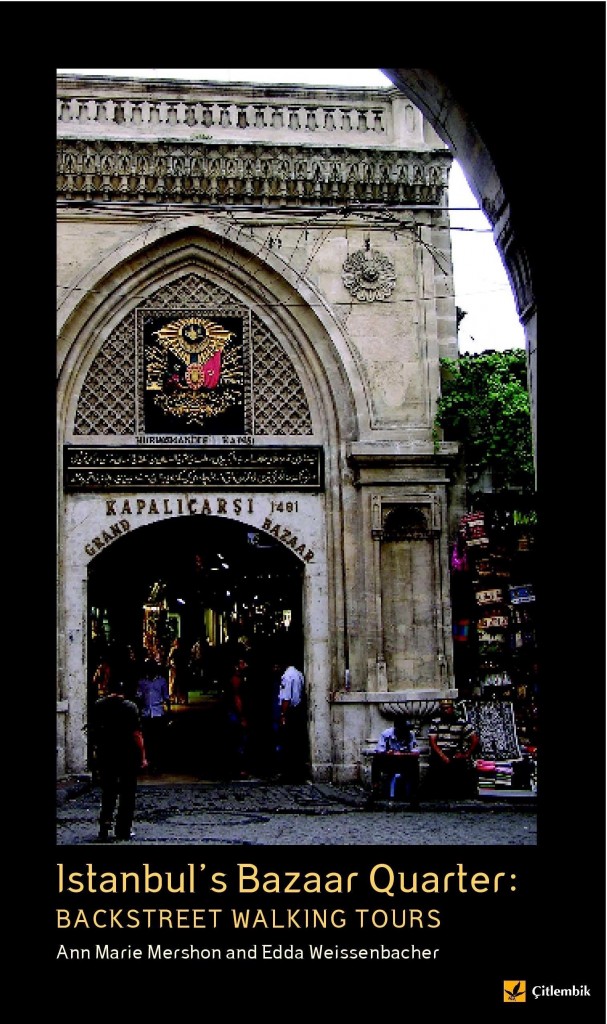
I’ve spent a busy few weeks here—four days on the Koç campus with my friend Marnie, then ten in Kadiköy in my friend Leah’s apartment. Most of the time I’ve worked on our book of walking tours around the Grand Bazaar. It’s been grueling, fascinating, and fun. What adventures I’ve had!

On my second day here, Edda and I did the first walk with Marnie serving as our tour guide (to test our directions). I learned quickly that the directions needed to be FAR clearer. First test: C+. (We didn’t let her use the maps, which I’m confident will help.)

edda-cover-photo.jpg
Edda over Istanbul

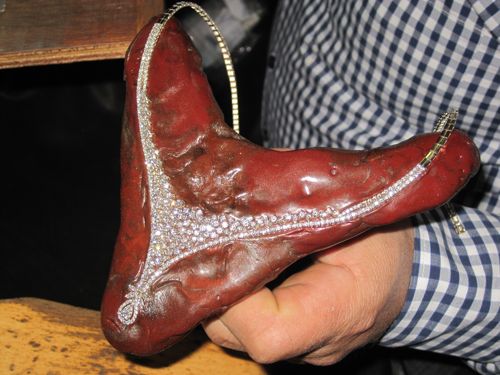
The next test was walk two, which Edda and I did by ourselves a few days later. We added meticulous details to our directions, carefully checking street names and building locations. We also did some interviews for feature articles. Edda helped me shop in the Cebeci Han for a belly-dancing costume for my sister-in-law, too. WOW—the shopowner kept pulling outfit after outfit from some mysterious source; the selections were incredible. Women shopowners are extremely rare in Turkey, so I was pleased to buy from a woman. That was a successful day for us—second test: B+ (a few wrinkles in building locations).

pb170056.JPGpb170057.JPG

One of many belly-dancing selections

We spent the next day working in Edda’s charming (albeit treasure-cluttered) penthouse apartment overlooking the Golden Horn and Sultanahmet. It was supposed to rain that day, hence the choice to review photos and clarify details together, our laptops side by side on her kitchen table. I had no idea that she’d lay out a lavish lunch for me: mushroom soup (tantalizing), shredded vegetable salad (scrumptious), olives, pickled beets, and fresh bread. YUM! Once I was completely full, she pulled out the main dish: a big bowl of rice topped with a delicious vegetable and sausage goulash (from her Austrian roots). Full as I was, I managed to devour every bite. When she pushed me to seconds, though, there was no hope. I was STUFFED! That was my Thanksgiving dinner. And I am truly thankful for all that I have.

The next day (forecast cloudy with little chance of rain) we met at the Çemberitaş monument near the Grand Bazaar, umbrellas in hand. I’d forgotten my camera, but it was no great loss, as it rained all day. At one point we were climbing a steep cobblestone street in a downpour. The tile gutter running down the center was a torrent, and water poured over our feet. Nothing to do but continue, which we did. Yet another Istanbul adventure.

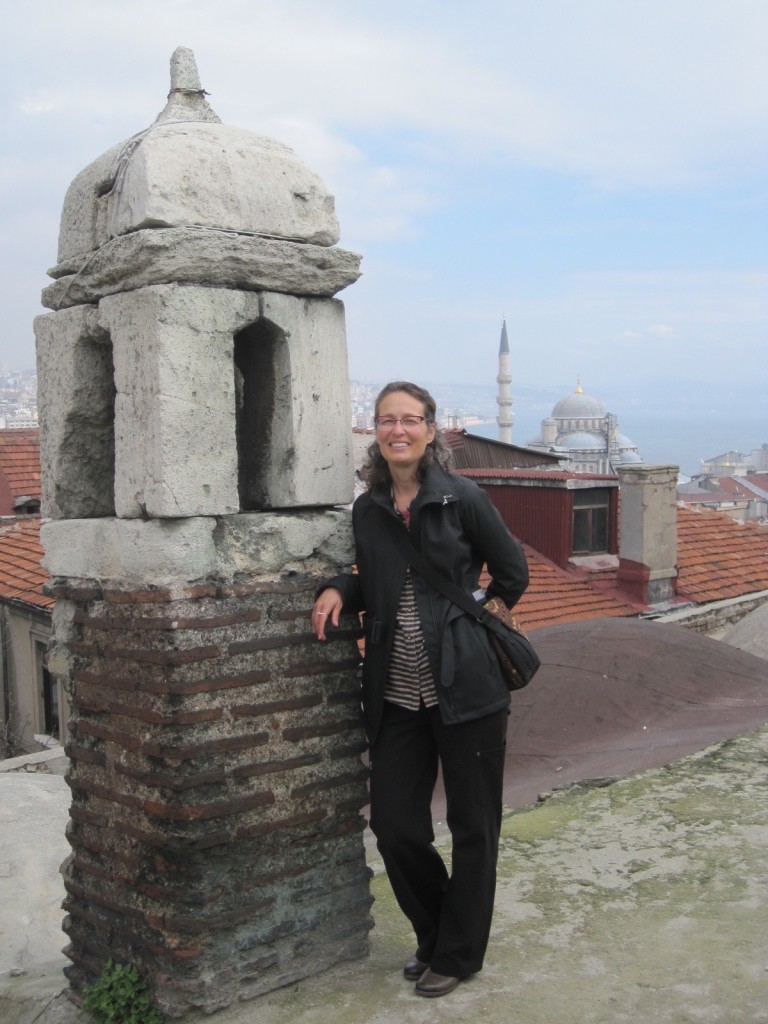
Our last day of trekking together was a long one, and the highlight was a rooftop that I had discovered on my own. The Sair Han (the Büyük Valide Han’s third courtyard) has an outdoor stone stairway leading up to a rooftop with an amazing view overlooking the Golden Horn and the Marmara (and lots of stray dogs). We were snapping pictures when a friendly young man carrying a white chicken appeared and began chatting with us. He offered to show us the view from the highest point, and of course we accepted. He led us around the corner of the Tower of Eirene, a crumbling edifice on the corner of the rooftop, and we clambered up two more rooftop levels to the pinnacle—what fun! (Let me remind you that my friend Edda is 70 years old—a youthful and sprightly woman always game for adventure.) At the top we discovered two tiny workshops, one for dying lace, and the other for making tea. Unbelievable. Luckily, our young guide (a tea shop owner from the main floor of the han) led us down through a maze of crumbling stairways to his shop, where he invited us to return later. Unfortunately, we didn’t. Too busy!

edda-doing-her-thing.jpg

Edda scrambling up the Tower of Eirene

Another highlight that day was an interview with a street cobbler, a man who sets up shop every day on a corner beneath a tree. Year round, he brings his table, an old sewing machine, and his last (a cobbler’s tool). When it rains, he adds an umbrella, and when its cold, a small grill. What a guy!

tarkan.jpg

Tarkan the street cobbler

It’s been a fun, rewarding, and exhausting week. 2000 photos and 40,000 words behind me, I’m hankering for a LONG nap on the plane. By the way, yesterday we delivered our book to Çitlembik Publishers—all except the maps. I have to make some corrections on those. It’s been an exciting project, and I know the work is far from over, but we’re on schedule. HOORAY!!!!!

pb260038.JPG

Edda and I celebrating our completed project

So what’s a han?

When I was first invited to join one of Edda’s hans walking tours, I had no clue what a han was. Did I care? A walking tour in Sultahahmet was temptation enough. Little did I know on that first fascinating walk that I would soon be collaborating with Edda Weissenbacher on a book of her walking tours. But I digress.

kalcilar-han-second-level.jpg
Kalcılar Han, upper story
A han, in case you are as uninformed as I was, is an ancient inn, a stop along the camel trading routes. Caravans of merchants stayed there for a few nights, weeks, or even longer to trade their wares in the city. It usually had two levels of rooms around a porticoed courtyard. The upper level rooms were reserved for sleeping and living, while the lower level offered storage rooms for merchandise, usually a kitchen, and sometimes stables for the caravans’ camels and horses. The courtyard’s fountain and perhaps a small mosque served the residents of the han. Hans were like small, bustling castle keeps, their massive gates locked securely at night against burglars.
cuhaci-han.jpg
Cuhacı Han with Nur-u Osmaniye Mosque behind it.
Not surprisingly, many hans were located near the Grand Bazaar (Covered Market) area where merchants traded their wares. Built between the years 500 and 1900, scores of ancient hans still stand, though most have been remodeled and many are unfortunately dilapidated. A few of the more notable ones are the Vezir Han (next to the Çemberlitaş Hamam), the Büyük Valide Han (on Mercan Caddesi behind the Grand Bazaar), and the Taş Han, west of the bazaar near the Laleli Mosque. There are also a number of very charming hans located within the bazaar, offering an oasis of peace and sunshine—a welcome break from the hectic bustle of the Grand Bazaar.

buyuk-yeni-han-angled-walls.jpg

Büyük Yeni Han–ancient walls

The Taş Han, one of my favorite hans, was recently refurbished with close attention to historical accuracy. Sultan Mustafa III had it built in 1763 as a part of the Laleli Mosque complex, originally intending it as an inn for his guests. According to tradition, visitors to the hans were accorded free meals and lodging for three days, then they were expected to move on (sort of like the guests and the “old fish” proverb). The han was then known as the Sipahi Han, since “spahee” means a place for donkeys; the han’s underground cistern was converted to a stable. Later the han was used as a Janissary station (for the sultan’s soldiers), an inn, and eventually a bazaar. It went through a number of name changes, finally ending up with the very unassuming name Taş Han (stone building).

tas-han-entry.jpg
Taş Han entryway

Over the years the han fell into disrepair, but it was purchased in 1987 by Kemal Ocak, a Turkish leather merchant with a vision for the han’s future. It took years to secure permission to restore the han, and Ocak was eager to set things in motion. The restoration was grueling, completed by a team of 30-40 experienced restoration specialists working day and night. Ocak paid close attention to detail, and his project was endorsed (though not funded) by the Ministry of Antiquities, which required mountains of paperwork as well as careful attention to historical restoration. Completed in 1993, the results of Ocak’s efforts are impressive.

tas-han-kemal-olcak-rug-portrait.jpg

Kemal Ocak, Taş Han renovator
A visit to the charming Taş Han transports us back hundreds of years. Its modest arched entrance and stone corridors lead to an open courtyard topped with as many chimneys as the original structure would have had—one for each upstairs sleeping cell. The former storerooms that ring the courtyard are now shops offering clothing, leather, and fur. The courtyard is graced by a fountain, near which groups of men sit around tables shaking backgammon dice, sipping tea, and smoking water pipes (nargile). A stairway at the far end leads down to what was once a Byzantine cistern. It is now the Arkat, a night club restaurant that features nightly floor shows of Turkish music, magic, and of course, bellydancing. After the show diners dance into the wee hours. That probably didn’t happen in the early days of the han, but who knows?
belly-dancer.jpg
Belly dancer in the Arkat Restaurant
Across the courtyard is a passage to a second courtyard with another fountain in the charming Tas Han Restaurant as wel as another entrance to the han.For more information, watch for our new book, Edda’s Istanbul—Back-street walking tours around the Grand Bazaar by Edda Renker Weissenbacher and Ann Marie Mershon. It should be out next summer.

Two women’s Greek island adventure

Two Women and five Greek Islands

After a bit of a bump (illness—poor, poor Susie), the two of us headed for the Greek islands two days late. We took a bus from Izmir to Cesme (CHESH-may), and hopped on the ferry to Chios, Greece.

Though my heart remains with the warm people of Turkey, I couldn’t help but be charmed by the light-spirited Greeks. It was a pleasant shock to see women operating as equals with men—waiting tables, driving motorbikes, and working in shops. This was quite a shift from Turkey, where nearly all service workers are male (though women are well-represented in the professional world). I was also surprised to see the ample physiques of the Greeks—obesity is rare among young Turks. A friend told us that the Greeks are the heaviest of the European populations. My theory is that their diet relies more heavily on olive oil and bread, while vegetables predominate the Turkish diet.

octopus-anyone.jpg

OCTOPUS, ANYONE? WINE PERHAPS?

Chios Town was a bustling port, the harbor ringed with outdoor coffee shops, bars, and restaurants. We wheeled our suitcases to a spot near our targeted hotel (no reservations) and ordered cold drinks. As usual, we were drenched in sweat, but smiling. I went around the corner to make reservations at the Hotel Filoxenia, which was another second-story hotel, up about 25 marble stairs. Oh, well. We managed. Our corner room had a well-lit make-up mirror, a tiny balcony, and huge windows. We were happy!

The next morning at breakfast we started chatting with a Greek man about our plans for the day, and he offered to show us the island. Takis lives in Athens but was born on Chios and loves it dearly. He drove us (in his father’s rickety old Volvo) over the mountains to a beautiful secluded beach near a lovely chapel dedicated to Saint Markella, who was killed as she tried to escape her father (who intended to rape her for becoming a Christian). We swam in the turquoise water, shared grilled fish at a small beachside restaurant, then swam and lazed in the shade while Takis visited his home village to finish plans for a home he was building there. That evening we treated him to dinner and dancing. It was quite a day, let me tell you!

takis-and-two-happy-women.jpg

TAKIS AND TWO HAPPY WOMEN

Our next stop was Mykonos, famous for its ancient windmills and pink pelicans. We took two ferries to get there, one to Samos, then another to Mykonos. They were both slow ferries, so we were able to wander the indoor decks as well as the top open deck. We enjoyed the ferries as much as the islands, which is good since we spent a good portion of our time on them. (Note to self: plan at least three days for each island, as it takes hours to travel from one to the next.)

pink-pelican.jpg

A PINK PELICAN HITCH-HIKER ON MYKONOS

When we arrived at Mykonos, we were a bit slow getting off the ferry, so we missed the bus and the taxis. Oops! We decided to drag our suitcases down the road and see if we could flag down a taxi along the way. Two young men stopped to offer us a ride in their open Jeep. We were surprised at their offer, and I imagine they were even more surprised to see that we weren’t sweet young things. However, they never showed their disappointment; they were charming—two Turkish guys who worked on a cruise ship and had rented a jeep to go into town for the evening. They laughed their heads off at my Turkish, though they were tickled to chat with me. They dropped us off near our hotel, though we chose a long, convoluted route through the meandering crowded streets of Friday Night Mykonos.

mykonos-chapel.jpg

MYKONOS CHAPEL

We finally found the Apollon Hotel, which was more than lovely. A sprightly old woman hopped off her antique daybed in the living room when we knocked on the door. She grinned as she embraced us, welcoming us warmly to her family home of hundreds of years. Although it was midnight, we went out to seek food and dancing. We ended up at a Greek taverna where we had saganaki (fried cheese) and moussaka (an eggplant hotdish). The people watching was incredible, with people dressed in every imaginable attire (including a man in a long-sleeved black T-shirt and grey briefs—my goodness!) By the time we were done eating, it was 1:30 and we were bushed. Oh, well.

After a good sleep, we packed up again (Maria needed to clean the room for her full house the next night) and headed out to explore our charming island. The streets in old Mykonos are all flat stones, and the buildings are all painted white with colored doors. It’s gorgeous. When we went back for our luggage, Maria charmed us yet again as we took her photos. Though her English is limited, she was an absolute delight, possibly my favorite thing in Mykonos.

susie-and-maria.jpg

SUSIE AND MARIA

Next stop: Santorini, our “grand destination”. The island of Santorini is actually the top of a submerged volcano that erupted thousands of years ago. The city sits atop a steep caldera like white icing, overlooking small islands in its center. The great draw of Santorini is its spectacular sunset over the caldera. The first night Susie and I found a front-row table at a city cafe, and the second night we took a taxi to the Santos Winery, where we enjoyed a flight of wines with cheese for the big event. The wine on Santorini was delicious—far better than the Turkish wines I’d grown accustomed to. Of course, my favorite drink in Greece was Mythos, their slightly-sweet beer. I’m sure I drank my share! Needless to say, we found great dancing both nights on Santorini; I dragged Susie home before sunrise each night.

santorini-wine.jpg

SUNSET ON SANTORINI

santorini-chapel.JPG

A SANTORINI CHAPEL

We also spent a night on Naxos, where we mostly basked in the pool of our hotel to while away the heat of the day. We explored the old city in the evening, though. The streets were strewn with oleander blossoms along the route of a Catholic procession that would happen later that evening. After relaxing on a secluded beach, imbibing in a late afternoon beer, and much searching, we found a restaurant recommended in the Lonely Planet, where we had what was easily the finest meal of our trip. Such luck we have!

Actually, we had many fine meals, incredible views, and delightful experiences in both Turkey and Greece. What a month!

No one can convince me that life isn’t truly grand.

farewell-to-greece.JPG

FAREWELL TO GREECE! (AT LEAST FOR NOW)

The Mediterranean and Agean Coasts

The second leg of my summer travels was a 9-day trek with four other women across the Mediterranean and Agean coasts of Turkey. My goodness—what an adventure!

After bidding farewell to many of our Blue Cruise mates, we took off. We five were dropped off at the foot of Mount Olympus at Bayram’s Treehouse Resort near the beach—my friend Sue from Grand Marais, Jana and her friend Beate from Berlin, and Shelly, a Minneapolitan teaching in the Czeck Republic.

bayrams-treehouse-lobby.jpg

MY BUDDIES AT BAYRAM’S

The first night we took a bus up to the top of Mount Olympus to see the Chimera, flames that come straight from the rocks, 24/7. The hike to the top was dicey in the moonless dark, much like a rock- strewn portage. Our friend Christy (traveling on her own) was the only one who thought to bring a flashlight, so the rest of us relied on the beams of our followers. The hike up was well worth the sweaty effort, though. We emerged on a rocky field dotted with campfire-sized flames emerging straight from the rocks. It was both eerie and fascinating, obviously the object of myths.

susie-at-chimera.jpg

A SWEATY SUSIE AT THE CHIMERA

The next day we explored the ruins of Olympus near the beach and lazed away the heat of the day ina shady spot, reading and marveling at the pristine beachfront. That night after dinner we walked back to the beach in the dark, using my tiny penlight to guide us. Dumb. Beate twisted her ankle badly. After soaking her ankle in the frigid mountain stream, she hobbled back to Bayram’s, where we found a first-aid trailer. The doctor fixed her up with sauve, an ankle wrap, an ice pack, and ibuprofen. He offered us a drink, then walked across the stream to buy us beers. Go figure!

Next stop: Antalya. It was hot, over 100 degrees. We stayed at at the Dedekonak Pension, managed by a charismatic young surfer named Mike. He memorized our names immediately and made us feel very much at home. We followed his recommendation for a lunch spot, where we sat outdoors in the shade near an ancient castle enjoying Antalya’s incredible vista of mountains jutting from the Mediterranean.

hadrians-gate-antalya.jpg

SUSIE AND ME AT HADRIAN’S GATE, ANTALYA

Monday was my birthday, and Jana had champagne, mini-cakes, a candle, and gifts all set out for me in the pension courtyard. What a sweetheart!

birthday-breakfast.jpg

BIRTHDAY BREAKFAST CHAMPAGNE

Afterwards we piled back into the car for the four hour drive to Kalkan. It’s a charming town, and it took us a while to locate the Balikci Han. Once we found it, we were PLEASED—too lovely for words! It was clearly the gem of our trip. When Jana went to park the car, she returned with five iced lattes for us, complete with a handsome waiter carrying them on a tray. My second birthday treat.

janas-coffee-surpise.jpg

JANA’S COFFEE SURPRISE DELIVERY

The Balikci Han (fish peddler’s inn) has all of six rooms, and it sits at the edge of Kalkan’s old town, just a half block above the swimming beach. The rooms are charming, with hand-embroidered silk bed-coverings, antique furniture, and lovely beaded lamps and light fixtures. The breakfast tables were on a tree-shaded terrace.

As soon as we got settled, we hit their amazing beach. The water was both hot and cold, changing temperature every stroke we swam. We discovered that a frigid mountain stream empties into the bay at that beach.

We had a DELICIOUS dinner at the Kaptan’s Restaurant, just across the block from our hotel. Since the waiter had helped us carry our luggage to the hotel, this was a natural choice. We shared mezes and entrees, and everything was delicious, especially the cigara borek. It was the BEST!

birthday-dinner.jpg

A BIRTHDAY DINNER TOAST TO GREAT TIMES TOGETHER

The next morning we drove to Saklikent Gorge. Once we passed the tourist booths and paid our small entry fee, we followed a wooden walkway hanging along the cliff above the river. It was a bit odd to see a huge Turkish flag strung across the gorge far above us—but this is Turkey.The walkway ended at a maze of Turkish-pillowed “booths” perched over the water. There must have been 15 of them, as well as tables and chairs set along the rocks.

We forded the icy, rushing water beyond the restaurant area, and were amazed to continue along a mere trickle of warm water As we continued up the gorge, the formations became more and more amazing. It was spectacular. The entire mountain is marble, so it’s amazing to think of how many years it took the river to wear away this phenomenal gorge.

saklikent-gorge.jpg

JANA AND SHELLY IN THE SAKLIKENT GORGE

On our way to Akyaka we stopped at Kayakoy, a city deserted after the 1923 population exchange. When the Turkish Republic was established, Greek Christians were deported to Greece, while Muslims were brought back. It was a painful time for many towns, where Christians and Muslims had lived in harmony for centuries. Kayakoy, frozen in time, is a testament to the lifestyle of many centuries.

Akyakya, our next stop, is an interesting little tourist town where all the buildings follow a similar design, mostly two stories with intricate woodwork ceilings and eves. Lovely! Once we settled in, we decided to scope out restaurants up the river behind our hotel. A man invited us in for tea or coffee, which Sue fanagled into a glass of wine for each of us. Go figure! After dinner we threw fish scraps into the river, which was soon writhing with eels under the restaurant’s floodlights. Unbelievable!

The next day we took a boat cruise to five beaches on the Gokova Bay, including the famed Cleopatra’s Island. Antony developed the island for Cleopatra with a small city (now ruins) and a beach with imported sand from Egypt. The beach sand, which supposedly has healing properties, is protected. The grains are rounded rather than granular, so it’s funny to walk on (underwater), sort of a combination of mud squishy and sand loose. You can’t sit on it, and there’s a huge fine for taking any away. There were probably 15 or 20 security guards. Many people sat in the water below the roped-off beach, smearing sand on their bodies, faces, etc. Amazing. Our next swim spot had a 100-foot cliff, which some men dove from. It was frightening, but they all survived.

cleopatra-beach.jpg

CLEOPATRA BEACH

On Friday we headed for Selcuk, stopping on the way at the Dilek Peninsula, where we had another picnic, swam, and lay in the sun. Life is rough in the swamps!

Selcuk (on the Agean) felt like home to me, as this was my third visit. The Bella Hotel was charming as usual. The staff remembered me from last summer, but they particularly remembered my son Ross and my dog Libby. Hmmm…

bella-hotel-jana-shelly.jpg

JANA AND SHELLY AT THE LOVELY BELLA HOTEL IN SELÇUK

We relaxed on the terrace restaurant/bar and enjoyed a lovely dinner. Saturday we drove up to Şyrince (SHEER-en-jay), a quaint mountain village which charmed everyone. Our favorite spot, though, was the little man who sits in a tiny shelter carving wooden spoons from cedar branches. We chatted with him and took many photos, though I lost them with my camera the next day. Oh, well. Fortunately, I’d downloaded most of my photos earlier. I’ve gotten great mileage out of that camera, and it’s given me wonderful memories of my adventures in Turkey. I bid it a fond farewell along with Turkey.